Facts
On 31 October 2015, Mohideen Basha and Habib Mohamed sustained fatal stab injuries near Aroma Bakery, Oppanakara Street, Coimbatore.
Source reference: paras. 2.1–2.10The prosecution alleged that, following a dispute over removal of beef from Mohideen Basha’s shop, A1 stabbed Mohideen Basha while A3 and A5 restrained him, and A2 stabbed Habib Mohamed while A4 and A6 restrained him.
Source reference: paras. 2.1–2.10The trial court convicted A1, A3, A4, A5 and A6 under Sections 147, 148, 302 and 302 read with Section 149 IPC, and sentenced them principally to imprisonment for life.
Source reference: para. 1A1, A3, A4 and A6 preferred criminal appeals; A5 did not appeal.
Source reference: paras. 6–7Issues
Whether the prosecution proved beyond reasonable doubt that the appellants participated in the homicidal assault and committed the offences under Sections 147, 148, 302 and 302 read with Section 149 IPC?
Source reference: paras. 12–13, 32–35Whether the eyewitness testimony was reliable in view of the contradictions regarding the accused’s overt acts, the time and place of occurrence, the conduct of the witnesses, and the delayed recording and forwarding of their statements?
Source reference: paras. 15–31Whether the alleged suppression of the earliest information, non-collection of CCTV footage and mobile-call records, absence of bloodstains from the scene, and doubtful recoveries created a reasonable doubt regarding the prosecution case?
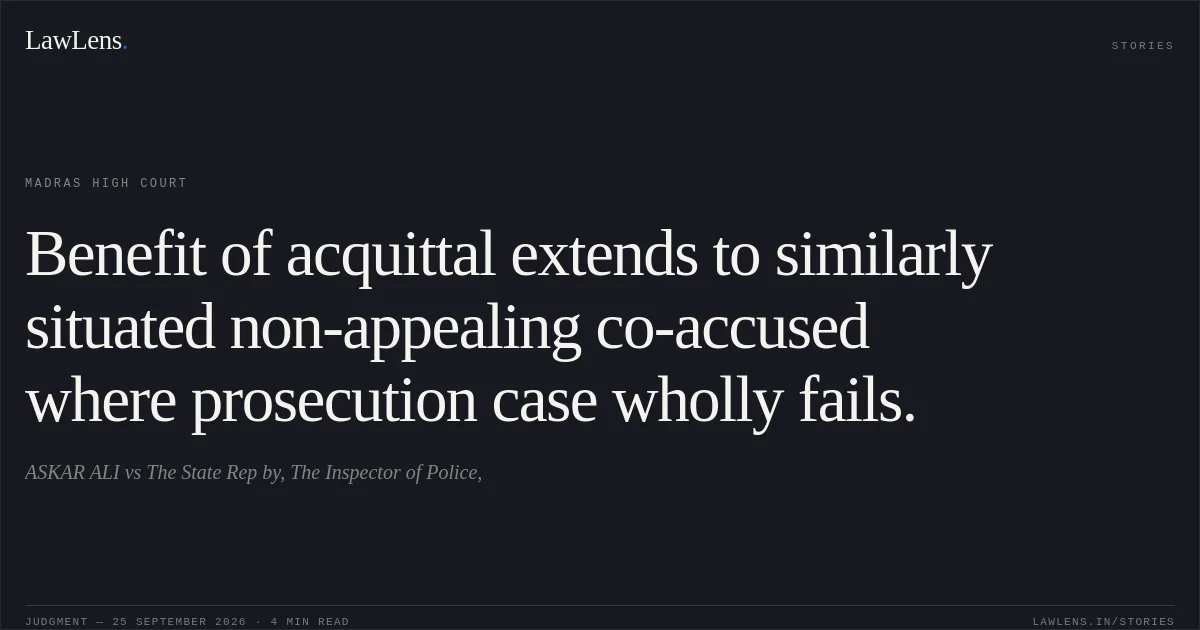
Source reference: paras. 16, 27–28, 32–34Whether the benefit of an appellate acquittal could be extended to A5, who had not preferred an appeal?
Source reference: paras. 36–40Law Applied
The Court applied Sections 147, 148, 302 and 302 read with Section 149 IPC, concerning rioting, rioting armed with a deadly weapon, murder, and constructive liability of members of an unlawful assembly.
Source reference: para. 1It applied the fundamental criminal-law principle that the prosecution must establish guilt beyond reasonable doubt and that serious doubts arising from material contradictions, suppression of the earliest information, unreliable eyewitness testimony, or defective investigation must enure to the benefit of the accused.
Source reference: paras. 32–35The Court also considered the requirement under Section 313 CrPC that incriminating circumstances relied upon by the prosecution must be put to the accused, holding that failure to put PW2’s evidence caused prejudice.
Source reference: para. 34On the non-appealing accused, the Court relied on Sahadevan v. State of Tamil Nadu, (2012) 6 SCC 403, Bijoy Singh v. State of Bihar, (2002) 9 SCC 147, and Md. Sajjad @ Raju @ Salim v. State of West Bengal, (2017) 11 SCC 150, which establish that where the entire prosecution case is found unreliable and no conviction can safely be sustained, the benefit of acquittal may be extended to a similarly situated non-appealing co-accused.
Source reference: paras. 36–38Reasoning
Although the medical evidence established that both deaths were homicidal and caused by stab injuries, the Court found that the prosecution failed to reliably connect the appellants with the crime.
Source reference: para. 32The earliest information appeared to have been given by PW2 at the hospital, yet the prosecution relied on a later complaint by PW1 registered at 1:30 a.m.; the inconsistency between PW2’s account and the police evidence indicated suppression of the true genesis of the case.
Source reference: paras. 15–16The eyewitnesses materially contradicted one another regarding which accused restrained each deceased and who instigated the attack.
Source reference: para. 17Their conduct was also considered unnatural: witnesses allegedly present during a double stabbing neither immediately informed the police nor took effective steps to assist the victims, while several material witnesses were not examined.
Source reference: paras. 18–23, 29–31The Court further noted that the complaint placed the occurrence immediately after the 7:30 p.m. phone call, whereas the witnesses later shifted the time to approximately 9:30–9:40 p.m.; the prosecution did not recover the alleged mobile phones or call records, collect available CCTV footage, photograph the scene, or satisfactorily explain the absence of bloodstains and the delayed transmission of material documents.
Source reference: paras. 20–22, 27–28, 32–34The alleged recoveries and forensic evidence were also considered unreliable, as the seized articles did not furnish incriminating blood-group evidence and the accused were allegedly found wearing the same clothes several days after the incident.
Source reference: para. 33In these circumstances, the evidence was unsafe for sustaining convictions, and the failure to put PW2’s incriminating evidence to the accused under Section 313 CrPC further vitiated the trial process.
Source reference: para. 34Holding
The Court held that the prosecution had not proved the appellants’ guilt beyond reasonable doubt and that the convictions could not safely be sustained.
The appeals filed by A1, A3, A4 and A6 were allowed; the trial court’s judgment dated 27 October 2025 in S.C. No. 195 of 2016 was set aside, and those appellants were acquitted of all charges.
Source reference: para. 40Applying the parity principle recognised in Sahadevan and Md. Sajjad, the Court extended the benefit of acquittal to A5 despite his failure to file an appeal.
Source reference: paras. 36–40All accused were directed to be released forthwith unless required in another case; any fine paid was ordered to be refunded, and the connected miscellaneous petitions were closed.
Source reference: para. 41Acts & Sections Cited
12 provisions across 3 statutes referred to in this judgment. Each provision opens on LawLens.
Bharatiya Nagarik Suraksha Sanhita, 20231
Indian Penal Code, 18608
Code of Criminal Procedure, 19733
Original Court PDF
ASKAR ALIvsThe State Rep by, The Inspector of Police,
Click to open original judgment
Original judgment, available to read, download and summarize on LawLens.in