Facts
The Appellant was convicted by the Trial Court under Sections 363, 376 of the IPC and Section 4 of the POCSO Act for allegedly kidnapping and raping a 13-year-old girl on April 17, 2018
Source reference: p. 2-3The prosecution case, initiated by the victim's father (PW-2), alleged that the Appellant enticed the victim away with the intent to marry her
Source reference: p. 3The victim (PW-3) testified that she was forcibly married at a temple and then taken to Ranchi, where she was kept in a rented room
Source reference: p. 9-11The Trial Court sentenced the Appellant to ten years of rigorous imprisonment
Source reference: p. 2The Appellant challenged the conviction on the grounds of material contradictions and lack of corroborating evidence
Source reference: p. 6Issues
1. Whether the testimony of the victim (PW-3) satisfies the legal standard of a "sterling witness" to sustain a conviction
Source reference: p. 6 / para. 122. Whether the prosecution proved the charges of kidnapping and sexual assault beyond reasonable doubt in light of material contradictions between witnesses and the absence of key independent evidence
Source reference: p. 10-153. Whether the statutory presumption under Section 29 of the POCSO Act can be invoked in the absence of established foundational facts
Source reference: p. 16 / para. 24.2Law Applied
The court applied Section 363 (kidnapping) and Section 376 (rape) of the IPC, alongside Section 4 of the POCSO Act
Source reference: p. 1-2It relied on the "sterling witness" doctrine established in Rai Sandeep @ Deepu v. State (NCT of Delhi), which requires a witness's testimony to be of such high quality that it inspires absolute confidence without the need for corroboration
Source reference: p. 16The court considered Section 29 of the POCSO Act regarding the presumption of guilt, provided foundational facts are proved by the prosecution
Source reference: p. 16Section 42 of the POCSO Act regarding the prohibition of double punishment for the same act
Source reference: p. 2Reasoning
The High Court found that the victim (PW-3) was not a "sterling witness" due to significant inconsistencies. While PW-3 claimed only she and her grandmother were present during the kidnapping, her uncle (PW-4) claimed to be an eyewitness who was assaulted by the Appellant, yet the grandmother was never examined and no medical reports supported the uncle's alleged injuries
Source reference: p. 9-10, 14The informant (PW-2) admitted he signed the FIR blindly at the police’s direction, casting doubt on the fardbeyan's authenticity
Source reference: p. 8Notably, the Investigating Officer failed to investigate the alleged crime scene in Ranchi or examine any independent neighbors or relatives, despite the victim allegedly being dragged through the village
Source reference: p. 11-12While the medical report (PW-5) showed an abrasion, the doctor clarified there was no evidence of recent sexual intercourse, and the examination occurred weeks after the alleged incident, making it impossible to link the injury definitively to the Appellant
Source reference: p. 14-15Holding
The Court held that the prosecution failed to establish the foundational facts of the case, rendering the statutory presumption under Section 29 of POCSO inapplicable
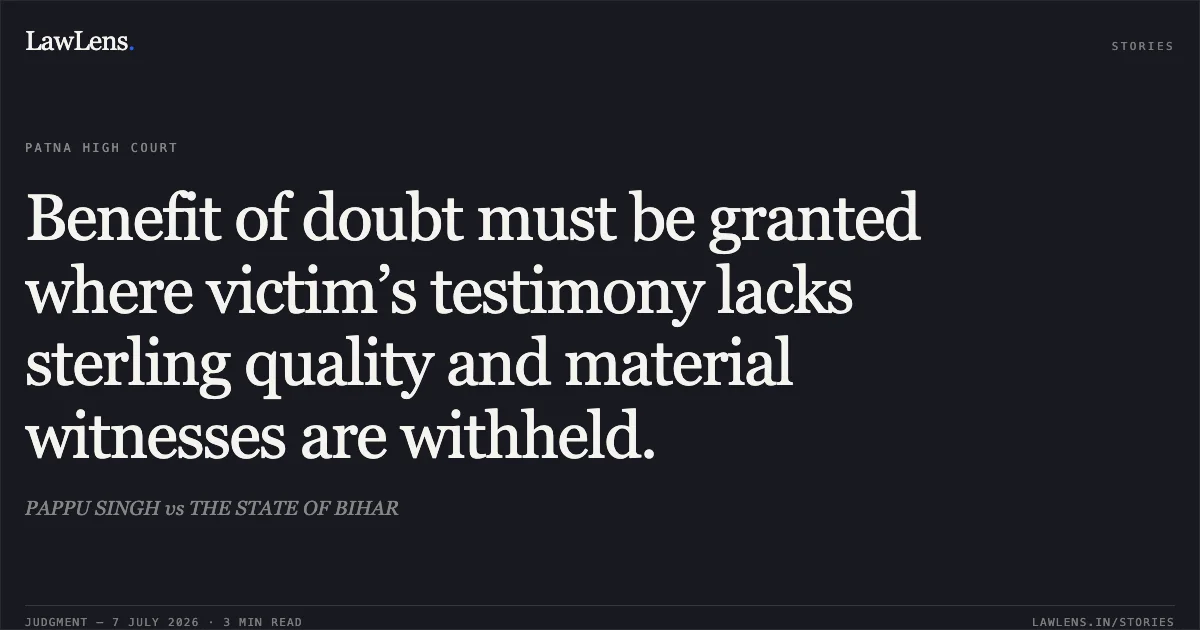
Due to the lack of evidence of "sterling" quality and the failure to examine material witnesses (the grandmother and IO), the Trial Court's judgment was found unsustainable
Source reference: p. 15-16The High Court allowed the appeal, set aside the conviction and sentence dated April 29, 2024, and ordered the Appellant’s immediate release from judicial custody
Source reference: p. 17Acts & Sections Cited
11 provisions across 3 statutes referred to in this judgment. Each provision opens on LawLens.
Indian Penal Code, 18604
Code of Criminal Procedure, 19733
Protection of Children from Sexual Offences Act, 20124
Original Court PDF
PAPPU SINGHvsTHE STATE OF BIHAR
Click to open original judgment
Original judgment, available to read, download and summarize on LawLens.in


![Subsequent exoneration does not retrospectively invalidate a finalized promotion select list.. UNNIKRISHNAN M vs M/o Environment And Forests. CAT - ['Ernakulam']. LawLens](/stories/thumbnails/subsequent-exoneration-does-not-retrospectively-invalidate-a-finalized-promotion-select-li-ce80a0e84f2f4887857271e8b4341c42.webp)