Facts
The applicants were found in unauthorized possession of 130 liters of kerosene intended for the Public Distribution Scheme (PDS) without a valid license
Source reference: p. 6In 2017, the Additional Chief Judicial Magistrate, Nadiad, convicted them in Criminal Case No. 8859 of 2006, a decision upheld by the 5th Additional Sessions Judge, Nadiad, in 2018
Source reference: p. 2Both courts sentenced the applicants to one year of simple imprisonment and a fine of ₹1,000 under the Essential Commodities Act
Source reference: p. 2The applicants filed a revision application before the High Court, which suspended the sentence in 2018
Source reference: p. 2-3During final hearing, the applicants limited their plea to seeking the benefit of probation, noting the lapse of time and their clean conduct since the offense
Source reference: p. 4Issues
1. Whether the court should exercise its discretionary power under Section 360 of the CrPC to grant the benefit of probation to the convicts in a case involving the Essential Commodities Act
Source reference: p. 5-7Law Applied
Section 360 of the Code of Criminal Procedure, 1973 (CrPC), which permits administrative release on probation for offenders convicted of crimes punishable by fine or imprisonment up to seven years
Source reference: p. 6Section 7(1)(a)(ii) of the Essential Commodities Act, 1955, and the Kerosene (Restriction on Use and Fixation of Ceiling Price) Order, 1993
Source reference: p. 6Precedent set in Tarak Nath Kesari v. State of West Bengal (2023) and Lakhvir Singh v. State of Punjab (2021), which established that relief of probation may be granted even for old offenses if the accused has maintained a clean record over several decades
Source reference: p. 7Reasoning
The court observed that while the applicants were guilty of diverting PDS kerosene, the offense occurred nearly two decades ago (2006)
Source reference: p. 2, 6The court noted that although judiciaries are typically "slow" to grant probation in essential commodity cases due to the impact on public beneficiaries, the specific circumstances justified leniency
Source reference: p. 6Specifically, the applicants were first-time offenders with no reported criminal antecedents since the original conviction
Source reference: p. 4, 7Following the Supreme Court’s reasoning in Tarak Nath Kesari, the court concluded that since the sentence imposed was within the seven-year limit required by Section 360 CrPC and the applicants had maintained peace and good behavior, there was no distinct reason to deprive them of the benefit of probation
Source reference: p. 7Holding
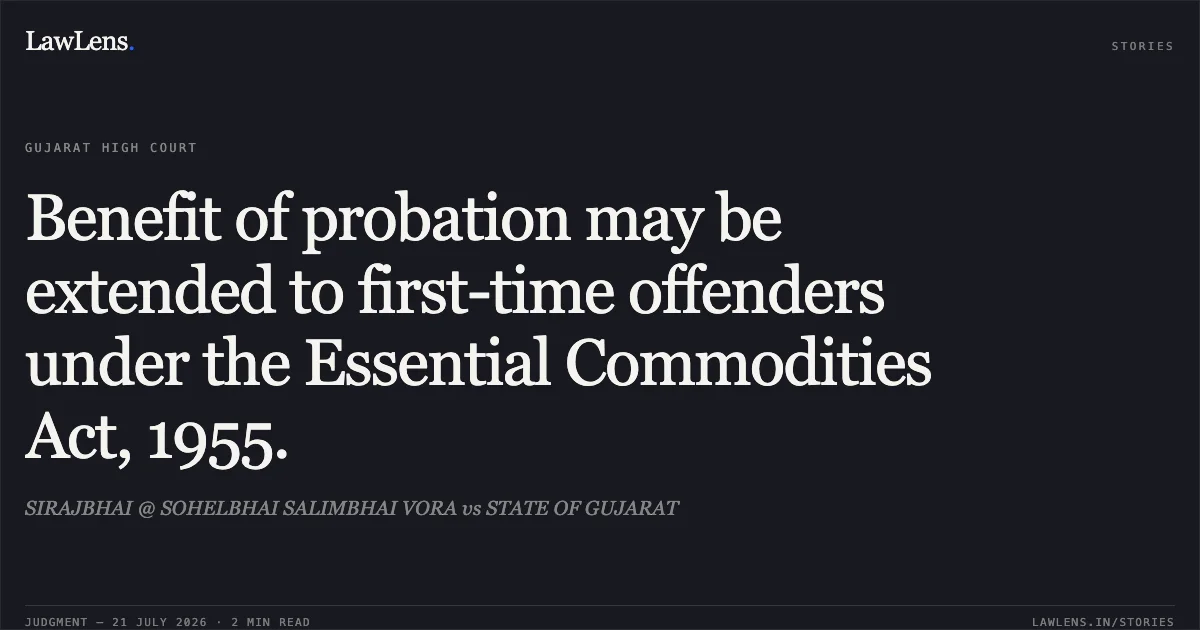
The High Court partly allowed the revision application. While maintaining the conviction, it modified the sentence by directing that the applicants be released on probation under Section 360 of the CrPC
The applicants are required to enter into bonds and furnish fresh sureties before the trial court to ensure peace and good behavior for the remainder of the period
Source reference: p. 8The R. & P. were ordered to be sent back to the lower courts immediately
Source reference: p. 8Acts & Sections Cited
5 provisions across 2 statutes referred to in this judgment. Each provision opens on LawLens.
Code of Criminal Procedure, 19733
Original Court PDF
SIRAJBHAI @ SOHELBHAI SALIMBHAI VORAvsSTATE OF GUJARAT
Click to open original judgment
Original judgment, available to read, download and summarize on LawLens.in