01Facts
On the intervening night of 9–10 June 1997, the petitioner allegedly entered the informant’s house at about 2:00 a.m. with the intention of stealing goats. Two goats were allegedly taken away, and a third goat was killed by severing its neck.
¶ 3–5The informant raised an alarm, following which the accused allegedly fled. After the police did not register the case, the informant initiated proceedings before the Magistrate; pursuant to an order under Section 156(3) Cr.P.C., Tundi P.S. Case No. 36 of 1997 was registered for offences under Sections 379, 427, 428 and 448 IPC.
¶ 3–5The trial court convicted the petitioner and sentenced him to concurrent terms of imprisonment ranging from one to six months.
¶ 2The Sessions Court dismissed his appeal and affirmed the conviction and sentence.
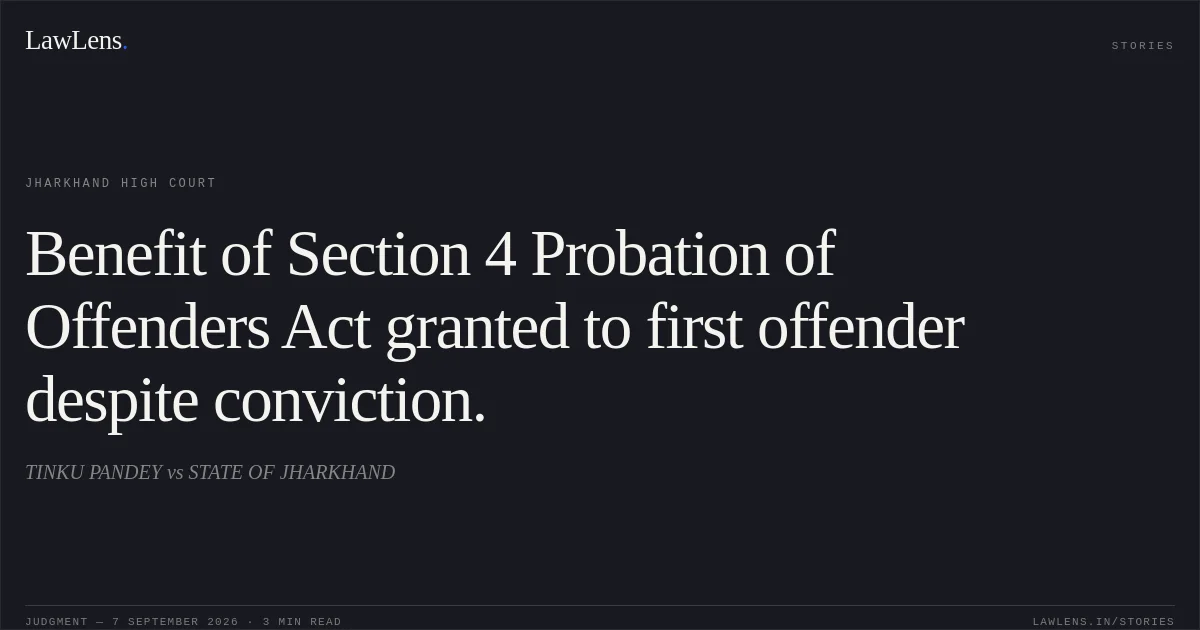
¶ 8Before the High Court, the petitioner did not challenge the conviction on merits and sought the benefit of Section 4 of the Probation of Offenders Act, 1958, contending that this was his first offence and that he had no adverse antecedents.
¶ 1002Issues
i.Whether the concurrent findings convicting the petitioner under Sections 379, 427, 428 and 448 IPC required interference in revision.
¶ 12–13ii.Whether, considering that the petitioner was a first-time offender and the nature and circumstances of the offence, he was entitled to the benefit of Section 4 of the Probation of Offenders Act, 1958.
¶ 14–1503Law Applied
The Court applied Sections 379, 427, 428 and 448 of the Indian Penal Code, concerning theft, mischief causing damage, mischief involving an animal, and house-trespass, respectively.
¶ 2, 13It also applied Section 4 of the Probation of Offenders Act, 1958, which permits release of an offender on probation of good conduct instead of immediately imposing substantive imprisonment, after considering the offender’s age, character, antecedents and the circumstances of the offence.
¶ 10, 14–16The Court treated the petitioner’s first-offender status, age, antecedents, character and the overall circumstances of the occurrence as relevant considerations for extending probation.
¶ 15Provisions in the judgment · 6 · Linked ones open on LawLens
Indian Penal Code, 1860 Section 379Section 427Section 428Section 448
Code of Criminal Procedure, 1973 Section 156
Probation of Offenders Act, 1958 Section 4
04Reasoning
The High Court found that the informant’s testimony identifying the accused and describing the occurrence was corroborated by other prosecution witnesses regarding the manner and place of occurrence.
¶ 13It therefore held that the concurrent findings of guilt under Sections 379, 427, 428 and 448 IPC were legally proper and did not warrant interference in revision.
¶ 13However, while the trial court had refused probation on the ground of the gravity of the offence, the High Court gave weight to the fact that the petitioner had no previous conviction or adverse antecedents and that the case represented his first offence.
¶ 14–15Applying Section 4 of the Probation of Offenders Act, the Court considered reformation more appropriate than immediate incarceration.
¶ 1505Holding
The revision was dismissed on merits insofar as the conviction was concerned.
¶ 16However, the sentence was modified: instead of undergoing the substantive imprisonment imposed by the trial court, the petitioner was directed to be released under Section 4 of the Probation of Offenders Act upon furnishing a bond of Rs. 5,000 with one surety of like amount, undertaking to maintain peace and be of good behaviour for one year.
¶ 16If the bond was not furnished within two months, the trial court was directed to secure the petitioner’s attendance; violation of the bond conditions could result in his being required to undergo the original sentence.
¶ 17–18Original Court PDF
TINKU PANDEYvsSTATE OF JHARKHAND
Click to open original judgment
Original judgment, available to read, download and summarize on LawLens.in