Facts
Haryana Renewable Energy Development Agency (“HREDA”) issued an RfP in August 2017 for setting up paddy-straw-based biomass power projects in Haryana.
Source reference: paras. 10–18; pp. 9–12The RfP provided that bidders would offer discounts on the applicable generic tariff, described as the “ceiling tariff,” while the successful bidders would subsequently approach the Haryana Electricity Regulatory Commission (“HERC”) for tariff determination under Section 62 of the Electricity Act, 2003.
Source reference: paras. 10–18; pp. 9–12Jind Bio-Energy LLP and Fatehabad Bio-Energy LLP were allotted 9.9 MW projects each after offering discounts in the bidding process.
Source reference: paras. 3, 18; pp. 6, 11HPPC sought HERC’s approval to execute PPAs with the selected developers.
Source reference: paras. 20–21; p. 12By order dated 3 January 2019, HERC approved the PPAs, subject to the tariff agreed by the developers not being revisited.
Source reference: paras. 20–21; p. 12The parties thereafter executed PPAs dated 22 February 2019.
Source reference: paras. 23–24, 27; pp. 12–14The PPAs defined “Tariff” as the tariff determined by HERC after applying the bidder’s discount, but added that it would remain “subject to” the 2017–18 ceiling tariff.
Source reference: paras. 23–24, 27; pp. 12–14The developers challenged the application of the ceiling tariff as an absolute cap.
Source reference: paras. 21–25; pp. 12–14HERC initially held that the ceiling tariff forming the basis of selection could not be exceeded in tariff determination.
Source reference: paras. 21–25; pp. 12–14The developers filed Appeal No. 348 of 2019 before the Tribunal.
Source reference: paras. 21–25; pp. 12–14Separately, HERC directed the parties to modify the PPAs because the executed definition of “Tariff” deviated from the definition approved in its order dated 3 January 2019.
Source reference: paras. 26–30, 53–60; pp. 14–15, 33–37HPPC challenged that direction in Appeal No. 95 of 2022.
Source reference: paras. 26–30, 53–60; pp. 14–15, 33–37Issues
1. Whether the ceiling tariff used as the basis for offering discounts in the RfP also operated as an absolute maximum cap on the tariff which HERC could determine under Section 62 of the Electricity Act, 2003?
Source reference: para. 31; p. 152. Whether the PPAs executed between HPPC and the developers were required to be modified because their definition of “Tariff” deviated from the draft PPA approved by HERC?
Source reference: paras. 53–60; pp. 33–37Law Applied
The Tribunal applied Section 62 of the Electricity Act, 2003, under which the State Commission determines the tariff for electricity supplied by generating companies.
Source reference: paras. 34–41; pp. 16–24The RfP clauses were construed to mean that the bidder’s discount, and not the bid-stage ceiling tariff, would apply to the tariff determined by HERC for the project.
Source reference: paras. 34–41; pp. 16–24The Tribunal relied on the principle of contemporanea expositio, under which the interpretation placed on a document by the authority responsible for framing and implementing it is entitled to considerable persuasive weight, as recognised in Desh Bandhu Gupta & Co. v. Delhi Stock Exchange Association Ltd., (1979) 4 SCC 565.
Source reference: para. 45; pp. 26–28It also applied the principle in Afcons Infrastructure Ltd. v. Nagpur Metro Rail Corporation, (2016) 16 SCC 818, that the author of tender documents is ordinarily best placed to interpret them, absent perversity, mala fides, or legal error.
Source reference: para. 46; pp. 28–29Further, a PPA executed after regulatory approval must conform to the Commission-approved draft, and material deviations may be directed to be corrected.
Source reference: paras. 58–60; pp. 35–37Reasoning
The Tribunal read Clauses 1.6.1 and 1.6.2 of the RfP together.
Source reference: paras. 34–40; pp. 16–23Clause 1.6.1 required bidders to offer discounts with reference to the applicable ceiling or generic tariff, while Clause 1.6.2 expressly required the successful bidders to seek project-specific tariff determination under Section 62, with the offered discount to be applied to the tariff fixed by HERC for the project throughout the PPA period.
Source reference: paras. 34–40; pp. 16–23Accordingly, the ceiling tariff was relevant for evaluating and selecting bidders, but did not become an immutable upper limit on HERC’s subsequent tariff determination.
Source reference: paras. 34–40; pp. 16–23HREDA’s own interpretation supported this construction, particularly because biomass fuel, transportation, labour, and other variable costs could change over time, making a fixed 2017–18 cap commercially unviable.
Source reference: paras. 42–50; pp. 24–31The Tribunal therefore held that allowing tariff above the bid-stage ceiling did not rewrite the parties’ bargain but gave effect to the RfP and the statutory tariff-determination process.
Source reference: paras. 51–52; pp. 31–33On the second issue, the Tribunal compared the executed PPAs with HERC’s approved draft.
Source reference: paras. 54–60; pp. 34–37HERC had specifically directed that the tariff payable should be the year-to-year tariff determined with reference to the project’s COD, less the discount offered by the IPP.
Source reference: paras. 54–60; pp. 34–37The executed PPAs, however, inserted an additional qualification making the tariff subject to the 2017–18 ceiling tariff.
Source reference: paras. 54–60; pp. 34–37This was a deviation from the approved PPA, and the developers’ consent to the executed document could not validate a term inconsistent with the Commission’s approval.
Source reference: paras. 54–60; pp. 34–37Holding
Appeal No. 348 of 2019 was allowed.
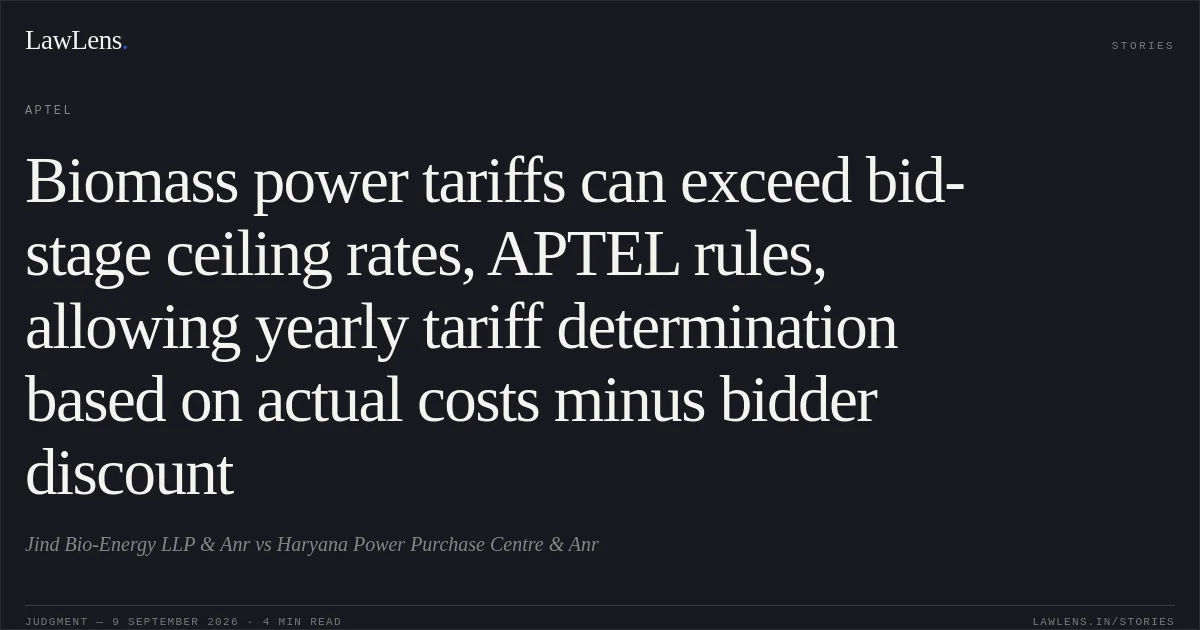
The Tribunal held that the ceiling tariff used for determining the bidders’ discounts was not an absolute cap on the tariff to be determined by HERC under Section 62.
Source reference: para. 52; pp. 32–33; para. 62; p. 38HERC could determine the tariff on a year-to-year basis, and the determined tariff could exceed the bid-stage ceiling tariff, subject to application of the bidder’s discount.
Source reference: para. 52; pp. 32–33; para. 62; p. 38Appeal No. 95 of 2022 was dismissed.
Source reference: paras. 60–62; pp. 37–38The Tribunal upheld HERC’s direction requiring HPPC and the developers to modify the PPAs so that the definition of “Tariff” conformed to the Commission-approved draft PPA and reflected the year-to-year tariff determined by HERC less the applicable bidder discount.
Source reference: paras. 60–62; pp. 37–38Acts & Sections Cited
2 provisions across 1 statute referred to in this judgment. Each provision opens on LawLens.
Electricity Act, 20032
Original Court PDF
Jind Bio-Energy LLP & AnrvsHaryana Power Purchase Centre & Anr
Click to open original judgment
Original judgment, available to read, download and summarize on LawLens.in