Facts
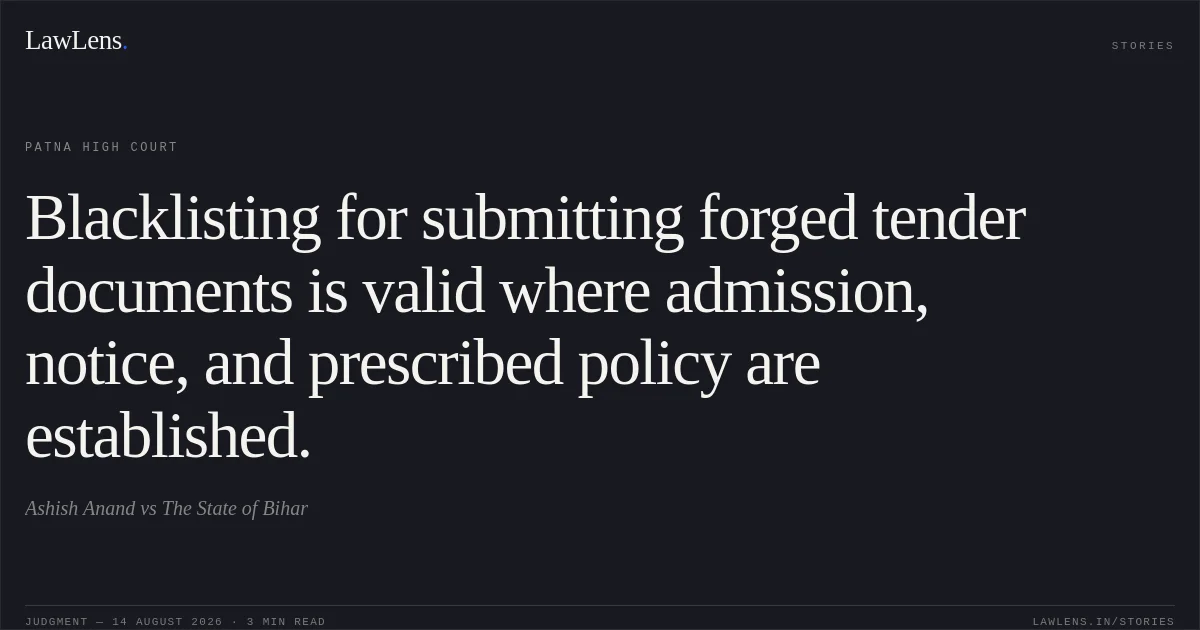
The petitioner participated in a BSEIDC tender for construction of a 10+2 school building at Sindhiya, Dagarua, Purnea, pursuant to NIT No. 10/2022-23.
Source reference: no citationThe respondents, however, stated that during technical verification his work-experience certificate was found false and fabricated; consequently, he was never technically qualified, issued a work order, or allotted the work.
Source reference: paras. 3, 6, 9–10A show-cause notice dated 25 January 2023, followed by a reminder dated 21 March 2023, was issued to the petitioner.
Source reference: para. 7In his reply dated 27 March 2023, he admitted submitting the false work-experience certificate and tendered an unconditional apology.
Source reference: paras. 17–18By order dated 11 May 2023, the Chief Engineer, BSEIDC blacklisted him for ten years under BSEIDC Office Order/Letter No. 73 dated 2 June 2022, which prescribed ten-year blacklisting for submission of forged or false documents.
Source reference: paras. 5, 17–20The writ petition was filed in 2025, approximately two years after the impugned order, without an explanation for the delay.
Source reference: paras. 4, 11Issues
Whether the petitioner, having allegedly made false or misleading averments and having approached the Court after unexplained delay, was entitled to invoke the equitable and discretionary jurisdiction under Article 226 of the Constitution?
Source reference: para. 8(i)Whether the ten-year blacklisting order dated 11 May 2023, passed for submission of a forged or fabricated work-experience certificate, was liable to be interfered with despite the petitioner’s admission and the alleged compliance with the applicable policy and natural justice requirements?
Source reference: para. 8(ii)Law Applied
The Court applied Article 226 principles that writ jurisdiction is extraordinary, discretionary, and equitable; a litigant must approach the Court with clean hands, disclose material facts, and avoid misleading pleadings.
Source reference: paras. 12–14It relied on K.D. Sharma v. Steel Authority of India, (2008) 12 SCC 481, Prestige Lights Ltd. v. State Bank of India, (2007) 8 SCC 449, and Dalip Singh v. State of Uttar Pradesh, (2010) 2 SCC 114, which hold that suppression, misrepresentation, or false statements may disentitle a litigant from relief.
Source reference: paras. 12–14The Court further applied the Bihar Contractor Registration Rules, 2013, read with BSEIDC Letter No. 73 dated 2 June 2022, prescribing ten-year blacklisting for submission of forged or false documents.
Source reference: paras. 5, 20Under Patel Engineering Ltd. v. Union of India, (2012) 11 SCC 257, blacklisting is a recognised power of the State if exercised for a legitimate purpose, fairly, rationally, and without arbitrariness.
Source reference: para. 21Under Gorkha Security Services v. Government (NCT of Delhi), (2014) 9 SCC 105, a meaningful show-cause opportunity must precede blacklisting because of its serious civil consequences.
Source reference: para. 22Reasoning
The Court found that the petitioner’s assertion that the contract had been awarded and that preliminary work had commenced was unsupported: he produced no work order or other material, while the respondents specifically asserted that the false certificate was detected during technical scrutiny and that no work was ever allotted.
Source reference: paras. 9–10This conduct, coupled with the petitioner’s unexplained delay in filing the writ petition nearly two years after the blacklisting order, disentitled him from equitable relief under Article 226.
Source reference: paras. 11–16On the merits, the petitioner had received an initial show-cause notice, a reminder notice, and an opportunity to submit a written explanation; he used that opportunity to admit that the certificate was false and apologise.
Source reference: paras. 17–19, 23The Court therefore held that the principles of natural justice were satisfied, and that the ten-year penalty merely implemented the consequence expressly prescribed by the applicable BSEIDC policy and contractor-registration framework.
Source reference: paras. 20, 23–24The admitted submission of a fabricated certificate also undermined the petitioner’s plea for leniency or interference on proportionality grounds.
Source reference: paras. 18, 24Holding
The Court answered both issues against the petitioner.
It held that the petitioner’s unsupported and misleading pleadings, unexplained delay, and failure to approach the Court with clean hands barred equitable relief under Article 226.
Source reference: paras. 15–16It further held that the blacklisting order was passed after adequate show-cause opportunity, was based on the petitioner’s admitted submission of a false certificate, and conformed to the applicable BSEIDC policy and Bihar Contractor Registration Rules.
Source reference: paras. 19–24The writ petition challenging the ten-year blacklisting was accordingly dismissed, and all pending applications, if any, were disposed of.
Source reference: paras. 26–28Original Court PDF
Ashish AnandvsThe State of Bihar
Click to open original judgment
Original judgment, available to read, download and summarize on LawLens.in