Facts
The Petitioner, a limited company, was subjected to a search by State Tax authorities (Respondent No. 3) on February 12, 2025, regarding Input Tax Credit (ITC) availed from a specific supplier
Source reference: para. 5(i)On February 27, 2025, Respondent No. 2 issued provisional attachment orders via FORM GST DRC-22 for the Petitioner’s bank accounts under Section 83 of the Maharashtra Goods and Services Tax (MGST) Act, 2017
Source reference: para. 5(iii)Subsequently, on March 7, 2025, the Petitioner’s Electronic Credit Ledger (ECL) was blocked under Rule 86A of the Central Goods and Services Tax (CGST) Rules, 2017
Source reference: para. 5(v)The Petitioner challenged these actions on the grounds that the statutory one-year limit for such restrictions had expired, and that the blocking occurred without a pre-decisional hearing or independent application of mind
Source reference: para. 3 & 7Issues
1. Whether the restriction on the Electronic Credit Ledger (ECL) under Rule 86A of the CGST Rules can legally continue beyond the expiry of one year from the date of imposition.
Source reference: para. 7 & 102. Whether the principles of natural justice require the grant of a pre-decisional hearing before blocking a taxpayer's ITC under Rule 86A.
Source reference: para. 123. Whether the provisional attachment of bank accounts under Section 83 of the MGST Act ceases to have effect after the expiry of one year.
Source reference: para. 7Law Applied
Rule 86A(3) of the CGST Rules, 2017, which stipulates that any restriction imposed on the ECL shall cease to have effect after the expiry of one year from the date of its imposition
Source reference: para. 3 & 11Section 83(2) of the MGST Act, which mandates that a provisional attachment of property/bank accounts ceases to have effect after one year
Source reference: para. 7The court followed the precedents of Seya Industries Ltd. v. State of Maharashtra and NZS Traders Pvt. Ltd. v. Union of India, which establish the automatic unblocking of credit by operation of law
Source reference: para. 10-11the principle from K-9 Enterprises v. State of Karnataka, holding that blocking ECL entails serious civil consequences, necessitating a pre-decisional hearing under the principles of natural justice
Source reference: para. 12Reasoning
The court observed that the ITC was blocked in March 2025 and the bank accounts were provisionally attached on February 27, 2025
Source reference: para. 7Applying the "plain purport" of Rule 86A(3) and Section 83(2), the court reasoned that these restrictions had automatically lapsed by February and March 2026 respectively, as the statutory one-year maximum duration had expired
Source reference: para. 7 & 10The court rejected the Revenue's argument that a post-decisional hearing was sufficient, noting that the blocking of ITC has a "crippling effect" on business operations
Source reference: para. 12It concluded that the absence of a pre-decisional hearing violated natural justice because ITC, unlike liquid cash in a bank account, cannot be instantaneously withdrawn, thus negating the need for emergency action without notice
Source reference: para. 12-13Holding
The High Court allowed the Writ Petition, holding that the blocking of ITC and provisional attachment of bank accounts beyond the one-year period was arbitrary and illegal
The court quashed the provisional attachment orders dated February 27, 2025, and directed the Respondents to unblock the Petitioner’s ECL and defreeze the bank accounts
Source reference: Order (a)the Department remains at liberty to initiate appropriate fresh proceedings in accordance with the law regarding the underlying tax liability or ITC eligibility
Source reference: Order (b)Acts & Sections Cited
4 provisions across 2 statutes referred to in this judgment. Each provision opens on LawLens.
Central Goods and Services Tax Act, 20173
Maharashtra Goods and Services Tax Act, 20171
Original Court PDF
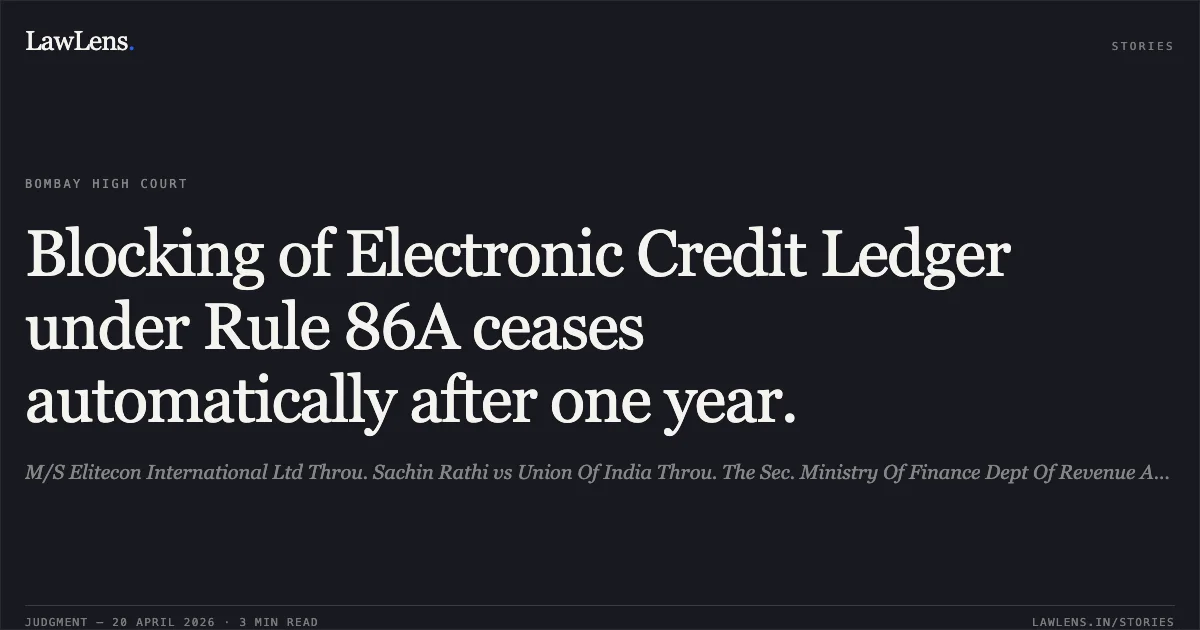
M/S Elitecon International Ltd Throu. Sachin RathivsUnion Of India Throu. The Sec. Ministry Of Finance Dept Of Revenue And Ors
Click to open original judgment
Original judgment, available to read, download and summarize on LawLens.in