Facts
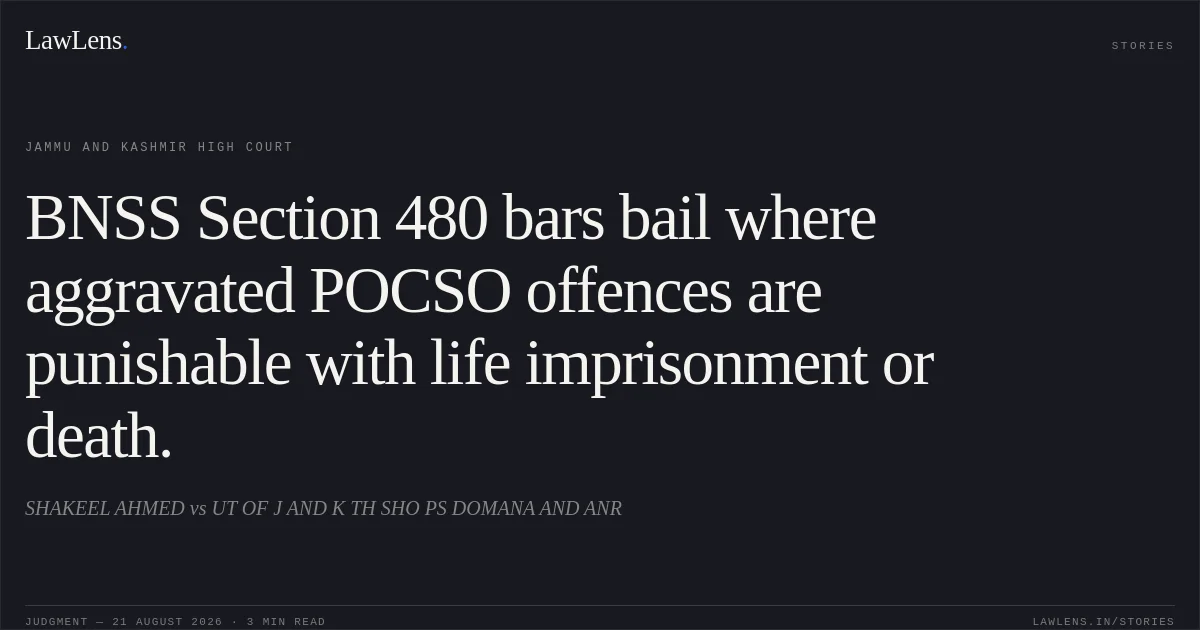
The petitioner sought regular bail under Section 483 of the Bharatiya Nagarik Suraksha Sanhita, 2023, in FIR No. 42/2025 registered at Police Station Domana for offences under Section 377 IPC read with Sections 5 and 6 of the POCSO Act; charges were subsequently framed under Sections 4 and 6 of the POCSO Act.
Source reference: p.1; para. 9The prosecution alleged that the petitioner, a religious teacher, sexually assaulted the minor victim in a mosque and that the assault continued for several days.
Source reference: p.3; p.5The FIR originated as a zero FIR lodged in Anantnag and was later transferred to Police Station Domana.
Source reference: p.3; p.5The petitioner had been arrested on 18 April 2025 and had remained in custody thereafter.
Source reference: p.5Of the eleven prosecution witnesses, five—including the victim and his father—had already been examined.
Source reference: p.2The trial court had previously rejected his bail application.
Source reference: p.2; p.4Issues
Whether the petitioner was entitled to regular bail on the grounds of prolonged incarceration, examination of the victim and other material witnesses, alleged delay in reporting the offence, and the protection of personal liberty under Article 21.
Source reference: p.2; p.5Whether the seriousness of the offences under Sections 4 and 6 of the POCSO Act, including the possibility of a death sentence under Section 6, attracted the restriction on bail under Section 480 of the BNSS.
Source reference: paras. 9–12Whether the presumptions under Sections 29 and 30 of the POCSO Act affected the consideration of bail at the pre-trial stage.
Source reference: para. 13Law Applied
The Court applied Sections 4 and 6 of the POCSO Act, under which penetrative sexual assault and aggravated penetrative sexual assault attract severe punishment, including imprisonment for life and, in the case of Section 6, potentially the death penalty.
Source reference: para. 9It held that the restriction under Section 480 of the BNSS applies where the offence is punishable with imprisonment for life along with the alternative possibility of capital punishment.
Source reference: para. 12The Court further held that the presumptions under Sections 29 and 30 of the POCSO Act are rebuttable and do not constitute an absolute bar to bail; however, they operate after the prosecution establishes the foundational facts of its case.
Source reference: para. 13Bail discretion must be exercised on the cumulative assessment of the facts and circumstances, and no single circumstance is universally determinative, as explained in Gurbaksh Singh Sibbia v. State of Punjab, AIR 1980 SC 1632.
Source reference: para. 11Reasoning
The Court treated the charges under Sections 4 and 6 of the POCSO Act as grave and heinous, particularly because Section 6 permits the imposition of the death penalty.
Source reference: paras. 9–10Although five prosecution witnesses, including the victim and his father, had been examined, the Court considered the trial to be at its final stage and likely to conclude shortly.
Source reference: para. 14It therefore declined to treat the petitioner’s custody or the examination of material witnesses as sufficient grounds for release.
Source reference: para. 14The Court also noted that the petitioner had not pleaded false implication and that the statutory restriction under Section 480 of the BNSS was applicable in view of the punishment prescribed for the charged offences.
Source reference: para. 12; para. 14The presumptions under the POCSO Act were held to be matters primarily relevant to the trial, but the seriousness of the charges and the stage of proceedings weighed decisively against bail.
Source reference: para. 13–14Holding
The Court held that the petitioner was not entitled to regular bail at that stage.
It found that the gravity of the offences, the applicability of the Section 480 BNSS restriction, and the near completion of the trial outweighed the petitioner’s grounds based on custody, examination of witnesses, alleged delay, and Article 21.
Source reference: para. 14The bail application and connected application(s) were accordingly dismissed, and the trial court’s rejection of bail was upheld.
Source reference: para. 14–15Acts & Sections Cited
8 provisions across 3 statutes referred to in this judgment. Each provision opens on LawLens.
Bharatiya Nagarik Suraksha Sanhita, 20232
Indian Penal Code, 18601
Protection of Children from Sexual Offences Act, 20125
Original Court PDF
SHAKEEL AHMEDvsUT OF J AND K TH SHO PS DOMANA AND ANR
Click to open original judgment
Original judgment, available to read, download and summarize on LawLens.in