Facts
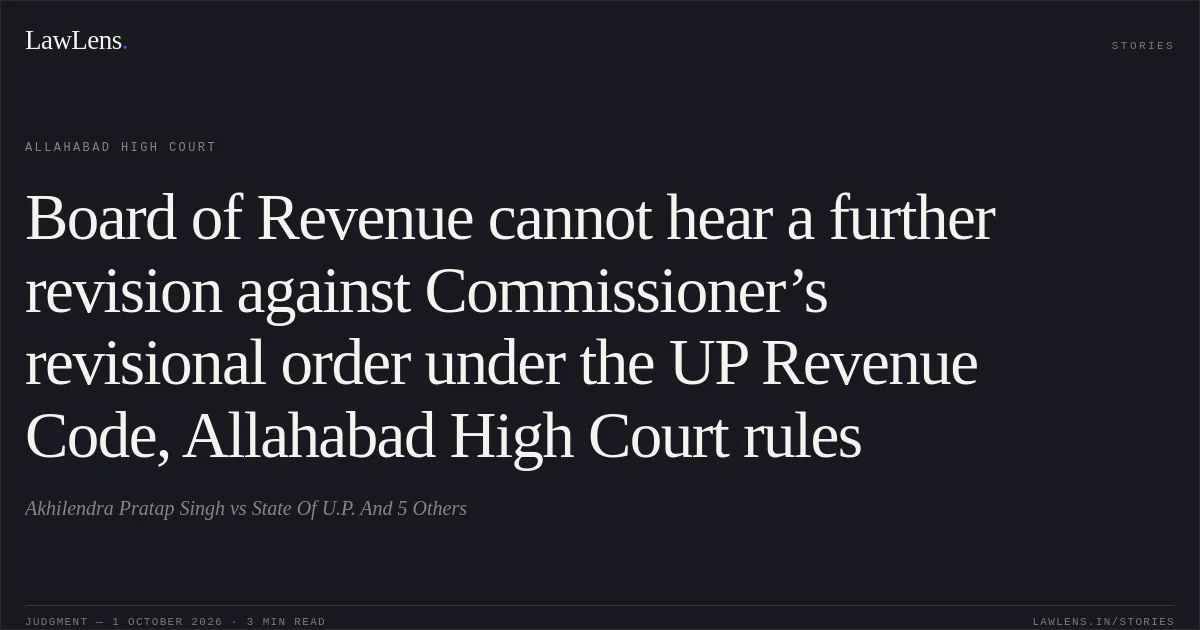
The petitioner claimed agricultural land under a registered Will allegedly executed by Chandan Singh, who died in 2016. Bhagwati Devi, Chandan Singh’s surviving sister, claimed natural succession and challenged the Will.
Source reference: para. 2The Tehsildar allowed the petitioner’s mutation claim, and the Sub-Divisional Magistrate dismissed Bhagwati Devi’s appeal. On revision under Section 210 of the U.P. Revenue Code, 2006, the Commissioner set aside those orders and directed deletion of the petitioner’s name, making detailed findings about the Will’s execution, genuineness, and surrounding circumstances.
Source reference: paras. 2–4The petitioner challenged the Commissioner’s order by writ petition, arguing, among other things, that the Will’s validity could not be finally adjudicated in mutation proceedings.
Source reference: paras. 5–6The respondents objected that a further revision before the Board of Revenue was available.
Source reference: paras. 7–11Issues
Whether the petitioner had an alternative statutory remedy of revision before the Board of Revenue against the Commissioner’s order passed under Section 210.
Source reference: paras. 9–15Whether the Commissioner, while deciding the revision concerning mutation, could determine disputed questions regarding the Will’s validity and the title claimed under it, or whether those questions required adjudication by a competent civil court.
Source reference: paras. 22–24Law Applied
Section 210(1) of the U.P. Revenue Code, 2006 gives the Board of Revenue and the Commissioner alternative revisional jurisdiction over orders of subordinate Revenue Courts in proceedings in which no appeal lies; it does not establish a further revisional tier from the Commissioner to the Board. Section 210(2) bars the same person from approaching the other revisional authority after invoking one, but does not expand the subject matter of revision.
Source reference: para. 14Under Tarachandra v. Bhawarlal, mutation based on a Will is not categorically barred, but a serious dispute about the Will’s validity, genuineness, or the testator’s capacity must be adjudicated by a competent civil court; mutation is fiscal and does not confer or determine title.
Source reference: para. 22Shravan Kumar v. Additional Commissioner (Judicial) similarly limits mutation authorities to determining whether a claim is made out for mutation, without empowering them to decide title.
Source reference: para. 23Parvathi Nairthi v. Laxmi Nairthy states principles governing proof of Wills in civil proceedings, including that exclusion of natural heirs alone does not invalidate a Will.
Source reference: para. 23Reasoning
The Court rejected the alternative-remedy objection because the Commissioner had already exercised revisional jurisdiction over the Sub-Divisional Magistrate’s order. Since Section 210 does not make the Commissioner subordinate to the Board for purposes of a further revision, the petitioner had no further statutory revision available.
Source reference: paras. 14–15On the merits, the Commissioner had made detailed findings on the Will’s execution, genuineness, the testator’s capacity, hospital registration, and the attesting witnesses, while a civil suit challenging the Will had not resulted in an adjudication on its validity.
Source reference: para. 24Whether those findings exceeded the limited scope of mutation proceedings raised a substantial question. The Court therefore preserved the position pending consideration, noting the risk of further dealings with the land and that mutation does not determine title.
Source reference: paras. 22–25Holding
The Court held that the writ petition was maintainable because no further revision lay before the Board of Revenue against the Commissioner’s revisional order.
It did not finally decide whether the Commissioner exceeded the permissible scope of mutation proceedings.
Source reference: paras. 24–29The Court issued notice, allowed time for affidavits, and directed that the Commissioner’s order remain stayed pending further orders; the parties were directed to maintain status quo regarding the land’s nature and possession and not to alienate it or create third-party rights.
Source reference: paras. 24–29The observations were expressly confined to interim protection and do not determine the writ petition finally.
Source reference: para. 29Acts & Sections Cited
3 provisions across 3 statutes referred to in this judgment. Linked provisions open on LawLens.
U.P. Revenue Code, 20061
U.P. Zamindari Abolition and Land Reforms Act, 19501
Indian Evidence Act, 18721
Original Court PDF
Akhilendra Pratap SinghvsState Of U.P. And 5 Others
Click to open original judgment
Original judgment, available to read, download and summarize on LawLens.in