Facts
On April 14, 2024, the deceased, Sanjaysingh, purchased a valid ticket from Ahmedabad to Surat.
Source reference: para. 2.1, 2.2While attempting to board the Mahuva – Bandra SF Express at Ahmedabad station, he lost his balance due to a heavy rush, fell into the gap between the platform and the train, and succumbed to fatal injuries.
Source reference: para. 2.1, 2.2The Railway Claims Tribunal (RCT) dismissed the claim, relying on a Divisional Railway Manager (DRM) Report and CCTV footage to conclude that the death was a "self-inflicted injury" caused by the deceased attempting to move between coaches on a moving train.
Source reference: para. 2.3, 3The appellants (widow and children) challenged this dismissal under Section 23 of the Railway Claims Tribunal Act, 1987.
Source reference: para. 1Issues
1. Whether the incident constitutes an "untoward incident" under Section 123(c)(2) of the Railways Act, 1989, or falls under the "self-inflicted injury" exception in the proviso to Section 124A.
Source reference: para. 2.3, 4.12. Whether the deceased can be classified as a "bona fide passenger" in the absence of a recovered ticket.
Source reference: para. 33. Whether the DRM Report, filed beyond the statutory timeline, can be relied upon to deny compensation.
Source reference: para. 7Law Applied
The court applied Section 123(c)(2) of the Railways Act, 1989, which defines an "untoward incident" as the accidental falling of any passenger from a train.
Source reference: para. 4.1It relied on the "strict liability" or "no-fault liability" principle under Section 124A, as interpreted in Union of India v. Rina Devi (2018), which clarifies that "self-inflicted injury" requires intentional harm, not mere negligence or rashness.
Source reference: para. 3, 5The court also applied Rule 27 of the Railway Passenger (Manner of Investigation of Untoward Incidents) Rules, 2003, regarding the 60-day deadline for DRM reports.
Source reference: para. 7The court applied the precedent in Shrikumar Gupta v. Union of India (2025) regarding the burden of proof for bona fide passengers.
Source reference: para. 4.1Reasoning
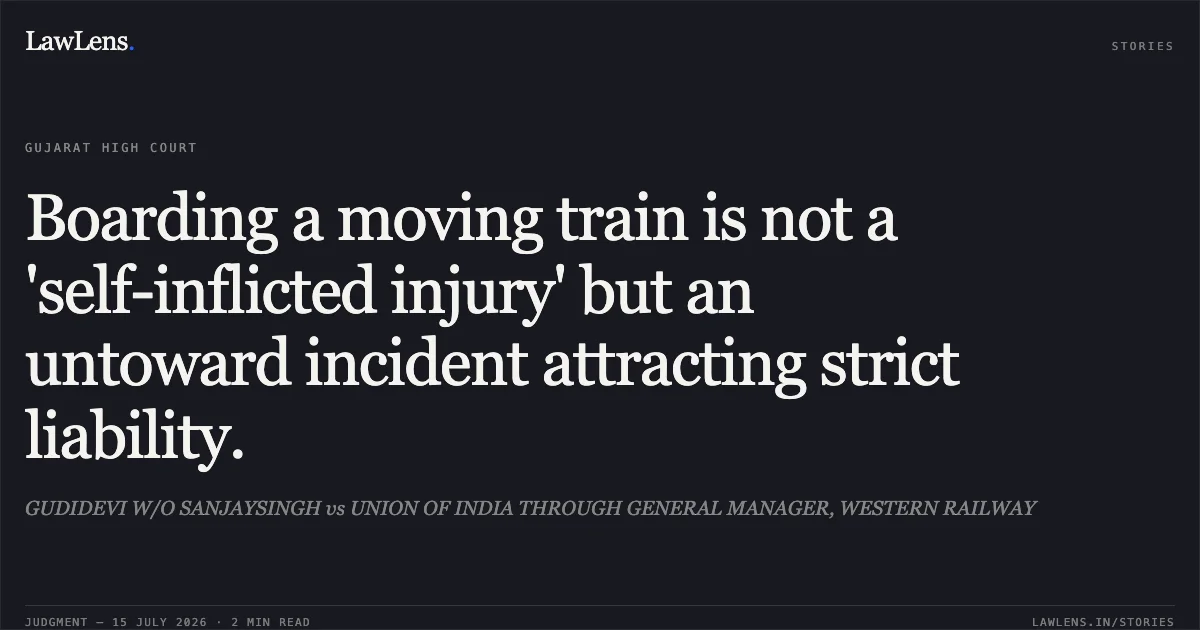
Citing Rina Devi, the court noted that boarding or de-boarding a moving train might be negligent, but it does not equate to a "criminal act" or "self-inflicted injury" unless there is malicious intent to cause self-harm.
Source reference: para. 5The court observed that no "sane person" would intentionally jump into a platform gap to cause injury.
Source reference: para. 4.1, 8Regarding passenger status, the court held that once an affidavit of relevant facts is filed, the burden shifts to the Railways; here, the Railways failed to prove the deceased was not bona fide.
Source reference: para. 4.1, 5The court invalidated the DRM Report’s findings as it was filed on February 6, 2025—nearly ten months after the incident—violating the statutory 60-day limit under Rule 27.
Source reference: para. 7Holding
The court held that the death was a result of an "untoward incident" and not a self-inflicted injury.
The court allowed the appeal and set aside the RCT’s judgment, directing the respondent Railway Administration to pay the statutory compensation of Rs. 8,00,000/- with 9% interest from the date of the incident until realization.
Source reference: para. 9Acts & Sections Cited
5 provisions across 3 statutes referred to in this judgment. Each provision opens on LawLens.
Motor Vehicles Act, 19881
Railway Claims Tribunal Act, 19871
Railways Act, 19893
Original Court PDF
GUDIDEVI W/O SANJAYSINGHvsUNION OF INDIA THROUGH GENERAL MANAGER, WESTERN RAILWAY
Click to open original judgment
Original judgment, available to read, download and summarize on LawLens.in


