Facts
The claimant, Mohd Rahees, filed a claim petition seeking statutory compensation for grievous injuries, including bilateral amputation of both legs, sustained on 17.11.2018 at Gondia Railway Station.
Source reference: p. 2-3He alleged he purchased a ticket for Nagpur but mistakenly boarded Train No. 58117 at Platform No. 2.
Source reference: p. 3Upon realizing the error, he attempted to alight but fell due to a sudden jerk.
Source reference: p. 3The Railway Claims Tribunal dismissed the petition on 23.11.2021, holding that the claimant was not a bona fide passenger and the incident was not an "untoward incident" because no ticket was recovered and he boarded a wrong train.
Source reference: p. 3-4During the pendency of this appeal, the appellant passed away, and his legal representatives were substituted.
Source reference: p. 1-2Issues
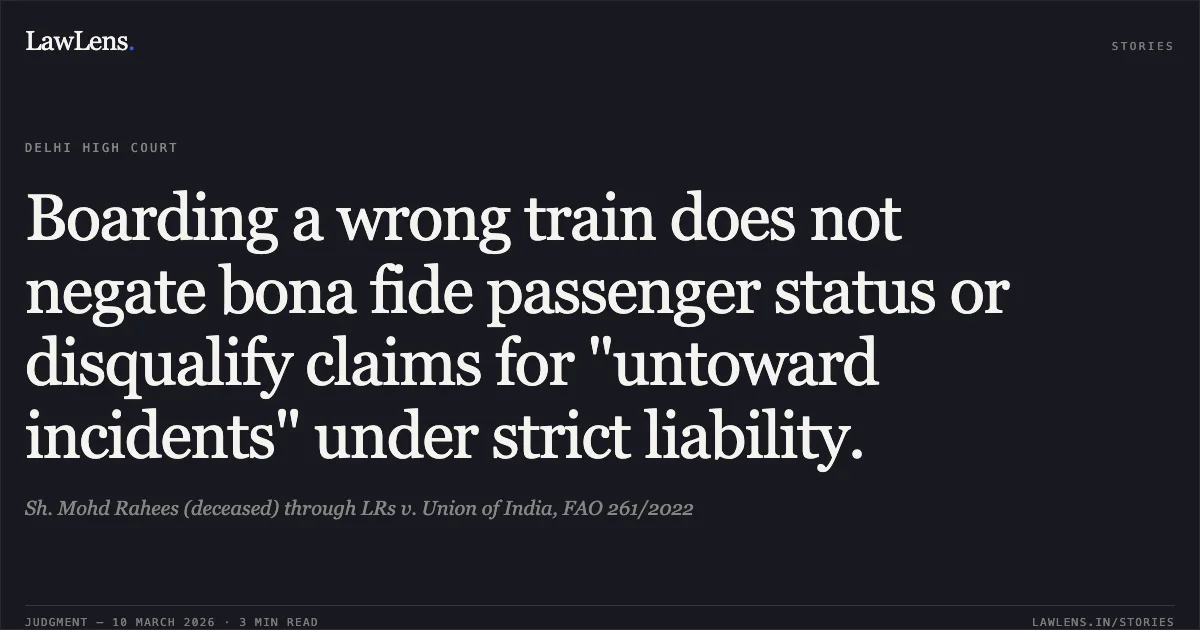
Whether a passenger who mistakenly boards the wrong train and whose ticket is not recovered can be classified as a bona fide passenger under the Railways Act?
Source reference: p. 5Whether the injuries sustained while alighting from a moving train during shunting operations constitute an "untoward incident" under Section 123(c) of the Railways Act, 1989?
Source reference: p. 4, 6Law Applied
The court primarily applied Section 123(c) and Section 124-A of the Railways Act, 1989, which establish a system of strict or "no-fault" liability for "untoward incidents," shifts the burden of proof to the Railways once a preliminary case is made, and excludes negligence as a defense.
Source reference: p. 3, 7It relied on Union of India v. Rina Devi, which held that the initial burden of proving bona fide passenger status is discharged by the claimant's affidavit, shifting the onus to the Railways.
Source reference: p. 5Furthermore, it applied Munnibai v. Union of India and Shrikumar Gupta v. Union of India, which established that boarding the wrong train does not disqualify a person from being a bona fide passenger.
Source reference: p. 5-6And Union of India v. Prabhakaran Vijaya Kumar, regarding the liberal interpretation of beneficial legislation.
Source reference: p. 7Reasoning
The Court found that the Tribunal erred by focusing on the non-recovery of the ticket and the boarding of a wrong train.
Source reference: no citationIt noted that the Railway’s own DRM report admitted the claimant was injured on railway premises and that he had mistakenly boarded the train after going to the wrong platform.
Source reference: p. 4-5Citing Rina Devi, the Court held that the claimant’s testimony on affidavit shifted the burden to the Railways to prove he was not a bona fide passenger, which they failed to do.
Source reference: p. 5The Court reasoned that boarding a wrong train is a common error and, per established precedents, does not strip a person of their status as a passenger.
Source reference: p. 6Furthermore, the Court rejected the "negligence" argument, stating that under Section 124-A, unless the injury falls under specific exceptions like self-inflicted harm or suicide, the Railways is liable regardless of the passenger's fault.
Source reference: p. 7Holding
The Court set aside the Tribunal’s judgment, holding that the injuries resulted from an "untoward incident" within the meaning of Section 123(c)(2) of the Act.
The Court held that the claimant was a bona fide passenger and his actions did not amount to intentional self-harm.
Source reference: p. 6-7The appeal was allowed, and the matter was remanded to the Tribunal to assess and disburse the compensation amount within two months, with the next hearing scheduled for 19.03.2026.
Source reference: p. 7-8Acts & Sections Cited
3 provisions across 3 statutes referred to in this judgment. Each provision opens on LawLens.
Railways Act, 19891
Code of Civil Procedure, 19081
Railway Claims Tribunal Act, 19871
Original Court PDF
Sh. Mohd Rahees (deceased) through LRs v. Union of India, FAO 261/2022
Click to open original judgment
Original judgment, available to read, download and summarize on LawLens.in


![Subsequent exoneration does not retrospectively invalidate a finalized promotion select list.. UNNIKRISHNAN M vs M/o Environment And Forests. CAT - ['Ernakulam']. LawLens](/stories/thumbnails/subsequent-exoneration-does-not-retrospectively-invalidate-a-finalized-promotion-select-li-ce80a0e84f2f4887857271e8b4341c42.webp)