Facts
JSW Jaigarh Port Limited (the Claimant before the Tribunal) placed two purchase orders in 2011 for EP conveyor belts manufactured by Forech India Limited.
Source reference: paras. 6–9, pp. 3–4The orders required compliance with specified technical standards and provided a warranty for free repair or replacement of defective or unserviceable parts.
Source reference: paras. 6–9, pp. 3–4; para. 65, p. 46After installation, waviness and air pockets were reported, and portions of the supplied belts were replaced.
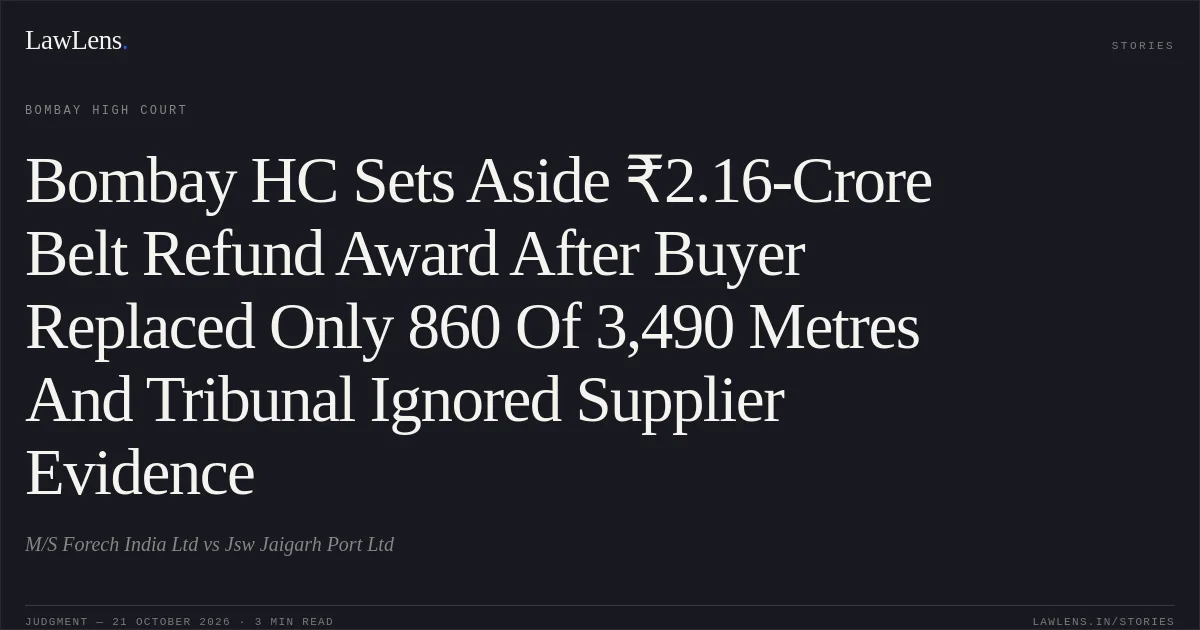
Source reference: paras. 14–17, pp. 5–6The Claimant sought, among other relief, a refund of the purchase price; the Tribunal awarded Rs. 2,16,44,423 with interest, after accounting for the encashed bank guarantees, and rejected Forech’s counter-claim.
Source reference: paras. 14–17, pp. 5–6; paras. 2–3, p. 2Forech challenged the award under Section 34 of the Arbitration and Conciliation Act, 1996.
Source reference: para. 2, p. 2Issues
Whether the Tribunal’s finding that the supplied belts were defective was reached after considering both parties’ evidence, or by disregarding Forech’s evidence.
Source reference: para. 40(1), p. 22Whether the Tribunal exceeded the contract’s warranty terms by awarding the price of the entire belting system, and whether the award thereby contravened the Sale of Goods Act, 1930 or Section 73 of the Indian Contract Act, 1872.
Source reference: para. 40(2), p. 22Whether the Tribunal treated the parties unequally in assessing their witnesses’ evidence, contrary to Section 18 of the Arbitration and Conciliation Act, 1996.
Source reference: para. 40(3), p. 22Whether the award suffered from patent illegality warranting interference under Section 34.
Source reference: para. 40(4), p. 22Law Applied
Under Section 34, a court does not sit in appeal over an arbitral award or reappreciate evidence; interference is available on the statutory grounds, including patent illegality appearing on the face of a domestic award under Section 34(2A).
Source reference: paras. 41–42, pp. 23–30Patent illegality must go to the root of the matter; it may arise where the Tribunal ignores vital evidence, contravenes substantive law or the Arbitration Act, or departs from the contract, but a reasonable contractual interpretation or a merely erroneous application of law is not enough (Associate Builders v. DDA; Ssangyong Engineering and Construction Co. Ltd. v. NHAI; MMTC Ltd. v. Vedanta Ltd.).
Source reference: paras. 41–42, pp. 23–30Section 18 requires equal treatment of the parties.
Source reference: para. 40(3), p. 22Under Sections 12 and 13 of the Sale of Goods Act, 1930, acceptance of goods may preclude rejection for breach of condition, leaving a claim for breach of warranty; Section 59 provides remedies for breach of warranty.
Source reference: paras. 63–65, pp. 42–46Section 73 of the Indian Contract Act, 1872 limits compensation to loss caused by the breach.
Source reference: paras. 63–65, pp. 42–46The contract’s warranty provided for free repair or replacement of defective or unserviceable parts.
Source reference: para. 65, p. 46Reasoning
The Court found that the Tribunal rejected Forech’s evidence concerning conveyor speed and operating parameters because its witnesses were in-house witnesses and not experts, while relying on evidence from the Claimant’s similarly situated in-house witnesses.
Source reference: paras. 52, 58–60, pp. 38–41The Tribunal’s failure to engage with Forech’s relevant evidence amounted to one-sided assessment and contravened the requirement of equal treatment.
Source reference: paras. 52, 58–60, pp. 38–41The Court also noted that only 860 metres of the 3,490 metres supplied were shown to have been replaced; there was no evidence that the remaining 2,630 metres, or the entire supply, had been replaced.
Source reference: paras. 59, 62, pp. 41–42As the Claimant had accepted and continued to use the belts, with replacement of defective portions, the case was one of breach of warranty.
Source reference: paras. 63, 65–67, pp. 42–47The award of the entire purchase price was inconsistent with the warranty’s provision for repair or replacement of defective parts and was unsupported by proof that the entire belting had been replaced.
Source reference: paras. 63, 65–67, pp. 42–47The Court held that these defects went to the root of the award and constituted patent illegality.
Source reference: para. 69, p. 48Holding
The Court allowed the Section 34 challenge and set aside the award, including the award on the counter-claim.
The petition was disposed of, with the parties left to pursue remedies available in law; if a further arbitration is sought, the evidence from the existing proceedings may be used along with such additional evidence as the Tribunal permits.
Source reference: paras. 70–71, p. 49Acts & Sections Cited
13 provisions across 3 statutes referred to in this judgment. Each provision opens on LawLens.
Arbitration and Conciliation Act, 1996
Sale of Goods Act, 19303
Indian Contract Act, 18721
Original Court PDF
M/S Forech India LtdvsJsw Jaigarh Port Ltd
Click to open original judgment
Original judgment, available to read, download and summarize on LawLens.in