Facts
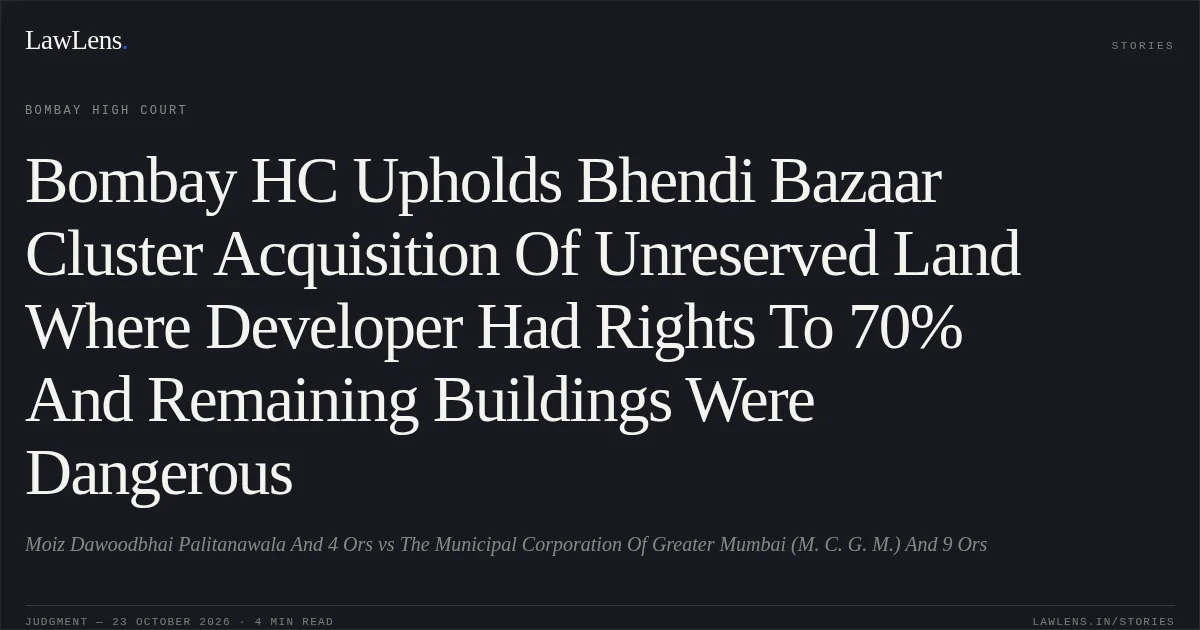
The petitions challenged the acquisition of properties in Bhendi Bazaar, Mumbai, for a Cluster Development Scheme (CDS) implemented by the Saifee Burhani Upliftment Trust. The petitioners disputed Regulation 33(9)(3)(5) of the Development Control and Promotion Regulations 2034 (DCPR), the acquisition notification dated 27 September 2019, the award dated 30 December 2019, and the taking of possession.
Source reference: para. 1–3, 19–27The Trust’s scheme had been considered by the High Power Committee (HPC) over several years; the acquisition followed after the Trust obtained development rights over the required proportion of the cluster and the remaining owners did not consent.
Source reference: para. 4–16, 91–95The properties were acquired, possession was taken, and the Lucky Building was later demolished. The petitioners had also sought enhancement of compensation under Section 64 of the Right to Fair Compensation and Transparency in Land Acquisition, Rehabilitation and Resettlement Act, 2013 (Act of 2013).
Source reference: para. 16–18, 107–109The second petition additionally alleged that the property was waqf property and that the Waqf Board had not been heard.
Source reference: para. 17, 27Issues
1. Whether Regulation 33(9)(3)(5) of the DCPR was ultra vires the MRTP Act, including because it permitted acquisition of land not separately reserved or designated for public purpose and allegedly involved excessive delegation.
Source reference: para. 19–21, 47–572. Whether the Regulation and the acquisition violated the petitioners’ rights under Article 300A of the Constitution or were invalid for want of public purpose.
Source reference: para. 73–82, 863. Whether the acquisition was vitiated by non-compliance with the Regulation or by procedural defects, including inadequate notice, denial of natural justice, unlawful sub-delegation, and failure to establish that the buildings were dangerous.
Source reference: para. 22–25, 87–1084. Whether the acquisition award was void under Section 91 of the Waqf Act, 1995, for want of notice to the Waqf Board.
Source reference: para. 27, 111–113Law Applied
The Court applied Sections 22(m), 125 and 126 of the MRTP Act, holding that Development Control Regulations form part of the development plan and that land required for a public purpose under those Regulations may be acquired under Section 126; the statutory concept of acquisition is not confined to land separately reserved or designated on the plan.
Source reference: para. 45–60Section 159 of the MRTP Act empowers the making of regulations consistent with the Act, while the statutory procedures for preparing or modifying the plan and regulations provide for public participation.
Source reference: para. 61, 65–72The Court also applied Article 300A, under which deprivation of property must be by authority of law, and held that statutory regulations and acquisition under the MRTP Act and the Act of 2013 met that requirement.
Source reference: para. 86It relied on the principles that public purpose is broad and may include schemes benefiting the community, and that delegated legislation is not excessive where it is guided by the parent statute and contains sufficient safeguards.
Source reference: para. 74–80On procedural fairness, the Court applied the prejudice-based approach to natural justice stated in State of Uttar Pradesh v. Sudhir Kumar Singh (2021) 19 SCC 706.
Source reference: para. 99–101It also considered the definition of “Collector” in Section 3(g) of the Act of 2013 and Rule 2(g) of the Maharashtra Rules, which include designated and specified officers, and Section 91(4) of the Waqf Act, which provides a procedure for seeking to have an order declared void where the Board was not given an opportunity.
Source reference: para. 103–106, 112Reasoning
The Court rejected the petitioners’ argument that acquisition required a separate reservation or designation, reasoning that the DCPR formed part of the development plan and that the land was required for the public purpose of urban renewal through cluster redevelopment.
Source reference: para. 53–60, 73–82It found that Regulation 33(9)(3)(5) contained safeguards—including minimum cluster-area requirements, the requirement that the promoter hold development rights over at least 70% of the land, the presence of dangerous buildings on the balance land, and HPC scrutiny—and therefore was neither ultra vires nor an instance of excessive delegation.
Source reference: para. 78–80The Court found that the scheme had been considered over time, that the petitioners had notice of it, and that the buildings’ age, cessed status and warning notices supported the finding that the dangerous-building requirement was met.
Source reference: para. 83–95It held that the petitioners showed no material prejudice from the alleged notice or hearing defects, and that the Deputy Collector was competent under the applicable statutory definition and rules.
Source reference: para. 96–106Complaints about the compensation amount were left to the Section 64 reference proceeding.
Source reference: para. 107As to the waqf claim, the Court noted that the Board had not applied under Section 91(4) within the prescribed period and had stated that it had no objection to the acquisition.
Source reference: para. 111–113Holding
The Court held that Regulation 33(9)(3)(5) was not ultra vires the MRTP Act or unconstitutional, that the acquisition was for public purpose and supported by authority of law, and that the petitioners had not established procedural grounds warranting relief.
It rejected the Waqf Act challenge and dismissed both writ petitions, while leaving the petitioners free to pursue their pending claim for enhanced compensation under Section 64 of the Act of 2013.
Source reference: para. 107, 110–113, 117–118Acts & Sections Cited
42 provisions across 3 statutes referred to in this judgment. Each provision opens on LawLens.
Maharashtra Regional and Town Planning Act, 1966.
Right to Fair Compensation and Transparency in Land Acquisition, Rehabilitation and Resettlement Act, 2013
Maharashtra Housing and Area Development Act, 1976.2
Original Court PDF
Moiz Dawoodbhai Palitanawala And 4 OrsvsThe Municipal Corporation Of Greater Mumbai (M. C. G. M.) And 9 Ors
Click to open original judgment
Original judgment, available to read, download and summarize on LawLens.in