Facts
The petitioner had obtained a Letter of Intent from the Slum Rehabilitation Authority (“SRA”) for redevelopment of the subject property.
Source reference: para. 2Under a Development Agreement dated 31 December 2014, respondent No.1 was appointed co-developer and assumed responsibility for financing and executing the redevelopment project, including construction of the rehabilitation buildings, payment of transit rent, statutory dues, obtaining permissions and Occupation Certificates, and compliance with SRA requirements.
Source reference: para. 2These obligations were reaffirmed through supplementary agreements dated 21 April 2016, 11 June 2021 and 14 June 2021.
Source reference: paras. 2–3Since Rehabilitation Building No.4 remained incomplete, the parties executed a Memorandum of Understanding (“MoU”) dated 11 September 2023.
Source reference: para. 4The MoU earmarked approximately 6,560 sq. ft. of respondent No.1’s free-sale premises as security for completing the rehabilitation building, paying transit rent and discharging connected liabilities.
Source reference: para. 4In the event of default, the security was to be released in favour of the petitioner for sale and utilisation of the proceeds towards completion of the project.
Source reference: para. 4On 17 September 2025, the SRA terminated the petitioner’s appointment as developer under Section 13(2) of the Slum Act, principally citing non-payment of transit rent.
Source reference: para. 5The petitioner challenged that order before the Apex Grievance Redressal Committee, which stayed its operation and directed deposit of Rs.50 lakhs towards transit rent and completion of the project by 1 September 2026.
Source reference: para. 5The petitioner invoked arbitration on 13 June 2026 and filed the present petition under Section 9 of the Arbitration and Conciliation Act, 1996, seeking protection of the security, appointment of a Court Receiver, authority to complete Rehabilitation Building No.4, and related monetary and protective reliefs.
Source reference: para. 6An ad interim order initially restrained the respondents from creating third-party rights in the unsold flats.
Source reference: para. 6Issues
Whether Clause 16 of the MoU superseded or replaced the arbitration clause contained in Clause 31 of the Development Agreement?
Source reference: paras. 23–33Whether the restriction in Clause 31, limiting the Arbitrator’s power to terminate the agreement or stop development work, also restricted the High Court’s jurisdiction under Section 9 of the Arbitration and Conciliation Act?
Source reference: paras. 34–46Whether the contractual documents prima facie imposed upon respondent No.1 the obligations to complete Rehabilitation Building No.4, pay transit rent, discharge statutory liabilities and obtain the requisite Occupation Certificate?
Source reference: paras. 47–54Whether the petitioner had established, prima facie, non-performance or breach of those obligations by respondent No.1?
Source reference: paras. 55–61Whether the petitioner had established a prima facie case and real apprehension requiring protection of the security created under the MoU?
Source reference: paras. 62–68Whether the petitioner was entitled to invoke substituted performance under Section 20 of the Specific Relief Act, 1963?
Source reference: paras. 69–86Whether, notwithstanding non-compliance with Section 20, the Court could appoint a Receiver and appoint the petitioner as the Receiver’s Agent for the limited purpose of completing the rehabilitation component?
Source reference: paras. 87–97Law Applied
The Court applied Section 9 of the Arbitration and Conciliation Act, 1996, which empowers the Court to grant interim measures for preservation of the subject matter of arbitration, protection of property, securing the amount in dispute and maintaining the efficacy of the arbitral process.
Source reference: paras. 39–40Section 9 is discretionary and cannot be used to rewrite the parties’ contract, finally determine disputed rights or grant relief inconsistent with the contractual framework.
Source reference: paras. 40–46The Court applied the principle that contractual provisions executed between the same parties should, where possible, be harmoniously construed; accordingly, the original arbitration clause and the later MoU arbitration clause were permitted to coexist.
Source reference: paras. 27–33Section 20(2) of the Specific Relief Act requires a written notice of not less than thirty days calling upon the defaulting party to perform before substituted performance can be undertaken; the requirement is mandatory because of the statutory negative language.
Source reference: paras. 72–78Under Section 20(3), once substituted performance is undertaken, the aggrieved party cannot claim specific performance.
Source reference: para. 79The Court also relied on Order XL Rule 1 of the Code of Civil Procedure, 1908, concerning appointment and powers of a Court Receiver.
Source reference: para. 98(ii)Reasoning
The Court held that the MoU did not expressly cancel or substitute Clause 31 of the Development Agreement; however, Clause 16 remained operative for disputes arising from the rights and obligations created by the MoU.
Source reference: paras. 27–33Both clauses were therefore to be read harmoniously.
Source reference: paras. 27–33Clause 31 restricted the Arbitrator, not the High Court’s statutory jurisdiction under Section 9.
Source reference: paras. 41–46Nevertheless, the Court had to mould relief so that it did not effectively terminate the Development Agreement or displace respondent No.1 contrary to the contractual arrangement.
Source reference: paras. 41–46On the contractual merits, Clause 5 of the Development Agreement and the subsequent agreements clearly placed upon respondent No.1 the responsibility for construction, payment of transit rent and statutory and project-related liabilities, including obtaining the Occupation Certificate.
Source reference: paras. 50–54The MoU’s creation of specific security for completing Rehabilitation Building No.4 demonstrated that the parties themselves recognised continuing obligations.
Source reference: paras. 56–68The SRA proceedings, outstanding liabilities, absence of the Occupation Certificate and alleged alienation of secured flats collectively established a prima facie dispute and a real apprehension that the arbitral subject matter could be defeated.
Source reference: paras. 56–68The petitioner, however, could not claim substituted performance under Section 20.
Source reference: paras. 73–83Its notice dated 13 June 2026 allowed only seven days for compliance, whereas Section 20(2) mandates a minimum thirty-day notice.
Source reference: paras. 73–83The Court rejected substantial-compliance and prior-default arguments, holding that the statutory condition had not been satisfied.
Source reference: paras. 73–83The Court nevertheless distinguished statutory substituted performance from a Court-supervised interim arrangement under Section 9.
Source reference: paras. 84–92Since the project involved rehabilitation of slum dwellers and delay would increase transit-rent and other liabilities, merely restraining alienation would not adequately preserve the arbitral subject matter.
Source reference: paras. 84–92Appointment of a Receiver, with the petitioner acting only as the Receiver’s Agent under judicial supervision, would protect the security without transferring ownership or finally deciding the parties’ rights.
Source reference: paras. 93–97Holding
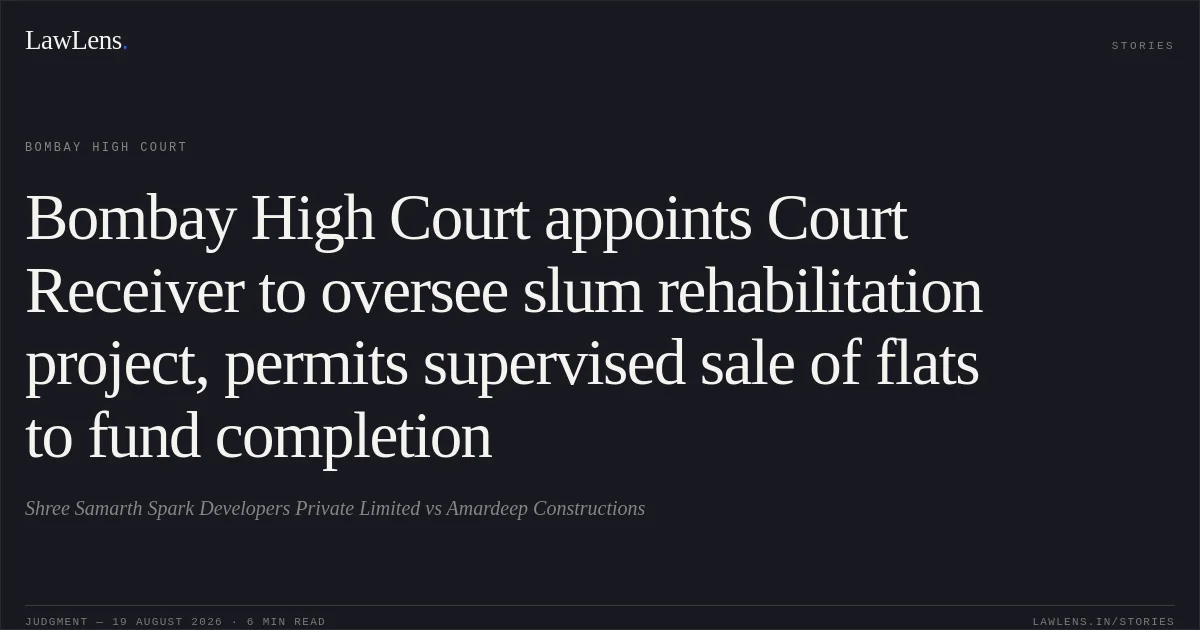
The petition was partly allowed.
The Court Receiver, High Court, Bombay, was appointed under Order XL Rule 1 CPC over the approximately 6,560 sq. ft. security area, with symbolic possession and supervisory powers.
Source reference: para. 98(ii)–(iii)The petitioner was appointed merely as the Receiver’s Agent, without any proprietary, possessory, development or equitable rights, and solely to facilitate completion of Rehabilitation Building No.4, obtain the Occupation Certificate and discharge directly connected statutory obligations.
Source reference: para. 98(iv)–(vi), (xvii)–(xviii)The Receiver could, after hearing the parties, permit sale of unsold free-sale flats to generate funds for completion of the rehabilitation building, payment of legitimate connected dues, transit rent, LUC charges and statutory charges.
Source reference: para. 98(vii)–(ix)Any sale required the Receiver’s prior written approval, and all proceeds were to be deposited in a Receiver-controlled escrow account.
Source reference: para. 98(vii)–(ix)Respondent No.1 was directed to hand over project documents and disclose details of the security area and unsold inventory.
Source reference: para. 98(xi), (xiii)Alienation or creation of third-party rights in the remaining security and unsold flats was restrained without the Receiver’s permission.
Source reference: para. 98(xii), (xiv)Immediate monetary reliefs and reimbursement claims were not granted, being disputed matters for arbitration.
Source reference: para. 98(xv)–(xvi)The petitioner could seek reimbursement of expenditure incurred pursuant to the order before the Arbitral Tribunal, but no reimbursement was assured by the Section 9 order.
Source reference: para. 98(xv)–(xvi)All findings were prima facie and non-binding on the Tribunal, and either party could seek modification or vacation of the arrangement under Section 17 after constitution of the Arbitral Tribunal.
Source reference: para. 98(xix)–(xxi)Acts & Sections Cited
3 provisions across 2 statutes referred to in this judgment. Each provision opens on LawLens.
Arbitration and Conciliation Act, 19962
Specific Relief Act, 19631
Original Court PDF
Shree Samarth Spark Developers Private LimitedvsAmardeep Constructions
Click to open original judgment
Original judgment, available to read, download and summarize on LawLens.in