Facts
The applicants sought execution of an arbitral award against Judgment Debtors Nos. 1–3, requiring payment of principal sums, interest and compensation.
Source reference: no citationThe debtors’ application for an unconditional stay of execution was rejected; although they were permitted to secure the award, they did not deposit the required amount or furnish security, and the Supreme Court upheld the relevant order subject to a modification concerning security for interest.
Source reference: pp. 4–6The decree holders then sought a show-cause notice under Order XXI Rule 37 CPC, alleging that the debtors had means to pay but had not paid, and had continued advancing funds to group entities after the award.
Source reference: pp. 6–11, 28–31The debtors disputed that they had realizable means or had acted dishonestly, and argued that the statutory conditions for arrest had not been established.
Source reference: pp. 12–19Issues
1. Whether the Court could issue a show-cause notice under Order XXI Rule 37 CPC without first finally determining that the Judgment Debtors should be arrested or detained.
Source reference: pp. 11–13, 51–53; para. 7.392. Whether the material on record made out a sufficient basis to issue such notice, particularly in light of the requirements in the proviso to Section 51 CPC concerning means to pay and refusal or neglect to pay.
Source reference: pp. 32–34, 50–53; paras. 7.9–7.14, 7.41–8Law Applied
Section 51 CPC permits execution of a money decree by arrest and detention, but its proviso bars detention unless the Judgment Debtor has had an opportunity to show cause and the Court records reasons for its satisfaction that a statutory ground is established, including that the debtor has had means to pay the decree or “some substantial part thereof” and has refused or neglected to pay.
Source reference: p. 32; para. 7.9Order XXI Rule 37 prescribes the show-cause procedure before arrest in the ordinary course; the notice is distinct from an order of arrest or detention.
Source reference: pp. 36–37, 51–53; paras. 7.19–7.20, 7.41Order XXI Rule 30 permits execution of a money decree by detention, attachment and sale, or both, while the Court retains discretion over simultaneous execution.
Source reference: pp. 35–37; paras. 7.16–7.17The Court relied on Jolly George Varghese v. Bank of Cochin, (1980) 2 SCC 360, for the principle that inability to pay alone does not justify detention, and Subrata Roy Sahara v. Union of India, (2014) 8 SCC 470, for the distinction between inability to pay and wilful non-payment despite means.
Source reference: pp. 43–45; paras. 7.29–7.32It also relied on Shyam Singh v. Collector, District Hamirpur, 1993 Supp (1) SCC 693, concerning the permissibility of concurrent execution, subject to judicial discretion.
Source reference: pp. 38–40; paras. 7.23–7.24Reasoning
The Court treated the application as seeking only a show-cause notice, not an immediate warrant of arrest or detention; the debtors would have an opportunity to respond before any later determination of detention.
Source reference: pp. 51–53; para. 7.41In considering whether notice was warranted, it relied on the debtors’ disclosed assets, their lending to group companies after the award, and the absence of an adequate explanation for why certain amounts received by group entities were not returned or applied towards the award.
Source reference: pp. 28–31; paras. 7.2–7.8It also considered that no payment had been made despite the conditional stay order and the subsequent proceedings.
Source reference: pp. 4–6, 26–28Applying Section 51(b), the Court construed “some substantial part thereof” to include an amount that might be small in relation to the total decree, and found that the debtors had not paid even such an amount.
Source reference: pp. 50–53; para. 7.41It therefore concluded that the record justified calling on the debtors to show cause, while leaving the ultimate question of detention open.
Source reference: no citationHolding
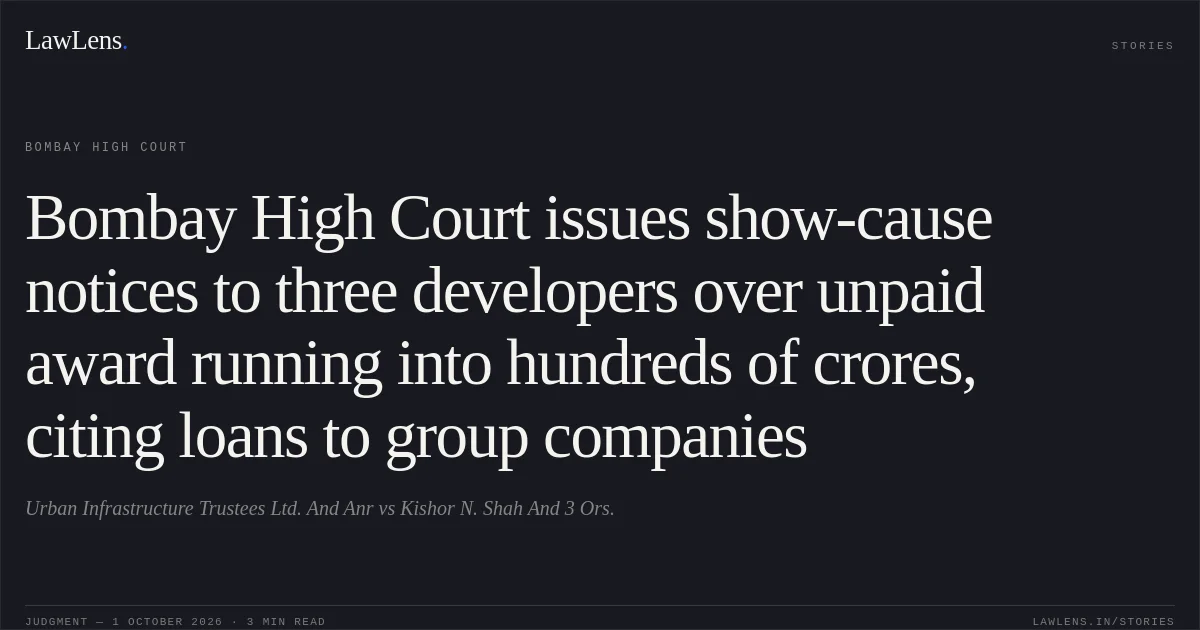
The Court held that a case had been made out to issue a show-cause notice under Order XXI Rule 37 CPC, finding prima facie that the Judgment Debtors had means to pay at least some part of the award but had refused or neglected to do so.
It directed that notice issue to Judgment Debtors Nos. 1–3, returnable on 27 October 2026, as to why they should not be committed to civil prison; it did not order their arrest or detention at this stage.
Source reference: pp. 52–53; para. 9On the debtors’ request, execution of the judgment was stayed for four weeks.
Source reference: p. 54; para. 12Acts & Sections Cited
10 provisions across 2 statutes referred to in this judgment. Each provision opens on LawLens.
Code of Civil Procedure, 19086
Arbitration and Conciliation Act, 19964
Original Court PDF
Urban Infrastructure Trustees Ltd. And AnrvsKishor N. Shah And 3 Ors.
Click to open original judgment
Original judgment, available to read, download and summarize on LawLens.in