Facts
The Applicant promoter sought appointment of a sole arbitrator under Section 11 of the Arbitration and Conciliation Act, 1996, relying on an arbitration clause in an Agreement for Sale dated 31 December 2020 for Flat No. 1901.
Source reference: para. 1–4The claims included balance sale consideration, an amount for additional area, and compensation. The allottee-Respondents had earlier obtained relief before MahaRERA under Section 18 of the Real Estate (Regulation and Development) Act, 2016 (“RERA”); the Applicant’s review was rejected, and it appealed to MahaREAT.
Source reference: para. 3–4The Respondents objected, among other things, that promoter-allottee disputes governed by RERA were non-arbitrable and that the Applicant’s participation in the RERA proceedings barred a later arbitration application.
Source reference: para. 19–28Issues
1. Whether a dispute between an individual promoter and allottee under an Agreement for Sale governed by RERA is non-arbitrable as a class, or whether arbitrability depends on the subject matter, relief sought, and statutory powers of RERA authorities.
Source reference: para. 61–642. Whether the Applicant’s earlier RERA proceedings, including its failure to seek reference under Section 8 of the Arbitration Act, barred its Section 11 application on grounds of parallel proceedings, election, or issue estoppel.
Source reference: para. 47–563. Whether the limitation of the Applicant’s individual claims could be decided at the Section 11 stage.
Source reference: para. 57–59Law Applied
Under Sections 11 and 16 of the Arbitration Act, the referral court’s scrutiny is limited, but it may consider a prima facie objection that a dispute is non-arbitrable; it should not conduct a detailed inquiry into the merits or limitation of individual claims.
Source reference: para. 31–32Under SBI General Insurance Co. Ltd. v. Krish Spinning, the Section 11 court’s limitation inquiry is confined to whether the Section 11 application itself was filed within time, leaving limitation of the underlying claims to the tribunal.
Source reference: para. 58The Court considered the competing Bombay High Court decisions in Rashmi Realty Builders Pvt. Ltd. v. Rahul Pagariya and Abhay Damodar Kanhere v. Morya Infraconstruct Pvt. Ltd., as well as Laxman Mura Vaid v. Shree Siddhivinayak, on the arbitrability of RERA-governed promoter-allottee disputes.
Source reference: para. 34–41, 61–64It also considered Sections 79, 88 and 89 of RERA, the anti-bifurcation principle in Sukanya Holdings (P) Ltd. v. Jayesh H. Pandya, and the principles concerning prior proceedings and overlapping reliefs in Anil v. Rajendra, SSIPL Lifestyle Pvt. Ltd. v. Vama Apparels (India) Pvt. Ltd., and Neo Developers Private Limited v. Rahul Bhargava.
Source reference: para. 48–56Reasoning
The Court found that an arbitration agreement existed and that the Applicant’s claims were genuine disputes, but held that the existence of the clause did not end the Section 11 inquiry where a prima facie non-arbitrability objection was raised.
Source reference: para. 30–33, 60The balance consideration and additional-area claims arose from the promoter-allottee transaction and could not be taken outside RERA merely by describing them as contractual or monetary claims.
Source reference: para. 43–45However, the Applicant’s claims had not been shown to have been decided by MahaREAT, and the record did not establish a prior decision rejecting arbitration or a blanket bar under Section 8, issue estoppel, or election; substantially overlapping reliefs could not, however, be pursued through parallel proceedings.
Source reference: para. 42, 47–56The Court left the limitation of the individual claims open, applying Krish Spinning.
Source reference: para. 57–59Because Rashmi Realty and Laxman Mura Vaid supported class-wide non-arbitrability while Abhay Kanhere took a materially different approach to the issue, the Court considered authoritative clarification necessary rather than finally deciding arbitrability itself.
Source reference: para. 61–65Holding
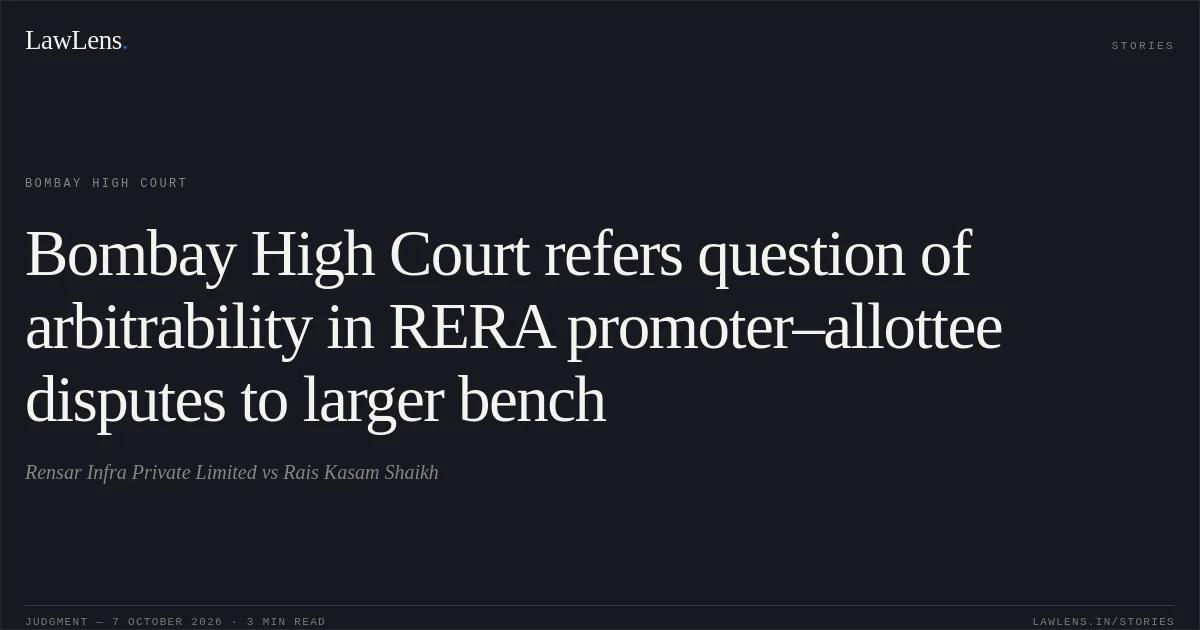
The Court did not finally hold that the Applicant’s claims were arbitrable or non-arbitrable.
It referred the question of whether RERA-governed disputes between an individual promoter and allottee are non-arbitrable as a class—or must be assessed by the nature of the dispute and relief—to an appropriate larger Bench, together with the related question concerning paragraph 63(i) of Rashmi Realty.
Source reference: para. 64–66The Section 11 proceedings were deferred pending the larger Bench’s decision.
Source reference: para. 67Acts & Sections Cited
19 provisions across 3 statutes referred to in this judgment. Each provision opens on LawLens.
Arbitration and Conciliation Act, 19965
Real Estate (Regulation and Development) Act, 2016.
Limitation Act, 19631
Original Court PDF
Rensar Infra Private LimitedvsRais Kasam Shaikh
Click to open original judgment
Original judgment, available to read, download and summarize on LawLens.in