Facts
The appellant challenged the order dated 3 February 2025 by which the learned Single Judge allowed the respondents’ application under Order VII Rule 10 of the Code of Civil Procedure, 1908 (“CPC”), and returned the plaint for want of territorial jurisdiction, with liberty to present it before the competent court.
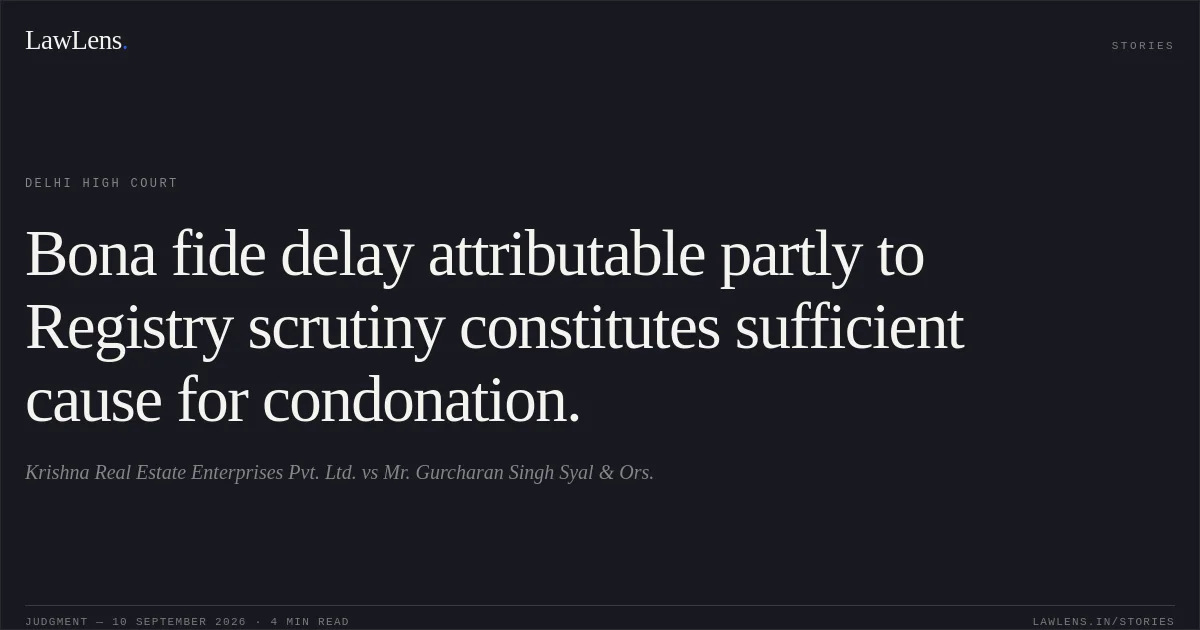
Source reference: para. 2; p. 11The appeal was filed on 8 March 2025, four days beyond the prescribed limitation period under Article 117 of the Limitation Act, 1963; the appellant therefore sought condonation of the four-day delay.
Source reference: para. 2After filing, the Registry raised several objections, including defects relating to court fees, indexing, translation of vernacular documents, classification of the appeal, legibility of annexures, and service upon the caveator.
Source reference: para. 3The appeal was ultimately accepted by the Registry on 23 September 2025, resulting in a claimed delay of 163 days in re-filing.
Source reference: paras. 3, 12–15Issues
Whether the appellant had shown sufficient cause under Section 5 of the Limitation Act, 1963, for condonation of the four-day delay in filing the appeal?
Source reference: paras. 7–10Whether the appellant had shown sufficient cause for condonation of the 163-day delay in re-filing the appeal, particularly in view of the Registry’s objections, change of counsel, and repeated scrutiny?
Source reference: paras. 7, 12–16Whether the appeal should be admitted and proceeded with after condonation of the filing and re-filing delays?
Source reference: paras. 16–22Law Applied
The Court applied Section 5 of the Limitation Act, 1963, under which an appeal may be admitted after the prescribed period if the appellant establishes “sufficient cause” for the delay.
Source reference: para. 8It relied on Collector, Land Acquisition, Anantnag v. Mst. Katiji & Ors., (1987) 2 SCC 107, which requires a liberal, pragmatic, and justice-oriented approach to delay, while rejecting a pedantic insistence that every day’s delay be explained with mathematical precision.
Source reference: para. 9; pp. 4–6The Court also relied on Pragati Construction Consultants v. Union of India & Anr., 2025 SCC OnLine Del 636, for the principle that curable procedural defects ordinarily should not defeat substantive rights; a filing should be treated as non-est only where the defects, considered cumulatively, demonstrate mala fide intent and absence of a genuine intention to prosecute the matter.
Source reference: para. 11; pp. 6–7The Court further referred to Article 117 of the Limitation Act, which prescribes a 30-day limitation period for an intra-court appeal from a judgment or order of a Single Judge of the High Court, and Delhi High Court Rules, Volume V, Chapter I, Part A, Rule 5, which permits reasonable time for removal of Registry defects and re-filing.
Source reference: paras. 2, 14Reasoning
The Court held that the four-day delay in filing was satisfactorily explained by the time required to compile and organise the voluminous record of the underlying suit.
Source reference: para. 10Given the short duration of the delay and the absence of any indication of mala fides, a liberal and pragmatic approach was warranted.
Source reference: para. 10As to the 163-day re-filing delay, the Court found that the delay was not attributable entirely to the appellant.
Source reference: para. 12The appeal underwent six rounds of scrutiny, and the Registry raised certain objections piecemeal, including translation, caveat-service, and indexing defects that could have been identified earlier.
Source reference: paras. 12–15The change of counsel, undertaken after the previous counsel failed to address the objections within a reasonable time, supported the appellant’s bona fides rather than indicating an intention to delay the proceedings.
Source reference: para. 12The Court also found that 48 days of the delay were attributable to the Registry’s handling of the scrutiny process, including the delayed reporting of objections.
Source reference: para. 15Although the appellant could have acted more promptly at certain stages, the Court concluded that the delay resulted from circumstances partly beyond its control and that denying the appeal on such procedural grounds would unjustly defeat the appellant’s right to appellate consideration.
Source reference: paras. 15–16Holding
The Court held that the appellant had established sufficient cause for both the four-day delay in filing and the 163-day delay in re-filing the appeal.
Applications CM APPL. 61130/2025 and CM APPL. 61131/2025 were accordingly allowed, and both delays were condoned.
Source reference: para. 17The appeal under Section 10 of the Delhi High Court Act, 1966, read with Order XLIII Rule 1 and Section 151 CPC, was admitted; the digital record of the Single Judge was requisitioned, and the matter was directed to be listed on 30 November 2026.
Source reference: paras. 19–22The Court expressly clarified that it had not examined the merits of the challenge to the return of the plaint for want of territorial jurisdiction at this stage.
Source reference: para. 7Acts & Sections Cited
5 provisions across 4 statutes referred to in this judgment. Each provision opens on LawLens.
Limitation Act, 19632
Arbitration and Conciliation Act, 19961
Code of Civil Procedure, 19081
Delhi High Court Act, 19661
Original Court PDF
Krishna Real Estate Enterprises Pvt. Ltd.vsMr. Gurcharan Singh Syal & Ors.
Click to open original judgment
Original judgment, available to read, download and summarize on LawLens.in