Facts
Respondent No. 2, an employee of Vinay Gupta, alleged that society members and staff obstructed him and three plumbers from entering the Om Shiv Darshan Co-operative Housing Society to install a water connection on 15 January and 5 March 2022.
Source reference: paras. 1, 4.1–4.4, 5.1–5.7; pp. 3–6The FIR, registered on 7 March 2022, invoked Sections 341 and 149 of the Indian Penal Code (IPC); a chargesheet was subsequently filed.
Source reference: paras. 1, 4.1–4.4, 5.1–5.7; pp. 3–6The petitioners sought quashing under Article 226 of the Constitution and Section 482 of the Code of Criminal Procedure (CrPC), contending that the obstruction arose from security protocols and a pre-existing dispute between the society and Gupta.
Source reference: paras. 1, 4.1–4.4, 5.1–5.7; pp. 3–6The Court had stayed further proceedings and heard the petition finally.
Source reference: para. 2; p. 3Issues
1. Whether the FIR and accompanying material, taken at face value, disclosed the offence of wrongful restraint under Section 341 IPC.
Source reference: paras. 13–18; pp. 10–132. Whether the High Court should exercise its powers under Article 226 and Section 482 CrPC to quash the FIR and resulting prosecution as an abuse of process.
Source reference: paras. 18–20; pp. 13–15Law Applied
Section 339 IPC defines wrongful restraint as voluntarily obstructing a person so as to prevent that person from proceeding in a direction in which they have a right to proceed; its exception excludes an obstruction of a private way over land or water where the obstructing person, in good faith, believes they have a lawful right to obstruct it.
Source reference: para. 13; pp. 10–11Section 341 IPC prescribes punishment for wrongful restraint, while Section 149 IPC concerns liability for acts committed by members of an unlawful assembly.
Source reference: paras. 1, 12; pp. 3, 9Article 226 of the Constitution and Section 482 CrPC empower the High Court to prevent abuse of process and secure the ends of justice.
Source reference: paras. 18–20; pp. 13–15Applying State of Haryana v. Bhajan Lal, 1992 Supp (1) SCC 335, the Court noted that quashing may be appropriate where the allegations, accepted in their entirety, do not prima facie constitute an offence, are inherently improbable, or the proceeding is manifestly attended by mala fides.
Source reference: paras. 18–20; pp. 13–15Reasoning
The Court considered that the society had complained to the police on the day of the first alleged incident, describing the entrants as unknown persons who had not complied with the society’s security procedures; the FIR was registered later and also alleged a second incident.
Source reference: paras. 10, 15(iii), (vi); pp. 8, 12The Court found that the society had not been notified of the proposed work, that permission had not been obtained from it, and that the municipal permission required Gupta to contact the relevant junior engineer.
Source reference: paras. 11, 13, 16; pp. 9–10, 12–13In the context of the parties’ wider disputes, the Court considered the petitioners’ actions to be bona fide performance of their security and society-related duties.
Source reference: paras. 14–17; pp. 11–13It concluded that the allegations did not establish that Respondent No. 2 had been prevented from proceeding in a direction in which he had a right to proceed, and that the prosecution appeared to convert a security-compliance dispute into a criminal case.
Source reference: paras. 14–17; pp. 11–13It therefore applied the Bhajan Lal categories concerning absence of a prima facie offence and proceedings allegedly attended by mala fides.
Source reference: para. 20; p. 15Holding
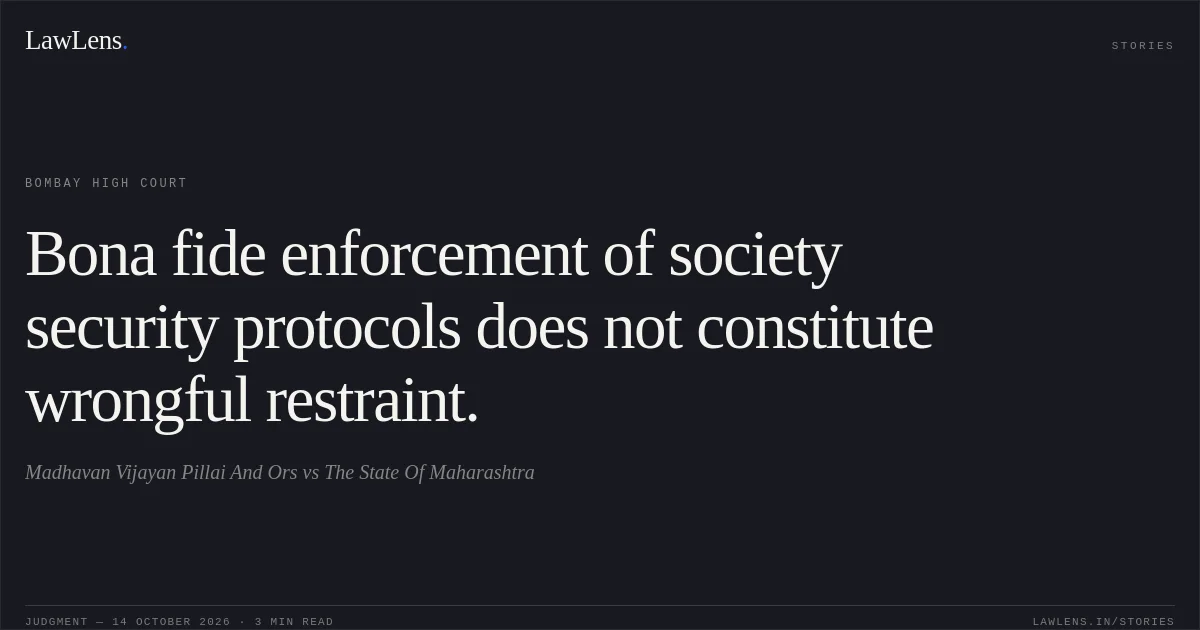
The Court held that, even if the FIR’s allegations were accepted in their entirety, they did not make out an offence under Section 341 IPC and that continuation of the prosecution would amount to abuse of process.
It allowed the petition under prayer clauses (a) and (aa), quashed the challenged FIR and resulting prosecution, and made the Rule absolute.
Source reference: paras. 18, 21; pp. 13, 16Acts & Sections Cited
6 provisions across 2 statutes referred to in this judgment. Each provision opens on LawLens.
Code of Criminal Procedure, 19733
Indian Penal Code, 18603
Original Court PDF
Madhavan Vijayan Pillai And OrsvsThe State Of Maharashtra
Click to open original judgment
Original judgment, available to read, download and summarize on LawLens.in