Facts
The respondents-landlords instituted an eviction petition under the H.P. Urban Rent Control Act, 1987 against the petitioner-tenant in respect of Shop No. 79/1, Ground Floor, Lower Bazar, Shimla, seeking eviction on the grounds of arrears of rent from 1 January 2012 and bona fide requirement of the landlords and their son for personal use, including installation of an X-ray machine.
Source reference: paras. 3–5The Rent Controller allowed the petition, holding the tenant liable for arrears of ₹17,320, while granting protection from eviction on that ground if the arrears with interest were deposited within the prescribed period; eviction was also ordered on the ground of bona fide requirement.
Source reference: para. 6The Appellate Authority-II, Shimla dismissed the tenant’s appeal and affirmed the eviction order on 13 October 2023.
Source reference: para. 7During the proceedings, both original landlords died. The tenant therefore contended in revision that the subsequent deaths extinguished the bona fide requirement and rendered the eviction order unenforceable.
Source reference: para. 8The revision was filed under Section 24(5) of the H.P. Urban Rent Control Act, 1987.
Source reference: para. 1Issues
Whether, in exercise of revisional jurisdiction under Section 24(5) of the H.P. Urban Rent Control Act, 1987, the High Court could reappreciate the factual findings regarding the landlords’ bona fide requirement?
Source reference: paras. 12–13Whether the subsequent death of both landlords during the pendency of the proceedings extinguished the bona fide requirement and invalidated or rendered unenforceable the eviction order?
Source reference: paras. 14–18Whether the bona fide requirement had to be assessed as on the date of filing of the eviction petition or as on the date of final adjudication/enforcement?
Source reference: paras. 15–18Law Applied
The Court applied Section 24(5) of the H.P. Urban Rent Control Act, 1987, under which revisional jurisdiction is limited and cannot be used as an appeal for reappreciation of evidence.
Source reference: para. 1Relying on Hindustan Petroleum Corporation Ltd. v. Dilbahar Singh, (2014) 9 SCC 78, the Court held that revision is not a rehearing on facts; interference is justified only where findings are perverse, unsupported by evidence, based on misreading of material evidence, or suffer from illegality, procedural irregularity, or gross error resulting in miscarriage of justice.
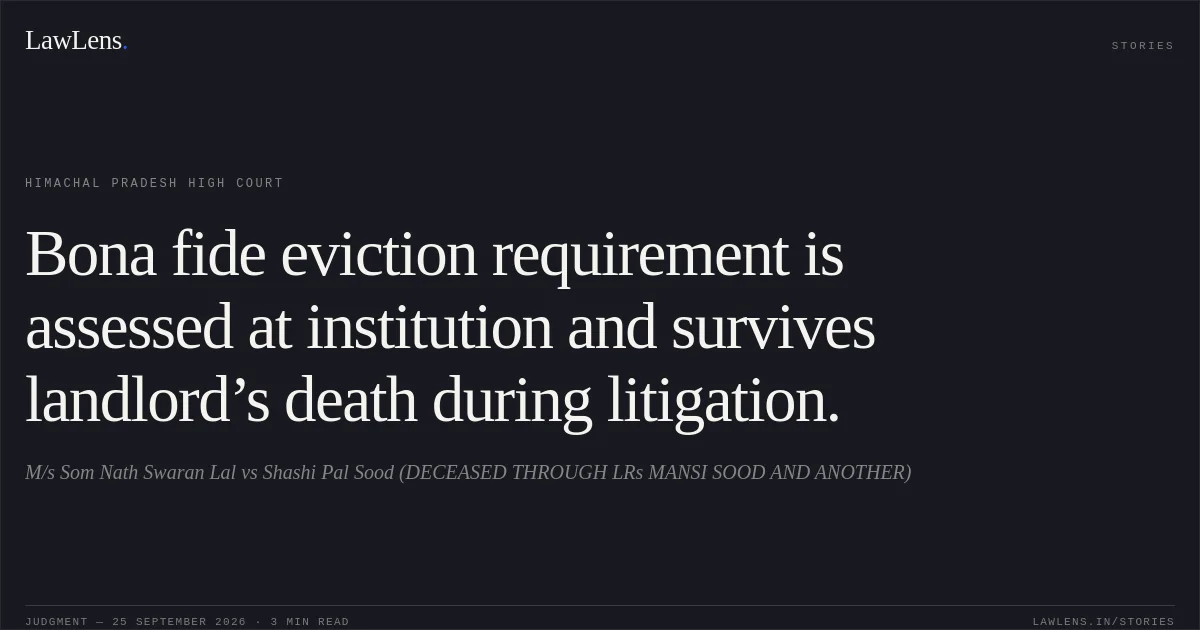
Source reference: paras. 12–13On the issue of bona fide requirement, the Court relied on Gaya Prasad v. Pradeep Srivastava, (2001) 2 SCC 604, G.C. Kapoor v. Nand Kumar Bhasin, (2002) 1 SCC 610, and D. Sasi Kumar v. Soundararajan, (2019) 9 SCC 282, for the rule that bona fide requirement is ordinarily examined as on the date of institution of the eviction proceedings; the subsequent death of the landlord during litigation does not, by itself, extinguish the requirement or defeat the eviction order.
Source reference: paras. 15–16The Court also treated the earlier decision of a coordinate Bench in the same litigation as binding between the parties, particularly on the effect of the death of one landlord and the relevance of subsequent events.
Source reference: paras. 17–18Reasoning
The High Court found that the Rent Controller had recorded findings, supported by material on record, that the demised premises were genuinely required for the landlords’ son and for installing an X-ray machine for visiting patients.
Source reference: para. 15Since the tenant did not challenge those factual findings on their merits, the Court held that no revisional interference was permissible under the restricted principles stated in Hindustan Petroleum.
Source reference: paras. 12–15The subsequent deaths of the landlords did not alter the legal position because the relevant date for determining bona fide requirement was the date on which the eviction petition was instituted.
Source reference: paras. 15–16Applying Gaya Prasad, G.C. Kapoor, and D. Sasi Kumar, the Court held that the death of a landlord during the pendency of an appeal or revision does not automatically nullify an otherwise valid eviction order; the legal representatives are entitled to defend and enforce the decree.
Source reference: paras. 15–16The Court further noted that the tenant’s similar objection had already been rejected by a coordinate Bench and had attained finality.
Source reference: paras. 17–18Holding
The Court held that the bona fide requirement had to be determined with reference to the date of filing of the eviction petition and that the subsequent deaths of both landlords did not extinguish that requirement or invalidate the eviction order.
Finding no perversity, illegality, or procedural irregularity in the concurrent findings of the Rent Controller and the Appellate Authority, the High Court dismissed the revision petition and affirmed the eviction order.
Source reference: para. 19No order as to costs was made; pending applications, if any, were disposed of.
Source reference: para. 19Acts & Sections Cited
1 provisions across 1 statute referred to in this judgment. Each provision opens on LawLens.
Code of Civil Procedure, 19081
Original Court PDF
M/s Som Nath Swaran LalvsShashi Pal Sood (DECEASED THROUGH LRs MANSI SOOD AND ANOTHER)
Click to open original judgment
Original judgment, available to read, download and summarize on LawLens.in