Facts
On the night of 24/25 August 2009, five members of one family were travelling from Kathua to Haridwar in a Santro car carrying ashes for last rites. Near Mandi Gobindgarh, at about 3:00 a.m., the car collided with a truck-trailer parked in a no-parking zone without tail-lamps, reflectors, indicators or warning flappers. All five occupants of the car died. An FIR was registered against the truck driver, who was subsequently charge-sheeted
Source reference: para. 6Four claim petitions under Section 166 of the Motor Vehicles Act, 1988, were filed in respect of the deaths of Dr. Rachna Batra, Suniel Gupta, Anil Gupta and Parveen Gupta. The Motor Accident Claims Tribunal held that the accident resulted solely from the negligent parking of the truck, rejected the insurer’s driving-licence defence, and awarded compensation of ₹56,00,000, ₹16,00,000, ₹50,12,000 and ₹11,72,000 respectively. The insurer filed appeals challenging negligence, liability and quantum, while the claimants filed cross-appeals seeking enhancement
Source reference: paras. 8–11Issues
Whether the accident resulted solely from the negligence of the truck driver, or whether contributory negligence should be attributed to the deceased driver of the car?
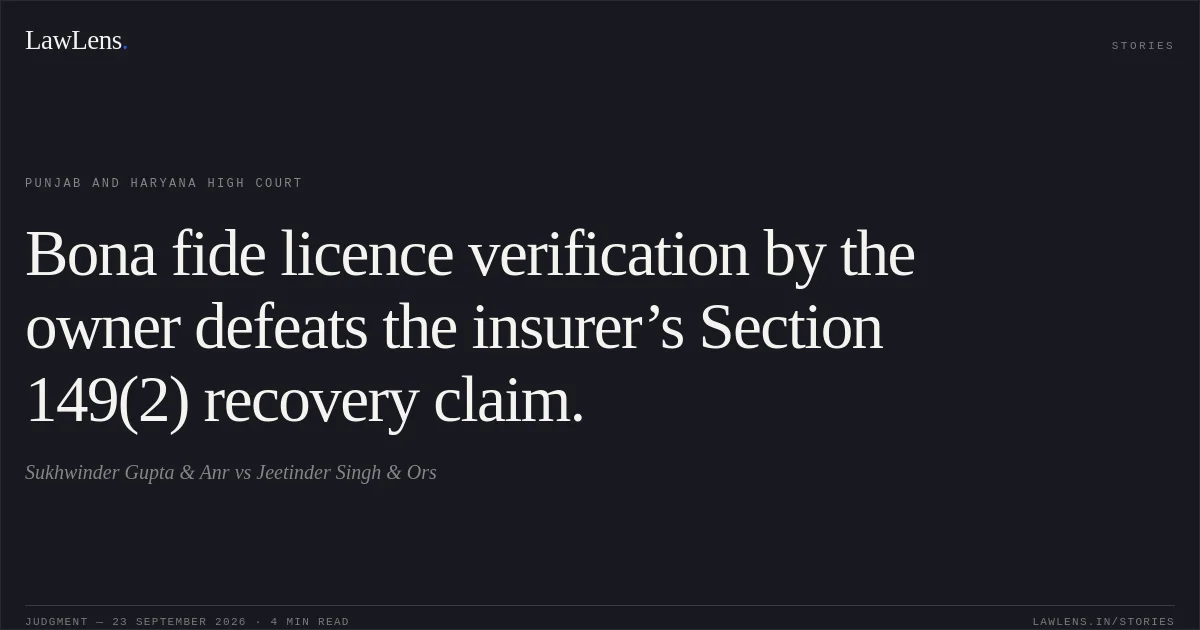
Source reference: para. 12(i)Whether the insurer established that the truck driver did not possess a valid and effective driving licence and was consequently entitled to exoneration or a right of recovery against the owner and driver?
Source reference: para. 12(ii)What was the just compensation payable in each claim petition, having regard to future prospects, deductions for personal expenses, the appropriate multiplier, income assessment and conventional heads of compensation?
Source reference: para. 12(iii)Law Applied
The Court applied Sections 149(2), 166 and 168 of the Motor Vehicles Act, 1988. Negligent parking of a heavy vehicle on a public or national highway at night without lights, reflectors or warnings constitutes negligence, and the party alleging contributory negligence bears the burden of proving it
Source reference: paras. 16–17Under United India Insurance Co. Ltd. v. Lehru, (2003) 3 SCC 338, National Insurance Co. Ltd. v. Swaran Singh, (2004) 3 SCC 297, and PEPSU Road Transport Corporation v. National Insurance Co. Ltd., (2013) 10 SCC 217, a fake or invalid driving licence does not by itself absolve the insurer; the insurer must prove a wilful breach attributable to the insured, including the owner’s knowledge or failure to exercise reasonable care
Source reference: paras. 26–29Compensation was reassessed under Sarla Verma v. Delhi Transport Corporation, (2009) 6 SCC 121, and National Insurance Co. Ltd. v. Pranay Sethi, (2017) 16 SCC 680, applying the prescribed future-prospects additions, personal-expense deductions, age-based multipliers and conventional heads.
Source reference: paras. 31–35Spousal and parental consortium were recognised in accordance with Magma General Insurance Co. Ltd. v. Nanu Ram, (2018) 18 SCC 130
Source reference: paras. 31–35Reasoning
The Court affirmed the finding of sole negligence against the truck driver because the truck had been parked at night in a prohibited area without any warning device. The insurer neither pleaded contributory negligence in its written statement nor effectively established it through evidence; photographs taken several hours after the accident could not reliably prove the position of the vehicles at impact
Source reference: paras. 13–21The insurer also failed to prove that the Bareilly driving licence relied upon by the owner was forged. The owner had obtained verification from the licensing authority and had tested the driver’s competence, thereby exercising reasonable care. The mere existence of another, allegedly invalid Pilibhit licence did not establish a wilful breach of the insurance policy
Source reference: paras. 22–30For quantum, the Court corrected the Tribunal’s failure to apply mandatory future prospects and the appropriate multipliers.
Source reference: paras. 38–69For Dr. Rachna Batra, the Court relied on the average of her two complete annual Australian income records, applied a 40% future-prospects addition, one-third deduction and multiplier of 15, while converting the resulting income at the exchange rate prevailing on the accident date
Source reference: paras. 38–45For Suniel Gupta, it rejected ad hoc deductions relating to housing instalments and applied a 40% future-prospects addition and multiplier of 15
Source reference: paras. 46–52For Anil Gupta, a permanent government employee below 40 years, it applied 50% future prospects and multiplier of 16
Source reference: paras. 53–58For Parveen Gupta, recurring allowances were included in his income, while reimbursements and non-recurring payments were excluded; 40% future prospects and multiplier of 16 were then applied
Source reference: paras. 60–69Holding
The insurer’s appeals, FAO Nos. 3573–3576 of 2013, were dismissed. The Court held that the accident was caused solely by the truck driver’s negligent parking and that the insurer had failed to establish the statutory defence under Section 149(2) of the Motor Vehicles Act; therefore, it remained liable to indemnify the owner and driver without any right of recovery
The claimants’ appeals were allowed and compensation was enhanced as follows: ₹4,61,05,920 for Dr. Rachna Batra, ₹48,14,000 for Suniel Gupta, ₹77,90,000 for Anil Gupta, and ₹29,20,240 for Parveen Gupta, with interest at 7.5% per annum on the enhanced amounts from the dates of filing until realisation
Source reference: paras. 45, 51–52, 57–58, 68–69; para. 70(b)–(e)The insurer was directed to deposit the enhanced amounts, after adjustment of sums already deposited or paid, within two months of receiving the certified copy of the judgment
Source reference: para. 70(f)In Dr. Rachna Batra’s claim alone, the insurer was granted limited liberty to seek modification concerning the treatment of foreign income if the pending Supreme Court reference in Tharunoju Eshwaramma v. K. Ram Reddy required a different computation method
Source reference: para. 70(g)Acts & Sections Cited
5 provisions across 2 statutes referred to in this judgment. Each provision opens on LawLens.
Indian Penal Code, 18602
Motor Vehicles Act, 19883
Original Court PDF
Sukhwinder Gupta & AnrvsJeetinder Singh & Ors
Click to open original judgment
Original judgment, available to read, download and summarize on LawLens.in