Facts
The deceased, a doctor by profession, had traveled to Mumbai for his D.G.O. examination.
Source reference: para. 4On October 17, 2007, he purchased a railway ticket at approximately 9:30 PM to travel from Mumbai CST to Bhusawal.
Source reference: para. 4At approximately 11:30 PM, between Mulund and Thane Railway Stations, the deceased met with a fatal accident.
Source reference: para. 4The Railway Claims Tribunal, Mumbai, rejected the appellant’s claim for compensation on March 9, 2015, ruling that the death was caused by being "knocked down" by an unknown train—based on the Station Master's (SM) memo—rather than an "untoward incident".
Source reference: para. 1, 5The Tribunal also raised issues regarding discrepancies in the deceased’s age and the lack of a ration card to prove relationship.
Source reference: para. 10, 11The appellant challenged this dismissal in the High Court.
Source reference: para. 2Issues
1. Whether the death of the deceased constitutes an "untoward incident" under Section 123 of the Railways Act, 1989.
Source reference: para. 1, 82. Whether the deceased was a "bona fide passenger" at the time of the incident.
Source reference: para. 93. Whether the relationship between the appellant and the deceased was sufficiently proved despite the absence of a ration card.
Source reference: para. 11Law Applied
The Court primarily applied Section 123 of the Railways Act, 1989, which defines an "untoward incident" to include the accidental falling of any passenger from a train carrying passengers.
Source reference: para. 8The Court also adhered to the principle that a passenger holding a valid ticket is considered a "bona fide passenger".
Source reference: para. 9The Court established that a legal heir certificate possesses higher evidentiary value than a ration card or a father’s death certificate for the purpose of proving the relationship between the applicant and the deceased.
Source reference: para. 11Reasoning
The Court scrutinized the Station Master’s (SM) memo, noting that the SM was not an eyewitness and no motorman or guard had reported a person being knocked down; thus, the finding that the deceased was hit by an unknown train lacked an evidentiary basis.
Source reference: para. 6, 7Given the timeline—purchasing a ticket at 9:30 PM for Bhusawal and the accident occurring at 11:30 PM on the same route—the Court determined the only probable conclusion was that the deceased fell from the Express Train.
Source reference: para. 7, 8Regarding passenger status, the recovery of the original ticket confirmed the deceased was a bona fide passenger.
Source reference: para. 9The Court dismissed the respondent’s arguments regarding age discrepancies (ranging from 26 to 31 years), noting that age is not strictly verified for second-class tickets and such minor variations do not invalidate a claim.
Source reference: para. 10The Court held that the legal heir certificate sufficiently proved the relationship, and the Tribunal erred by insisting on supplementary documents like a ration card.
Source reference: para. 11, 12Holding
The High Court allowed the appeal and reversed the Tribunal's order.
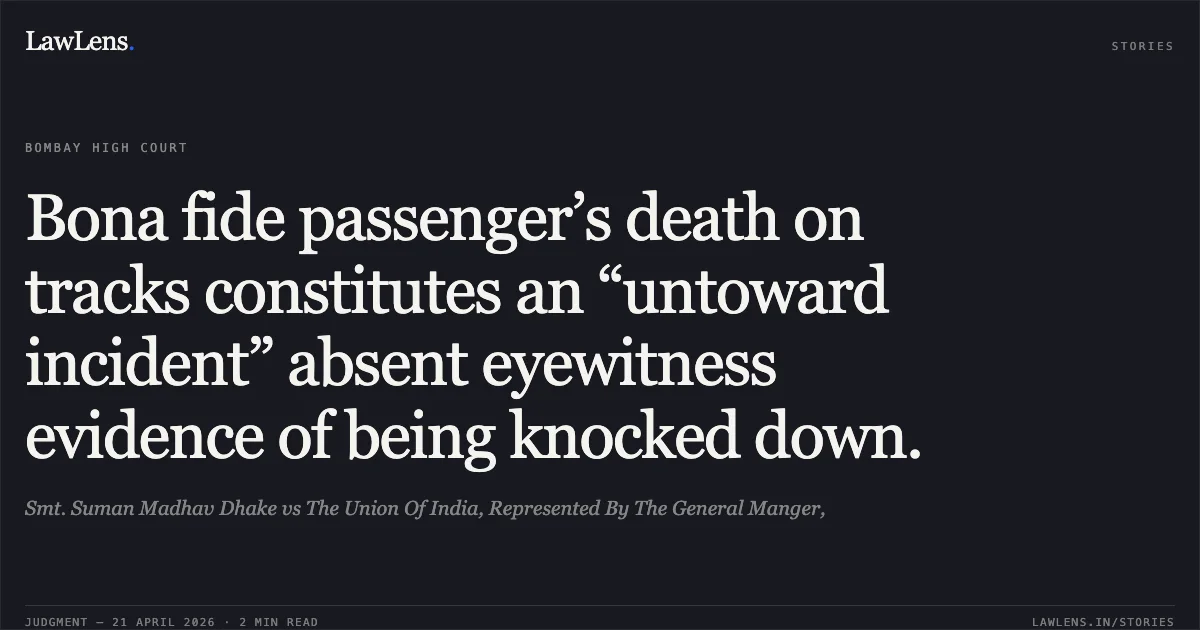
The Court held that the death resulted from an "untoward incident" and the deceased was a bona fide passenger.
Source reference: para. 8, 9The respondent was directed to pay compensation of Rs. 4,00,000/- with 6% interest per annum from the date of the accident, subject to a total cap of Rs. 8,00,000/-, to be remitted via bank transfer within eight weeks.
Source reference: para. 13Acts & Sections Cited
1 provisions across 1 statute referred to in this judgment. Each provision opens on LawLens.
Railways Act, 19891
Original Court PDF
Smt. Suman Madhav DhakevsThe Union Of India, Represented By The General Manger,
Click to open original judgment
Original judgment, available to read, download and summarize on LawLens.in


