01Facts
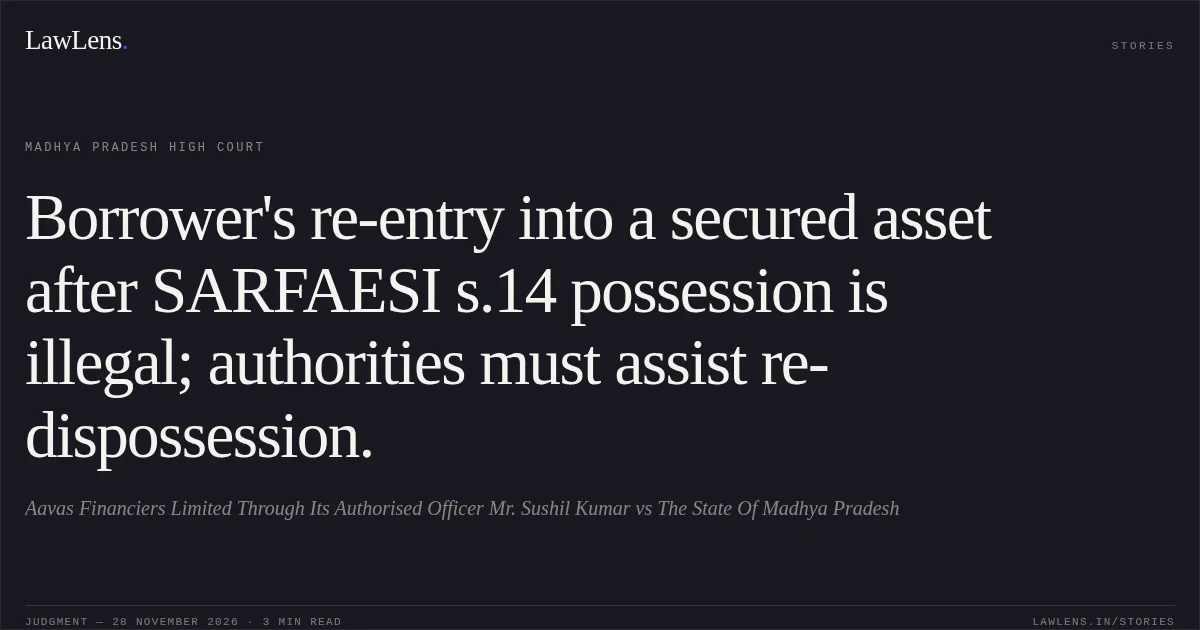
The petitioner, a secured creditor, took possession of the mortgaged property under the SARFAESI Act, 2002, pursuant to an order passed by the concerned authority.
p. 1, para 3The borrower then re-entered the property.
p. 1, para 3The borrower, along with family members, allegedly re-entered on the pretext of removing belongings and did not vacate.
p. 3, para 11, as quoted from the earlier orderThe petitioner filed a writ petition under Article 226 seeking (i) a mandamus directing the respondent authorities to render assistance, with police aid, to restore possession to its Authorised Officer, and (ii) directions to take appropriate action against the borrowers for trespass.
pp. 1, para 1 (relief clauses i–ii)The respondents' return contended that the petitioner had an alternative remedy and that the authorities could not re-execute an earlier possession order.
p. 3, para 10The court relied on its earlier order dated 16.06.2025 in W.P. No. 1681/2025, which is reproduced at paras 9–18.
p. 2, para 302Issues
i.1. Whether the District Magistrate or Chief Metropolitan Magistrate may re-execute a possession order under Section 14 of the SARFAESI Act where the borrower has re-entered the secured asset after the secured creditor took possession.
p. 3, para 10 · p. 4, para 14 (as quoted in the earlier order)ii.2. Whether the availability of an alternative remedy, including the SARFAESI mechanism, bars the writ petition under Article 226.
p. 3, para 13 (as quoted from the earlier order)03Law Applied
The court relied on Section 14 of the SARFAESI Act, which empowers the Chief Metropolitan Magistrate or District Magistrate to take possession of a secured asset on the secured creditor's written request, supported by an affidavit, and to use such force as necessary to secure compliance.
pp. 1–3, para 9, as quotedThe DM/CMM's action under Section 14 is ministerial, not adjudicatory, and is taken on behalf of the secured creditor.
pp. 4–5, para 16, quoting W.P. No. 11500/2020 (M.P. Full Bench)The court followed the Bombay High Court in Kotak Mahindra Bank v. State of Maharashtra (W.P. No. 6805/2023), which held that the DM is not functus officio and can re-execute his own Section 14 order, and that re-entry by borrowers is an illegality the court must not allow to continue.
p. 4, para 14The court relied on HDB Financial Services Ltd. v. State of Maharashtra (W.P. No. 1080/2024), which directed re-execution of possession orders.
p. 4, para 15The court drew a parallel with Section 248 of the M.P. Land Revenue Code, 1959, for the powers of revenue and executive authorities.
p. 5, para 17The SARFAESI Act provides its own recovery mechanism, so no effective alternative remedy was available.
p. 3, para 13, as quotedProvisions in the judgment · 3 · Linked ones open on LawLens
Securitisation and Reconstruction of Financial Assets and Enforcement of Security Interest Act, 2002 Section 13Section 14
MP Land Revenue Code 1959 Section 248
04Reasoning
The court first held that Section 14 contains no bar on re-executing a possession order. Dispossession of a borrower who has re-entered the mortgaged property is therefore legally permissible.
p. 3, para 10Because the Section 14 function is ministerial, the authorities owe assistance to the secured creditor, and the borrower's unauthorised re-entry cannot be rewarded.
p. 3, para 11 · p. 4, para 12Relying on the Bombay High Court's reasoning, the court treated the borrower's conduct as a device to defeat the statutory scheme, which the court should not tolerate.
p. 4, para 14On the alternative-remedy objection, the court reasoned that the SARFAESI Act itself supplies the recovery mechanism, so no effective alternative remedy existed in the circumstances.
p. 3, para 13The court also noted that the petitioner could initiate criminal proceedings for criminal trespass.
p. 4, para 12The present order adopts this reasoning by reference to the earlier order and does not add independent analysis.
p. 2, para 305Holding
The court held that the authorities are required to provide assistance to the petitioner in dispossessing the borrower from the mortgaged property and handing over possession in accordance with law.
p. 5, para 18, as quoted from the earlier orderThe writ petition is allowed. The respondent authorities are directed to act expeditiously, preferably within three weeks of receipt of the order, on the prayers in the petition.
p. 5, para 6 · p. 5, para 5The order does not expressly direct criminal action against the borrowers, though the earlier order noted that the petitioner may initiate such proceedings.
p. 4, para 12Original Court PDF
Aavas Financiers Limited Through Its Authorised Officer Mr. Sushil KumarvsThe State Of Madhya Pradesh
Click to open original judgment
Original judgment, available to read, download and summarize on LawLens.in