Facts
The appellants, cashew-processing concerns, had obtained credit facilities from Canara Bank secured by hypothecation and mortgages.
Source reference: paras. 3–10After the Bank classified their accounts as non-performing assets (NPAs), it issued SARFAESI notices and took consequential measures. The appellants challenged successive measures before the DRT; their applications were dismissed.
Source reference: paras. 3–10They also approached the High Court and DRAT, but the DRAT appeal was dismissed for failure to make the statutory pre-deposit under Section 18 of the SARFAESI Act.
Source reference: paras. 3–10They later filed a writ petition challenging the original NPA classification, alleging that the Bank had failed to apply applicable MSME revival and COVID-19 restructuring frameworks. The Single Judge dismissed the petition for delay and laches and the availability of an effective alternative remedy, while granting liberty to approach the appropriate forum and the benefit of Section 14 of the Limitation Act. The appellants appealed that dismissal.
Source reference: paras. 3–10Issues
1. Whether the High Court should entertain a writ petition under Article 226 challenging the foundational NPA classification and consequential SARFAESI measures when statutory remedies had been pursued but the DRAT appeal failed for non-compliance with the pre-deposit requirement
Source reference: paras. 14–202. Whether the appellants’ delay in challenging the NPA classification and their prior pursuit of remedies against consequential measures warranted dismissal of the writ petition
Source reference: paras. 18–20Law Applied
Article 226 jurisdiction is discretionary, and a High Court will ordinarily decline to exercise it where an effective statutory remedy is available, particularly in matters concerning recovery of bank dues.
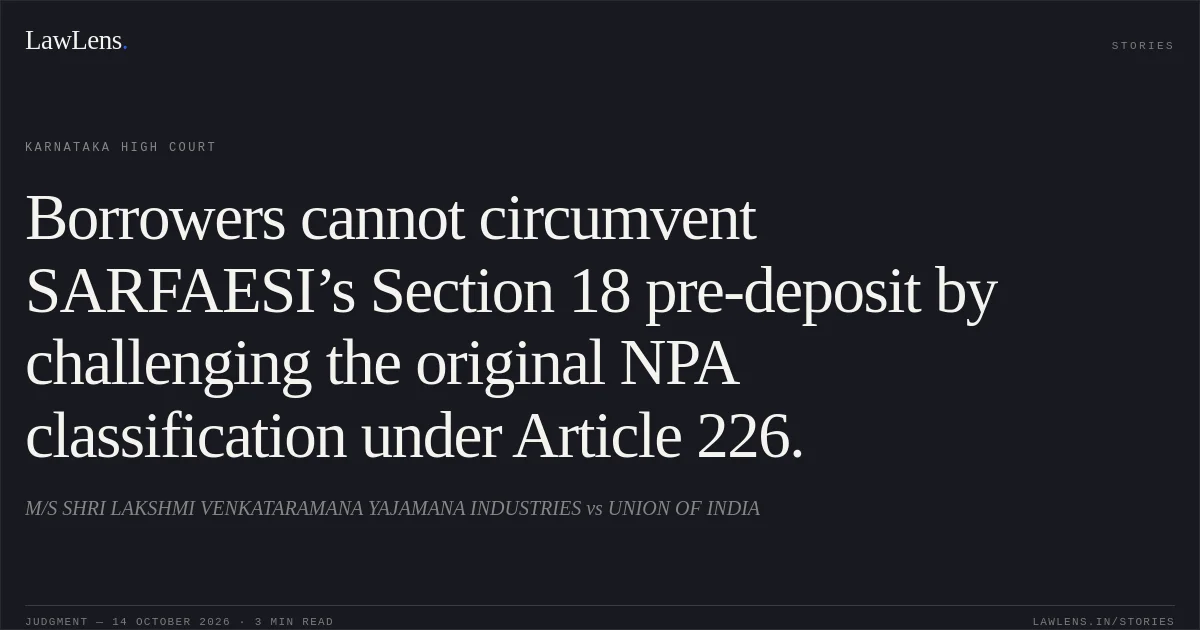
Source reference: paras. 14–19Under Sections 17 and 18 of the SARFAESI Act, an aggrieved person may challenge measures before the DRT and appeal to the DRAT, subject to the statutory pre-deposit. The pre-deposit requirement cannot be circumvented by invoking writ jurisdiction to reopen the recovery process.
Source reference: paras. 14–19The Court relied on United Bank of India v. Satyawati Tondon, (2010) 8 SCC 110, which emphasises restraint where an effective statutory remedy exists; Authorized Officer, State Bank of Travancore v. Mathew K.C., (2018) 3 SCC 85, on the ordinary rule against entertaining writ petitions where an alternative remedy is available; Phoenix ARC (P) Ltd. v. Vishwa Bharati Vidya Mandir, (2022) 5 SCC 345, on the statutory SARFAESI remedy; and Varimadugu Obi Reddy v. B. Sreenivasulu, (2023) 2 SCC 168, which disapproves using Article 226 as a circuitous route to avoid the Section 18 pre-deposit.
Source reference: paras. 14–19Reasoning
The appellants knew of the NPA classification when they challenged the Bank’s subsequent measures before the DRT. They pursued statutory proceedings, approached the High Court after an adverse DRT order, and then filed a DRAT appeal, which failed because they did not satisfy the Section 18 pre-deposit requirement.
Source reference: paras. 11–13, 18–20In these circumstances, permitting a later writ petition to challenge the original NPA classification would effectively allow them to reopen the recovery process despite that statutory failure and circumvent the pre-deposit requirement. The further delay in challenging the classification also weighed against discretionary relief under Article 226.
Source reference: paras. 11–13, 18–20Holding
The Court held that the Single Judge had properly declined to entertain the writ petition on grounds of delay and laches and the statutory remedy.
Finding no basis to interfere, it dismissed the writ appeal as devoid of merit and disposed of the pending interlocutory application.
Source reference: paras. 21–22Acts & Sections Cited
8 provisions across 4 statutes referred to in this judgment. Each provision opens on LawLens.
KARNATAKA HIGH COURT ACT, 19611
Securitisation and Reconstruction of Financial Assets and Enforcement of Security Interest Act, 20024
Limitation Act, 19631
Recovery Of Debts And Bankruptcy Act, 19932
Original Court PDF
M/S SHRI LAKSHMI VENKATARAMANA YAJAMANA INDUSTRIESvsUNION OF INDIA
Click to open original judgment
Original judgment, available to read, download and summarize on LawLens.in


