Facts
The petitioners and respondent No. 2 (complainant) entered into agreements in 2012 for the sale of 9 acres of agricultural land in Village Nandai for approximately ₹2.02 crores
Source reference: para. 3, 9The complainant alleged that despite paying 98% of the consideration, the petitioners failed to execute sale deeds, sold portions to third parties, and attempted to donate other parts
Source reference: para. 9An FIR (No. 539/2024) was lodged after 12 years, resulting in a charge sheet under Sections 420 and 120-B of the IPC
Source reference: para. 2, 3The petitioners moved the High Court under Section 528 of the Bharatiya Nagarik Suraksha Sanhita (corresponding to Section 482 CrPC/inherent powers) to quash the proceedings, contending the dispute was purely civil
Source reference: para. 2, 4Issues
1. Whether the allegations in the FIR and charge sheet prima facie constitute the criminal offence of cheating or merely represent a breach of contract of a civil nature
Source reference: para. 102. Whether the criminal proceedings should be quashed to prevent an abuse of the process of law due to inordinate delay and the absence of dishonest intention at the inception of the transaction
Source reference: para. 11, 14Law Applied
The court primarily applied Section 420 (Cheating) and 120-B (Criminal Conspiracy) of the IPC
Source reference: para. 7It relied on the seminal principles from State of Haryana v. Bhajan Lal, which permits quashing where allegations do not constitute an offence or are maliciously instituted
Source reference: para. 11The court further applied the doctrine from Indian Oil Corporation v. NEPC India Ltd. and Anukul Singh v. State of UP, which holds that a mere breach of contract does not constitute cheating unless fraudulent intent existed at the transaction's inception, and that the criminal justice system cannot be used as a shortcut for civil recovery
Source reference: para. 13It also noted its inherent power to quash proceedings even after a charge sheet is filed, as per Anand Kumar Mohatta v. State (NCT of Delhi)
Source reference: para. 12Reasoning
The Court observed that the transaction originated from written land sale agreements in 2012 and that the dispute fundamentally centered on the non-performance of contractual terms
Source reference: para. 10It reasoned that to attract Section 420 IPC, "mens rea" or dishonest intention must be present at the time the agreement was made; a subsequent failure to execute a deed or refund money does not retroactively transform a civil breach into a crime
Source reference: para. 5, 10The Court highlighted that the 12-year delay in filing the FIR strongly suggested the litigation was an afterthought intended to pressurize the petitioners for civil enforcement
Source reference: para. 4, 11Applying the Bhajan Lal criteria, the Court found the dispute to be "predominantly civil" and "overwhelmingly civil in nature," lacking the foundational ingredients of criminal liability
Source reference: para. 10, 14Holding
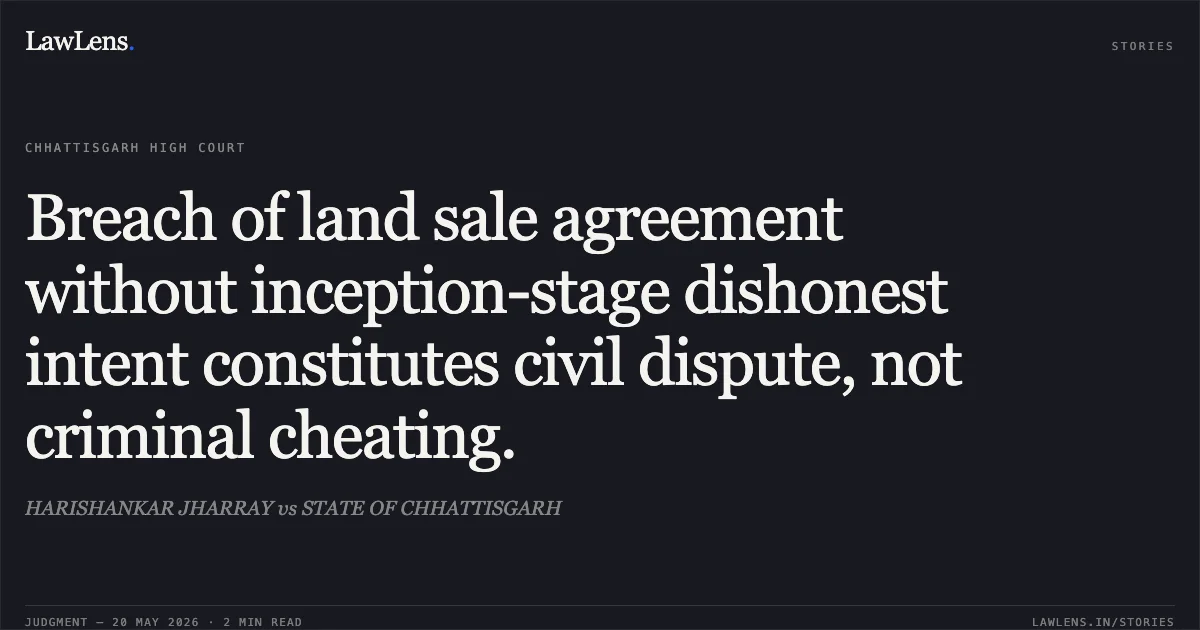
The Court answered both issues in the affirmative, holding that the controversy pertained to the enforcement of contractual obligations for which appropriate civil remedies exist
The Court allowed the petition and quashed Criminal Case No. 232/2025, the charge sheet, and the cognizance order pending before the Judicial Magistrate First Class, Rajnandgaon
Source reference: para. 15Acts & Sections Cited
7 provisions across 3 statutes referred to in this judgment. Each provision opens on LawLens.
Bharatiya Nagarik Suraksha Sanhita, 20231
Indian Penal Code, 18603
Code of Criminal Procedure, 19733
Original Court PDF
HARISHANKAR JHARRAYvsSTATE OF CHHATTISGARH
Click to open original judgment
Original judgment, available to read, download and summarize on LawLens.in


