01Facts
The petitioners' brick kilns were licensed in 1972 under the Haryana Control of Bricks Supplies Order, 1972 ("Order of 1972").
¶ 4Following a 2008 government decision on kilns near urbanizable zones, the District Magistrate, Yamunanagar, cancelled the licence on 29.01.2010 under Clause 8(i) of the Order of 1972, citing public interest.
¶ 4The Appellate Authority set that order aside on 26.04.2011, relying on the Policy/Guidelines dated 21.12.2010.
¶ 5On a fresh examination, the District Magistrate sought clarifications from the Director and the District Town and Country Planner. The Planner confirmed that the petitioner's kiln lay within the original municipal limits, and the Director recommended that kilns within municipal limits before 2000 could not run beyond 30.06.2011.
¶ 6 · ¶ 8The District Magistrate cancelled the licence again on 10.06.2013.
¶ 8–9The statutory appeal was dismissed on 28.04.2014, holding the kiln was within the old municipal limits and therefore hit by Clause 3 of the Policy.
¶ 10The petitioners argued that the kiln lay within the Municipal Corporation but outside the controlled and additional controlled areas, and so was protected by Clauses 1 and 4.
¶ 11The State contended that the kiln lay within municipal limits and Clause 3 applied.
¶ 13–15The matters were pending for years, during which affidavits were filed on the applicability of the 2010 and 2017 Policies and on municipal boundary history.
¶ 16–21The petitions were filed under Articles 226/227 of the Constitution.
¶ 202Issues
i.1. Whether a brick kiln situated within municipal limits, which later fell within a Municipal Corporation, is governed by Clause 3 (municipal limits) or Clause 4 (proposed extended limits) of the Policy dated 21.12.2010, such that its licence may be cancelled.
¶ 11 · ¶ 30–32ii.2. Whether the conversion of a Municipal Committee into a Municipal Council and then a Municipal Corporation alters the applicability of Clause 3 to the kiln.
¶ 33iii.3. Whether the District Magistrate may cancel the licence under the proviso to Clause 8(i) of the Order of 1972 in public interest, notwithstanding the Policy.
¶ 34–3703Law Applied
The court treated the Order of 1972 as the primary statutory source. Clause 8(i) permits revocation after a hearing, and its proviso empowers the District Magistrate to close a kiln in public interest due to city development and planning, subject to giving six months' notice or until 30 June of that year, whichever is later.
¶ 34–35The court held that any State policy must yield to the statutory provisions of the Order of 1972, and that the licensing authority retains independent power under Clause 8(i).
¶ 37The Policy dated 21.12.2010 governs kilns in urbanizable zones and municipal areas. Clause 1 restricts operation six months after a Section 4 notification under the Land Acquisition Act, 1894 or the grant of a CLU and colonizer licence.
¶ 26Clause 3 bars operation six months after the proceedings of the meeting for kilns within existing municipal limits, irrespective of Clause 1.
¶ 29Clause 4 applies only to areas proposed for inclusion in extended municipal limits under a published draft development plan.
¶ 30–31Provisions in the judgment · 2 · Linked ones open on LawLens
Code of Civil Procedure, 1908 Section 151
Right to Fair Compensation and Transparency in Land Acquisition, Rehabilitation and Resettlement Act, 2013 Section 4
04Reasoning
The court held that Clause 4 is inapplicable because the kiln is not in an area awaiting inclusion through a proposed extension; it is within the existing municipal limits. Clause 3 therefore governs, and the Policy's six-month period had expired.
¶ 31–32The court further held that the change from Municipal Committee to Corporation does not retrospectively convert existing municipal areas into proposed extended areas, so the petitioners' reliance on the Corporation's status and on the controlled-area classification was rejected as a device to escape Clause 3.
¶ 33On the statutory power, the court found that the District Magistrate invoked Clause 8(i) in both orders, taking into account that the kiln now lies within Corporation limits and poses public health hazards.
¶ 36Since Clause 8(i) is an independent statutory power and was applied after examining the facts, the Policy did not displace it.
¶ 37The court did not separately address the petitioners' contention that the Appellate Authority's 2011 order was ignored.
¶ 11(iv)–(v)05Holding
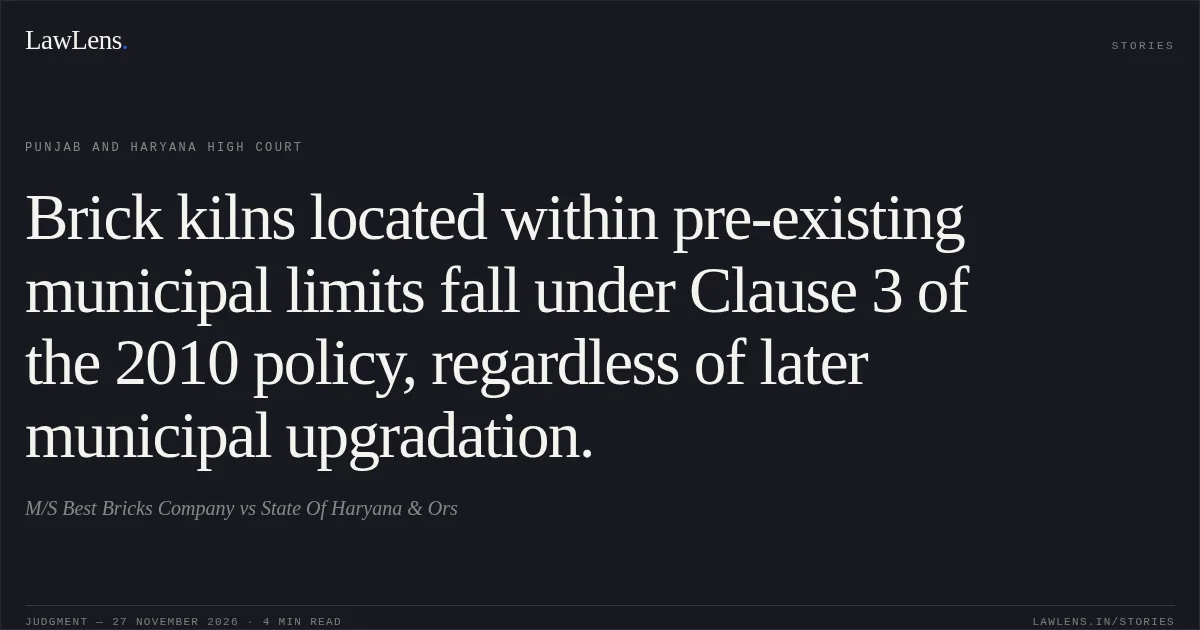
The court held that the kiln falls within existing municipal limits and is governed by Clause 3 of the Policy dated 21.12.2010, not Clause 4.
¶ 32–33The change in municipal status does not alter this position.
¶ 33The District Magistrate's cancellation under Clause 8(i) of the Order of 1972 is a valid exercise of independent statutory power.
¶ 36–37The court found no perversity or illegality in the orders dated 10.06.2013 and 28.04.2014 and dismissed CWP-9818-2014.
¶ 38CWP-11255-2014 was dismissed in the same terms on the reasoning in the lead case.
¶ 39All pending applications were disposed of.
¶ 40Original Court PDF
M/S Best Bricks CompanyvsState Of Haryana & Ors
Click to open original judgment
Original judgment, available to read, download and summarize on LawLens.in