Facts
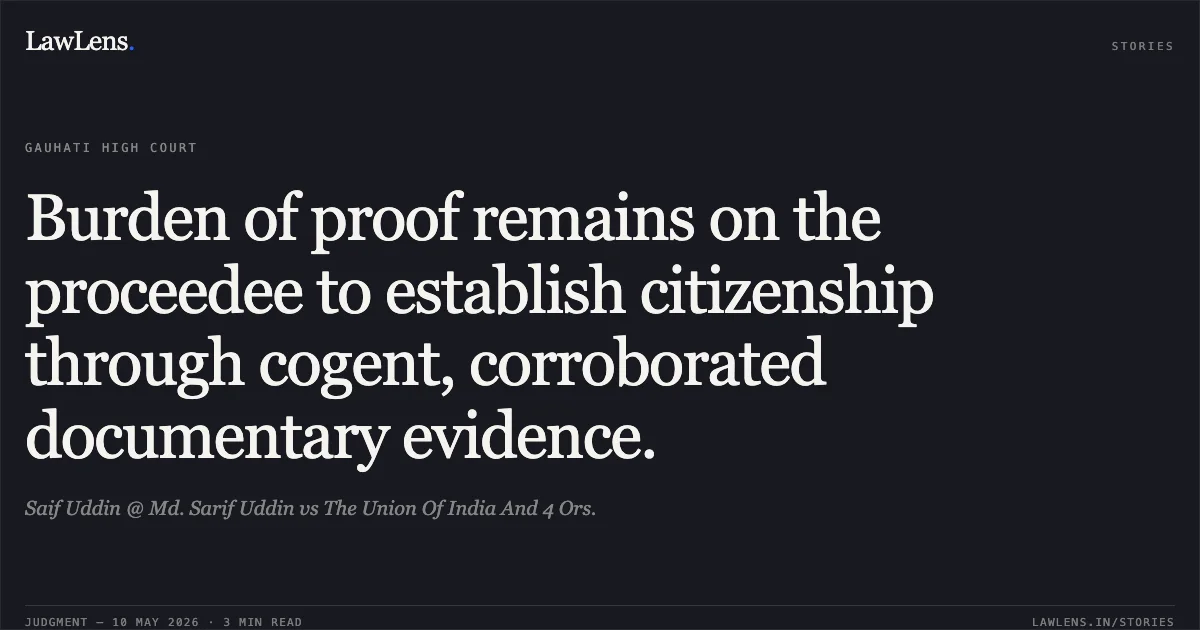
The petitioner, Saif Uddin @ Md. Sarif Uddin, challenged the opinion dated 31.10.2016 passed by the Foreigners Tribunal No. 10th, Nagaon at Sankardev Nagar, Hojai, in F.T. (D) Case No. 209/2015.
Source reference: p. 2The Superintendent of Police (B), Hojai, made a reference against the petitioner, leading to the Tribunal proceeding.
Source reference: p. 3The petitioner filed a written statement on 05.10.2015, claiming Indian citizenship by relying on Voter Lists from 1966 and 1970 containing his projected father's name (Ibrahim Ali), residency certificates from a Gaonbura and Gaon Panchayat, and his own Voter ID.
Source reference: p. 3, 4The Tribunal found that the petitioner failed to discharge his burden of proof and declared him a foreigner who entered India after 25.03.1971.
Source reference: p. 2, 3Issues
1. Whether the petitioner successfully discharged the burden of proof to establish his Indian citizenship under Section 9 of the Foreigners Act, 1946
Source reference: p. 3 / para. 142. Whether the findings of fact rendered by the Foreigners Tribunal are liable for interference under the Writ Court’s certiorari jurisdiction
Source reference: p. 8 / para. 16, 17Law Applied
The court primarily applied Section 9 of the Foreigners Act, 1946, which mandates that the onus of proving a person is not a foreigner lies solely on that person, notwithstanding the Indian Evidence Act.
Source reference: p. 7It followed Ghaus Mohammad v. Union of India and Fateh Mohd. v. Delhi Administration, establishing that the burden of proof never shifts from the proceedee.
Source reference: p. 7-8Regarding the proof of documents, the court relied on Romila Khatun v. Union of India (requiring proof of contents via contemporaneous records) and Rupjan Begum v. Union of India (requiring proof of both authenticity and content of certificates).
Source reference: p. 5-6, 10Under Central Council for Research in Ayurvedic Sciences v. Bikartan Das, the court defined the limits of certiorari jurisdiction, noting it is supervisory, not appellate, and should not be used to reweigh evidence unless an error of law is apparent on the face of the record.
Source reference: p. 9Reasoning
The Court observed that under Certiorari jurisdiction, it cannot act as an appellate body to review findings of fact unless they are palpably erroneous.
Source reference: p. 9It found the petitioner’s written statement lacked essential disclosures, such as his date of birth, details of siblings, or a family tree.
Source reference: p. 10, 11Although the petitioner submitted Voter Lists of 1966 and 1970, the Court held he failed to provide "link documents" connecting himself to the projected father.
Source reference: p. 10Additional Voter Lists (1977, 1985, 1989) produced during the writ petition contained gross inconsistencies in the father's age (e.g., father's age decreasing from 50 in 1977 to 45 in 1985, then jumping to 72 in 1989).
Source reference: p. 4, 10Furthermore, the residency certificates from the Gaonbura and Gaon Panchayat were held inadmissible because their authors were not examined to prove the contents.
Source reference: p. 4, 10In line with Nur Begum, the court emphasized that oral testimony alone is insufficient without corroboration from contemporaneous records.
Source reference: p. 11Holding
The Court answered the issues in the negative, holding that the petitioner failed to discharge the burden of proof under Section 9 of the Foreigners Act and that the Tribunal's decision-making process was legally sound.
The Court dismissed the writ petition and vacated the interim order. The opinion of the Foreigners Tribunal declaring the petitioner a foreigner post-25.03.1971 was upheld. The Court directed the immediate return of the records to the Tribunal for consequential actions in accordance with the law.
Source reference: p. 11Acts & Sections Cited
3 provisions across 1 statute referred to in this judgment. Linked provisions open on LawLens.
Foreigners Act, 19463
Original Court PDF
Saif Uddin @ Md. Sarif UddinvsThe Union Of India And 4 Ors.
Click to open original judgment
Original judgment, available to read, download and summarize on LawLens.in