Facts
The Appellant claimed to have served as a salesman for the Respondent since 1986
Source reference: p. 2, para 5.1He alleged that on 07.12.1991, the Respondent forcibly obtained his resignation and refused further employment
Source reference: p. 2, para 5.2A dispute was referred to the Labour Court on 15.10.1992
Source reference: p. 2, para 5.3The Respondent denied any employer-employee relationship, asserting the Appellant was never their employee
Source reference: p. 3, para 5.5The Labour Court, vide award dated 02.02.2007, held that the Appellant failed to prove his employment with the Respondent
Source reference: p. 3-4, para 5.9The Appellant challenged this via a Writ Petition, which was dismissed by the learned Single Judge on 09.05.2019
Source reference: p. 4, para 5.10The present Letters Patent Appeal (LPA) was filed against the Single Judge's judgment with a 465-day delay, which the court condoned
Source reference: p. 1, para 2Issues
1. Whether there existed an employer-employee relationship between the Appellant and the Respondent
Source reference: p. 3, para 5.62. Whether the Appellant's services were illegally terminated by the Respondent
Source reference: p. 4, para 5.93. Whether the High Court, under its supervisory jurisdiction (Articles 226/227), can interfere with concurrent findings of fact by lower tribunals
Source reference: p. 8, para 12Law Applied
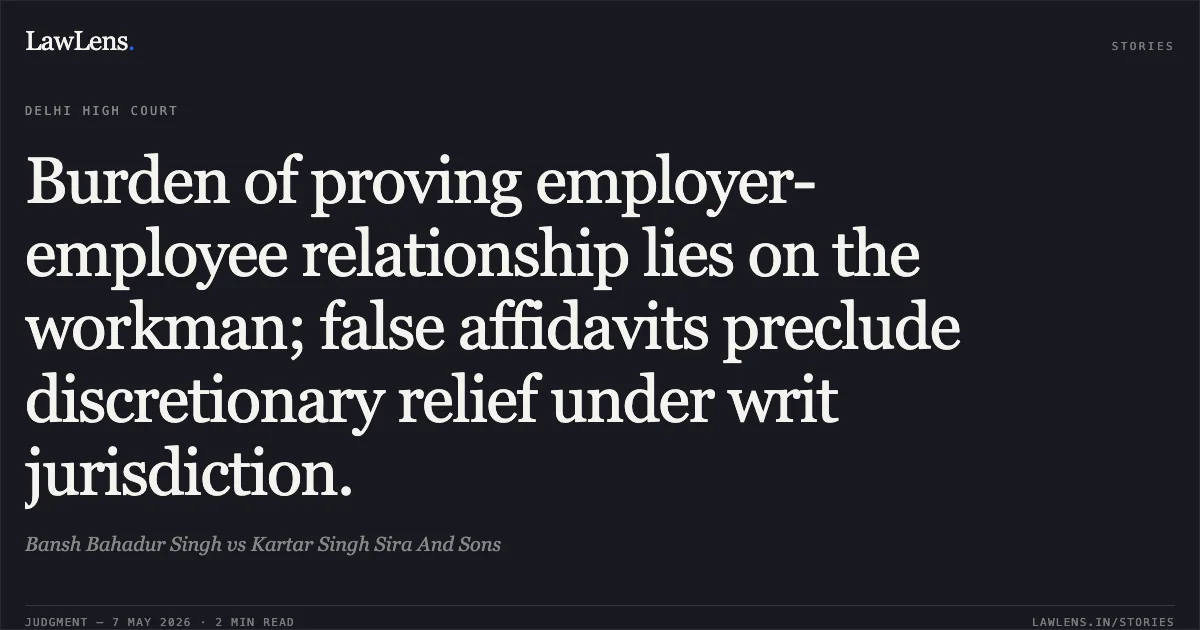
The court applied the principle that the burden of proving an employer-employee relationship lies on the workman
Source reference: p. 7, para 9It emphasized the scope of supervisory jurisdiction under Articles 226 and 227 of the Constitution of India, which is restricted to correcting jurisdictional errors or illegalities and does not permit the High Court to act as an Appellate Court or re-appreciate evidence unless findings are perverse or arbitrary
Source reference: p. 8, para 12The court also applied the doctrine that a party making false statements in evidence (pertaining to gainful employment) may have their testimony discredited
Source reference: p. 8, para 11Reasoning
The Court observed that the Appellant's reliance on an ESIC card was insufficient as the document did not bear the Respondent's name, but rather that of a separate entity
Source reference: p. 7, para 9Furthermore, while the Appellant relied on a Labour Inspector's report suggesting the management refused to "take back" the employee, the Appellant failed to examine the Labour Inspector to prove the report's contents
Source reference: p. 7-8, para 9Crucially, the court noted that the Appellant made a false statement on affidavit claiming he was unemployed post-termination, whereas cross-examination revealed he had worked for another establishment from 1994 to 2001
Source reference: p. 6, para 7.2; p. 8, para 11The Bench found that since the findings of the Labour Court were based on a thorough review of evidence and were not perverse, the Single Judge correctly refused to interfere under Article 226
Source reference: p. 9, para 13-14Holding
The Court answered the issues in the negative, holding that the Appellant failed to establish an employer-employee relationship
The Court affirmed that there was no error apparent on the face of the record in the Single Judge’s judgment
Source reference: p. 8, para 12The LPA was dismissed, and the orders of the Labour Court and the Single Judge were upheld. No order as to costs was made.
Source reference: p. 9, para 15Acts & Sections Cited
1 provisions across 1 statute referred to in this judgment. Linked provisions open on LawLens.
Industrial Disputes Act, 19471
Original Court PDF
Bansh Bahadur SinghvsKartar Singh Sira And Sons
Click to open original judgment
Original judgment, available to read, download and summarize on LawLens.in


