Facts
The Special Police Establishment, Lokayukta, challenged the judgment dated 17 March 2017 of the Special Judge, Prevention of Corruption Act, Chhatarpur, acquitting Gulab Singh of offences under Sections 7 and 13(1)(d) read with Section 13(2) of the Prevention of Corruption Act.
Source reference: para. 2The application seeking leave to appeal was required to be filed within 90 days but was filed with a delay of 379 days.
Source reference: para. 3The State attributed the delay to obtaining legal opinions and permissions, appointment and transfer of the Officer-in-Charge, appointment of standing counsel, collection of records, and preparation of the appeal.
Source reference: para. 3The respondent opposed condonation, contending that the explanation was vague, procedural, and insufficient under Section 5 of the Limitation Act.
Source reference: para. 4Issues
Whether the State had shown “sufficient cause” under Section 5 of the Limitation Act for condoning the 379-day delay in filing the application for leave to appeal against the judgment of acquittal.
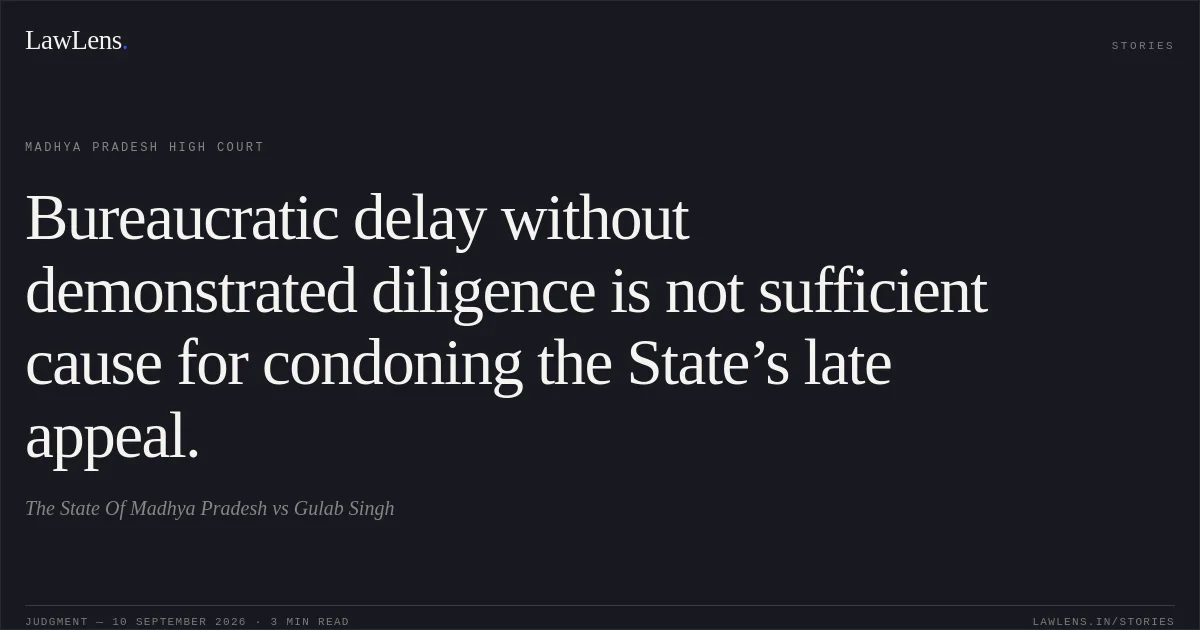
Source reference: paras. 1–6Whether bureaucratic delay, red-tapism, administrative permissions, transfer of the Officer-in-Charge, and procedural difficulties could, without proof of bona fide diligence and specific impediments, constitute sufficient cause for condonation of delay.
Source reference: paras. 7–10Whether the delay in challenging an acquittal should be assessed with particular strictness in view of the accused’s fortified presumption of innocence and accrued right to liberty.
Source reference: para. 11Law Applied
Section 5 of the Limitation Act permits condonation only where sufficient cause is established; the applicant must explain both the failure to file within the prescribed period and the subsequent delay, although an explanation of each day is not required.
Source reference: no citationThe Court relied on State of Nagaland v. Lipok AO, 2005 (3) SCC 752, which recognised that governmental functioning may involve procedural delay but did not dispense with the requirement of sufficient cause.
Source reference: para. 7It applied the later and stricter principles in Postmaster General v. Living Media India Ltd., (2012) 3 SCC 563; State of M.P. v. Bherulal, (2020) 10 SCC 654; Sheo Raj Singh v. Union of India, (2023) 10 SCC 531; DDA v. Tejpal, (2024) 7 SCC 433; and Shivamma v. Karnataka Housing Board, 2025 INSC 1104, that the State is not entitled to preferential treatment and must demonstrate bona fide, cogent, and diligent conduct.
Source reference: paras. 8–10Routine bureaucratic lethargy, red-tapism, administrative inefficiency, or movement of files is not, by itself, sufficient cause.
Source reference: paras. 8–10The Court further treated the limitation period as embodying the public policy of finality and certainty in litigation, particularly where an acquitted accused’s liberty is at stake.
Source reference: paras. 10–11Reasoning
The Court found that the State’s explanation merely narrated the movement of the matter through official channels and the appointment and transfer of officers, without establishing any genuine or unavoidable impediment.
Source reference: paras. 3, 10The delay in obtaining legal opinion, securing permissions, appointing the Officer-in-Charge, collecting records, preparing the appeal, and filing the application reflected bureaucratic lethargy, inaction, casual indifference, and lack of diligence rather than bona fide efforts made within the limitation period.
Source reference: para. 13The Court rejected the argument that the seriousness of the corruption allegations or the perceived public interest justified condonation, observing that if the matter was important enough to affect administration of justice, the State authorities were expected to act with greater vigilance and promptitude.
Source reference: para. 12Since the impugned judgment was one of acquittal, the accused’s initial presumption of innocence had been strengthened by the trial court’s decision, and condoning a delay of 379 days would adversely affect his accrued right to liberty.
Source reference: para. 11The State therefore failed to establish sufficient cause under Section 5.
Source reference: paras. 13–14Holding
The Court held that the State had not satisfactorily explained the 379-day delay and was not entitled to condonation merely because it was a governmental agency or because the delay resulted from administrative procedures.
I.A. No. 12399/2018 seeking condonation of delay under Section 5 of the Limitation Act was dismissed, and consequently the Miscellaneous Criminal Case seeking leave to appeal was also dismissed.
Source reference: paras. 15–16Acts & Sections Cited
4 provisions across 2 statutes referred to in this judgment. Each provision opens on LawLens.
Prevention of Corruption Act, 19882
Original Court PDF
The State Of Madhya PradeshvsGulab Singh
Click to open original judgment
Original judgment, available to read, download and summarize on LawLens.in