Facts
The petitioner, a Consignment and Forwarding Agent (CNF) for Dalmia Cement, sought the quashing of an order of cognizance dated 11.11.2022.
Source reference: p. 1-2The complainant (Opposite Party No. 2), a cement dealer for ten years, alleged that the petitioner generated false bills amounting to a loss of approximately Rs. 20,00,000/- and coerced him into signing "no dues" documents.
Source reference: p. 1-2The complainant argued that while payments were made directly to the company, the CNF manipulated the link site to generate fake bills.
Source reference: p. 2-3Conversely, the petitioner maintained that the dispute was a commercial matter arising from business transactions.
Source reference: p. 2Issues
Whether the allegations in the complaint constitute criminal offences under Sections 406 and 420 of the Indian Penal Code or represent a purely civil/commercial dispute
Source reference: p. 3Whether the prosecution can continue in the absence of evidence showing dishonest intention at the inception of the transaction
Source reference: p. 3Law Applied
Sections 406 (Punishment for criminal breach of trust) and 420 (Cheating and dishonestly inducing delivery of property) of the Indian Penal Code.
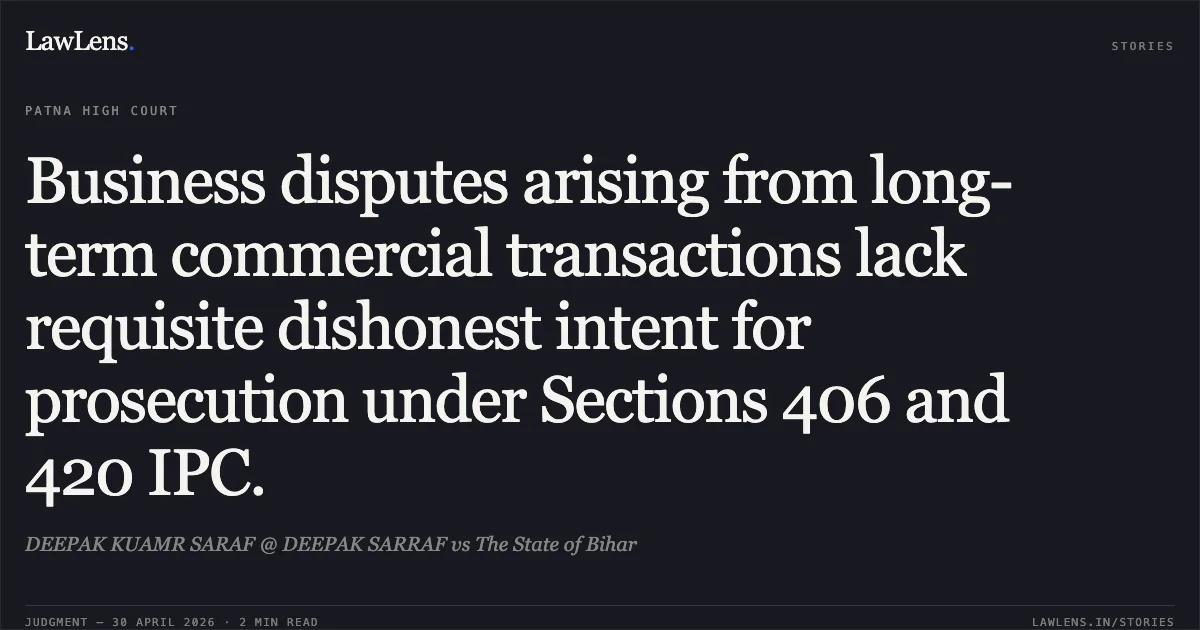
Source reference: p. 3The core legal principle applied is that for an offence of cheating or criminal breach of trust to be made out in a contractual context, there must be material to suggest a dishonest intention at the very beginning of the transaction; a mere breach of contract or a commercial dispute does not attract criminal liability.
Source reference: p. 3Reasoning
The court observed that the relationship between the parties was based on a long-standing business arrangement spanning ten years.
Source reference: p. 3Upon perusal of the FIR, the court determined that the matter was "out and out [a] business transaction".
Source reference: p. 3The court reasoned that there was no allegation or evidentiary material to suggest that the petitioner possessed a dishonest intention at the commencement of the dealings.
Source reference: p. 3Furthermore, the court found that the dispute essentially related to the business transactions between the dealer (complainant) and the cement company, rather than the petitioner personally, who acted merely as the CNF.
Source reference: p. 3-4Holding
The court answered the issues in favor of the petitioner, holding that no criminal offence was made out as the dispute was civil and commercial in nature.
The High Court allowed the petition and quashed the order of cognizance dated 11.11.2022 passed by the learned Judicial Magistrate, 1st Class, Katihar in Complaint Case No. 591 of 2022 insofar as it related to the petitioner.
Source reference: p. 4Acts & Sections Cited
2 provisions across 1 statute referred to in this judgment. Each provision opens on LawLens.
Indian Penal Code, 18602
Original Court PDF
DEEPAK KUAMR SARAF @ DEEPAK SARRAFvsThe State of Bihar
Click to open original judgment
Original judgment, available to read, download and summarize on LawLens.in