01Facts
The appellants held temporary excise licences, generally granted for six months, to operate liquor shops.
pp. 2–4 · ¶ 1–7On 2 March 2019, the Excise Commissioner suspended the shops’ operation in connection with the General Election. The election concluded on 23 May 2019, but the suspensions continued; the order was rescinded on 22 August 2019, without permitting the appellants to resume business for the unexpired licence period.
pp. 2–4 · ¶ 1–7The appellants challenged the suspension and non-restoration of their licences. In the related appeal, the appellants also challenged notifications dated 27 December 2019, which omitted the relevant licence category from the applicable Rules. Their writ petitions were dismissed, and the appeals were heard together.
pp. 7–13 · ¶ 12–2402Issues
i.Whether the suspension of the temporary licences was authorised by Sections 26 and 42 of the Bengal Excise Act, 1909, and whether its continuation after the election was legally justified.
p. 5 · ¶ 8 · pp. 18–20 · ¶ 32–34ii.Whether the appellants were entitled to resume business for the unexpired portion of their licence terms after the suspension order was rescinded.
p. 5 · ¶ 8 · pp. 19–22 · ¶ 33–36iii.Whether the State could rely on expiry by efflux of time, or on the omission of the relevant licence category by the notifications dated 27 December 2019, to deny the appellants the benefit of the suspended period.
pp. 11–13 · ¶ 22–24 · pp. 21–22 · ¶ 35–38iv.Whether the State’s action was arbitrary or unfair in the absence of stated reasons or any alleged licence-holder default.
pp. 5–6 · ¶ 8 · pp. 19–21 · ¶ 33–3503Law Applied
Under Section 42 of the Bengal Excise Act, 1909, the authority that granted a licence may suspend or cancel it on the statutory grounds; Section 26 provides for closure of liquor shops for public peace.
pp. 18–19 · ¶ 32Section 37 contemplates retail licences for a period not exceeding six months.
p. 16 · ¶ 29Although there is no fundamental right to trade in intoxicating liquor, a licence or privilege granted by the State cannot be curtailed arbitrarily: State action must be fair, reasonable and supported by cogent reasons.
pp. 17–18 · ¶ 32 · pp. 20–21 · ¶ 33–34The Court also relied on the principle that a court cannot supply reasons that the State itself did not give.
p. 20 · ¶ 33Provisions in the judgment · 8
Bengal Excise Act, 1909 Section 26Section 30Section 31Section 37Section 37ASection 42Section 85Section 86
04Reasoning
The Court found that the licences had been suspended shortly after they took effect, ostensibly in connection with the election, and that the suspension continued after the election ended.
pp. 18–22 · ¶ 32–35The suspension order did not identify the legal provision relied on, and the later order rescinding it gave no reason for the prolonged suspension. The State also identified no default by the appellants warranting suspension.
pp. 18–22 · ¶ 32–35In those circumstances, the Court held that the State could not deny the appellants the benefit of the licensed period merely by asserting that the licences had expired by efflux of time.
pp. 18–22 · ¶ 32–35The Court considered that allowing the category’s subsequent omission to defeat the appellants’ claim, without a stated justification for the earlier suspension, would perpetuate arbitrary and unfair State action.
pp. 18–22 · ¶ 32–3505Holding
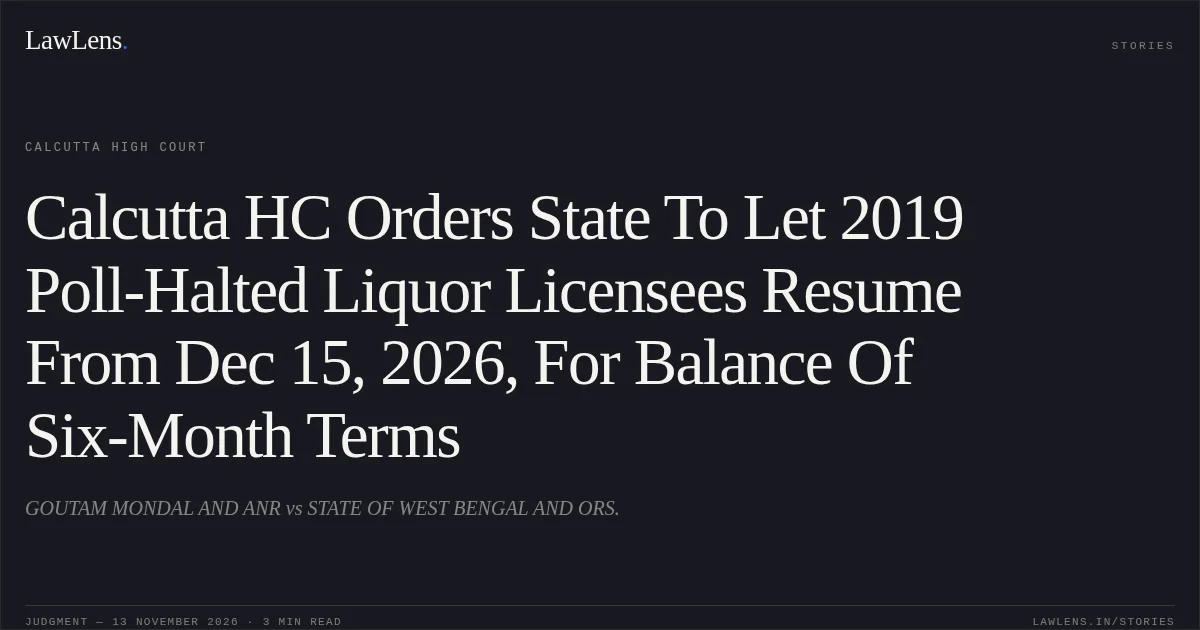
The Court allowed the appeals in part and directed the State to permit the appellants to operate their shops from 15 December 2026 for the balance of their respective six-month licence terms, to clear the stock held in their premises.
p. 22 · ¶ 36It granted liberty to apply under Rule 9(1)-F of the 2003 Rules and directed the authorities to decide such applications, and pending representations, within three months.
pp. 22–23 · ¶ 37–38Notifications Nos. 2067-F.T. and 2068-F.T., both dated 27 December 2019, were directed to remain in abeyance, only as to these appellants and only until the balance licence period ended.
p. 23 · ¶ 38The appeals were disposed of without costs.
p. 23 · ¶ 39Original Court PDF
GOUTAM MONDAL AND ANRvsSTATE OF WEST BENGAL AND ORS.
Click to open original judgment
Original judgment, available to read, download and summarize on LawLens.in