Facts
The petitioners completed their postgraduate degrees in December 2024 and began a three-year bond-service period as Senior Residents in 2025 under the Department’s SOP dated 16 February 2023.
Source reference: para. 35–44Under that SOP, candidates served for an initial year at medical colleges and hospitals and for the remaining period at secondary-tier or rural hospitals, with placement based on a merit list and counselling.
Source reference: para. 35–44In June 2026, the Department issued a new SOP introducing roster-based counselling.
Source reference: para. 8–12Subsequent circulars sought data and choices from candidates who had passed out in December 2024, and the resulting list altered the petitioners’ relative merit positions.
Source reference: para. 8–12, 47–50The petitioners sought to complete their bond service under the 2023 SOP; the State defended the new roster-based process, including on the basis that bond service constituted temporary appointment.
Source reference: para. 13–18, 23–33Issues
Whether the 2026 SOP could be applied to the petitioners after they had completed the first year of their three-year bond service under the 2023 SOP.
Source reference: para. 41–46Whether roster-based placement of Senior Residents was legally permissible in general.
Source reference: para. 16, 23–27, 41Law Applied
The Court relied on the principle that the rules governing a selection or recruitment process cannot ordinarily be altered after the process has begun; in Tej Prakash Pathak v. Rajasthan High Court, (2025) 2 SCC 1, the Supreme Court held that notified eligibility criteria cannot be changed midway unless the governing rules permit it, and any permissible change must satisfy Article 14 and the test of non-arbitrariness.
Source reference: para. 45The Court also referred to Monarch Infrastructure (P) Ltd. v. Commissioner, Ulhasnagar Municipal Corporation, (2000) 5 SCC 287, on the same “rules of the game” principle.
Source reference: para. 21The prior decisions in Dr. Aniket Mahata and Dr. Debashis Halder were cited for the proposition that bond-based Senior Residents are not thereby regular government appointees or government servants.
Source reference: para. 19–20, 38–40The Court did not decide the general legality of applying reservation rosters to Senior Residents.
Source reference: para. 41Reasoning
The 2023 SOP governed when the petitioners completed their courses, executed their bonds and commenced service.
Source reference: para. 42–46It provided for the same merit list to inform both the initial year’s placement and subsequent counselling, and did not provide for a new roster-based list at the start of the remaining two years.
Source reference: para. 42–46Applying the 2026 SOP after the petitioners had completed the first year would alter their relative positions and affect their placement prospects during an ongoing three-year bond commitment.
Source reference: para. 49–55The Court therefore treated the change as an impermissible mid-course alteration of the governing terms, notwithstanding the State’s position that the second tenure was yet to begin.
Source reference: para. 49–55It confined its decision to the petitioners’ ongoing bond service and left the general challenge to roster-based placement undecided.
Source reference: para. 41Holding
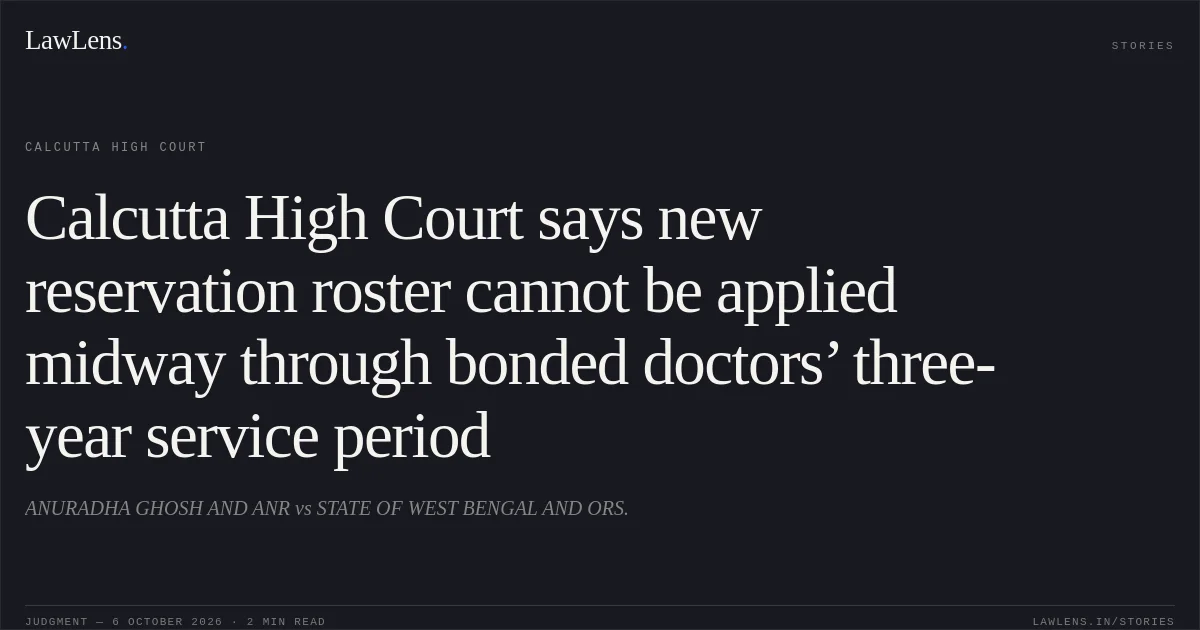
The Court held that applying the 2026 SOP to the petitioners’ batch, which began bond service under the 2023 SOP, would be improper and illegal.
It directed the respondents to permit the petitioners to complete their bond service under the 2023 SOP and disposed of the writ petition without costs.
Source reference: para. 55–58Original Court PDF
ANURADHA GHOSH AND ANRvsSTATE OF WEST BENGAL AND ORS.
Click to open original judgment
Original judgment, available to read, download and summarize on LawLens.in
![HRA parity claims must be assessed against similarly situated employees, with reasoned orders where parity is denied.. Shaphaba Thokchom vs DY. COMPTROLLER AND AUDITOR GENERAL OF INDIA. CAT - ['Guwahati']. LawLens](/stories/thumbnails/hra-parity-claims-must-be-assessed-against-similarly-situated-employees-with-reasoned-orde-a9c45995b0704be18e4bcf7b91c8e507.webp)
![Article 311(2)(c) dismissal is valid where relevant material shows an inquiry would endanger security sources.. Mohd Rafi vs GENERAL ADMINITRATIVE DEPARTMENT. CAT - ['Jammu']. LawLens](/stories/thumbnails/article-311-2-c-dismissal-is-valid-where-relevant-material-shows-an-inquiry-would-endanger-58dabaa9372a4b41bd304e91e9ebe890.webp)