Facts
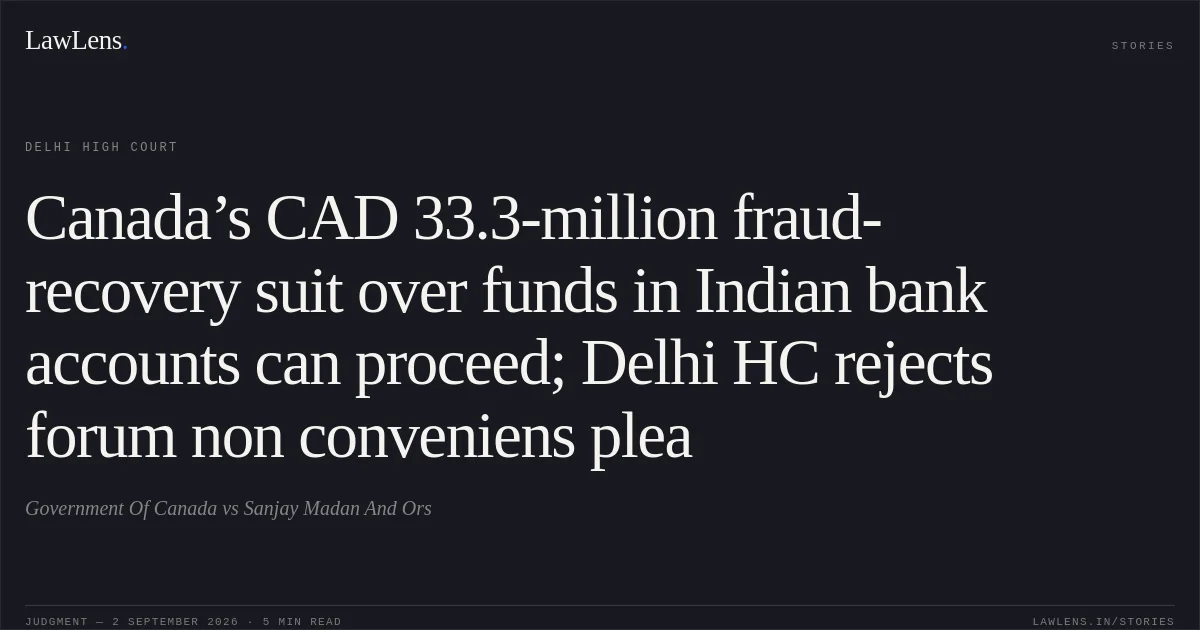
The Government of Canada instituted a suit seeking recovery and rendition of accounts concerning funds allegedly fraudulently obtained from the Government of Ontario and transferred from Canadian accounts to Indian bank accounts held by Defendant Nos. 1 and 2 or their family members.
Source reference: pp. 2–4, paras. 2–8Defendant No. 1 had pleaded guilty in Canada to charges relating to the Support for Families Program fraud and the Fee for Service Consultants fraud; Defendant No. 2 had likewise pleaded guilty to fraud-related offences.
Source reference: pp. 2–4, paras. 2–8The plaintiff alleged that approximately CAD 40.2 million had been transferred to Indian bank accounts, of which CAD 33,345,991 remained unrecovered.
Source reference: p. 4, para. 10Defendant No. 1 filed an application under Order VII Rules 10 and 11 read with Section 151 CPC seeking return or rejection of the plaint on the grounds that the suit was barred by limitation, that the Delhi High Court lacked territorial jurisdiction, that Canada was the more appropriate forum, and that the suit amounted to an abuse of process because related proceedings were pending in Canada.
Source reference: pp. 5–8, paras. 11–22Issues
1. Whether the plaint disclosed that part of the cause of action arose within the territorial jurisdiction of the Delhi High Court under Section 20 CPC, warranting return of the plaint under Order VII Rule 10 CPC?
Source reference: pp. 16–20, paras. 53–592. Whether the suit ought to be declined on the ground of forum non conveniens, with Canada being the more appropriate forum?
Source reference: pp. 6–7, paras. 17–19; pp. 31–36, paras. 69–723. Whether the suit was ex facie barred by limitation under Articles 4, 68 or 91(a), or otherwise under Article 113 of the Limitation Act, 1963, so as to attract rejection under Order VII Rule 11(d) CPC?
Source reference: pp. 5–6, paras. 13–16; pp. 36–52, paras. 73–954. Whether the suit constituted an abuse of process because related civil and criminal proceedings were pending in Canada?
Source reference: pp. 7–8, paras. 20–22; pp. 52–55, paras. 96–102Law Applied
Under Order VII Rules 10 and 11 CPC, territorial jurisdiction and limitation are considered on a demurrer, by accepting the plaint’s averments and documents as correct and disregarding the defence at that stage.
Source reference: pp. 17–19, paras. 55–60Section 20(c) CPC permits institution of a suit where the cause of action arises wholly or partly; a cause of action comprises every fact necessary for the plaintiff to prove to obtain relief.
Source reference: pp. 18–20, paras. 57–59; South East Asia Shipping Co. Ltd. v. Nav Bharat Enterprises (P) Ltd., (1996) 3 SCC 443The doctrine of forum non conveniens does not apply to ordinary civil suits governed by the CPC where the chosen Indian court otherwise possesses jurisdiction; it is principally relevant to foreign forums, including anti-suit injunction proceedings.
Source reference: pp. 31–36, paras. 69–72; Horlicks Ltd. v. Heinz India (P) Ltd., 2009 SCC OnLine Del 3342Articles 68 and 91(a) of the Limitation Act apply to suits concerning specific movable property and do not govern ordinary claims for recovery of money; Article 4 concerns suits by principals against agents.
Source reference: pp. 45–47, paras. 83–87In the absence of a specific provision, Article 113 applies, prescribing three years from when the right to sue accrues.
Source reference: pp. 47–50, paras. 88–92Section 17 postpones limitation where fraud or concealment prevents discovery of the right or necessary documents, although whether reasonable diligence could have led to earlier discovery is ordinarily a question of fact.
Source reference: pp. 37–41, paras. 74–78; Pallav Sheth v. Custodian, (2001) 7 SCC 549; Saranpal Kaur Anand v. Praduman Singh Chandhok, (2022) 8 SCC 401Explanation to Section 10 CPC expressly provides that pendency of a suit in a foreign court does not preclude Indian courts from trying a suit founded on the same cause of action.
Source reference: pp. 52–53, paras. 96–97Reasoning
The plaint specifically pleaded that the allegedly diverted funds were transferred into bank accounts maintained with Defendant Nos. 3–10, several of which were situated in Delhi, and that the funds could be last traced within this jurisdiction.
Source reference: pp. 20–27, paras. 61–63These pleaded facts constituted part of the transaction and furnished a part of the cause of action under Section 20(c) CPC; the reliefs for rendition of accounts and repatriation were also directed against Indian banks and the RBI.
Source reference: pp. 20–27, paras. 61–63The fact that Canada was not a reciprocating territory under Section 44A CPC further supported the practical necessity of pursuing an Indian suit for recovery against assets located in India, whether on the underlying cause of action or on a Canadian judgment.
Source reference: pp. 27–31, paras. 64–68The forum non conveniens objection was rejected because the proceeding was an ordinary civil suit, not an anti-suit injunction. Once the Delhi High Court had jurisdiction under the CPC, the plaintiff, as dominus litis, could not be non-suited merely because the evidence and related proceedings were principally located in Canada.
Source reference: pp. 31–36, paras. 69–72On limitation, the Court held that Articles 4, 68 and 91(a) did not ex facie apply: there was no pleaded principal-agent relationship, and the claim concerned recovery of money rather than specific movable property.
Source reference: pp. 45–47, paras. 83–87The plaint pleaded successive discoveries and specifically asserted that the KPMG report dated 7 January 2025 supplied critical particulars necessary to comprehend the extent and movement of the fraud and to institute the present proceedings.
Source reference: pp. 41–52, paras. 79–94Whether the plaintiff could reasonably have discovered the fraud earlier, and whether the later events constituted actionable accruals, were mixed questions of fact and law that could not be determined under Order VII Rule 11 CPC.
Source reference: pp. 41–52, paras. 79–94Finally, the pendency of Canadian proceedings did not by itself render the Indian suit abusive.
Source reference: pp. 52–55, paras. 96–102Holding
The Delhi High Court held that it possessed territorial jurisdiction because material parts of the alleged fund transfers and the reliefs against Indian banks and the RBI were connected with Delhi.
The plea of forum non conveniens was unavailable in the present ordinary civil suit.
Source reference: pp. 31–36, paras. 69–72The plaint was not ex facie barred by limitation, since the applicability of Section 17 and Article 113, the date of discovery, and the accrual of the right to sue involved triable factual questions.
Source reference: pp. 41–52, paras. 79–95The allegation of abuse of process was likewise not capable of summary determination and was not established merely by the pendency of Canadian proceedings.
Source reference: pp. 52–55, paras. 96–102Accordingly, Defendant No. 1’s application under Order VII Rules 10 and 11 read with Section 151 CPC was dismissed.
Source reference: p. 55, para. 103Acts & Sections Cited
23 provisions across 4 statutes referred to in this judgment. Each provision opens on LawLens.
Code of Civil Procedure, 19087
Limitation Act, 1963
Negotiable Instruments Act, 18812
Specific Relief Act, 19631
Original Court PDF
Government Of CanadavsSanjay Madan And Ors
Click to open original judgment
Original judgment, available to read, download and summarize on LawLens.in