01Facts
The petitioner holds a Diploma in Civil Engineering (1990–91), a B.A., and a PG Diploma in Computer Applications.
¶ 2–3He worked in several temporary and contractual capacities, including as a contractual Sub Engineer with the M.P. State Employment Guarantee Parishad/Council from 13.10.2006.
¶ 2–3The Development Commissioner, Panchayat and Rural Development Department, invited applications in January 2008 for the post of Sub Engineer (Civil) in Rural Engineering Services, with age relaxation up to 43 years.
¶ 4The petitioner applied, and the application was received on 15.02.2008, but no admission card was issued for the written examination of 27.05.2008.
¶ 4, 12–13Pursuant to the interim order dated 26.05.2008, he appeared and passed the written examination.
¶ 5, 13By order dated 23.07.2008, the Court permitted him to participate in the interview if he passed the written examination.
¶ 14By order dated 29.07.2008 (Annexure P/5), the respondents rejected his claim to appear in the interview without assigning reasons.
¶ 5, 16The respondents contended that he had crossed the 35-year age limit, that condition 4(D)(2) of the advertisement (age relaxation to 43 years) applies only to State Government employees, and that the Council is a registered society under the Registration of Societies Act, 1973.
¶ 7–9, 1902Issues
i.1. Whether a candidate who was permitted by the Court to appear in the written examination, passed it, and was thereby entitled to appear in the interview under the Court's order, could be denied the interview without assigning reasons.
¶ 11, 14–17ii.2. Whether the petitioner's eligibility for age relaxation under condition 4(D)(2) of the advertisement dated 13.01.2008 must be examined with reference to the recruitment-year rules and the nature of his engagement, rather than his present age or the mere legal status of the employing society.
¶ 19–24iii.3. Whether the lapse of time during the pendency of the litigation, or delay and laches, can by itself defeat the petitioner's claim.
¶ 39, 43–45, 53–5603Law Applied
The Court relied on Article 226 of the Constitution as the source of its power to grant effective relief and mould it to secure substantial justice without disturbing third-party rights.
¶ 60, 66It applied the age-relaxation condition 4(D)(2) of the advertisement dated 13.01.2008, read with the M.P. Development Commissioner, Panchayat and Rural Development Class-III Recruitment Rules, 1999, requiring eligibility to be judged on the relevant recruitment-year date and not the present age.
¶ 7–8, 20, 24From Shankarsan Dash v. Union of India, (1991) 3 SCC 47, the principle that selection-list inclusion confers no indefeasible right to appointment, but the State cannot act arbitrarily, so there is a right to fair consideration rather than to appointment.
¶ 26–29Recruitment must be fair and transparent, and criteria cannot be altered arbitrarily during the process, as followed from K. Manjusree v. State of Andhra Pradesh, (2008) 3 SCC 512, and Tej Prakash Pathak v. Rajasthan High Court, 2024 INSC 847.
¶ 31–33A litigant should not suffer from delay not attributable to him, as drawn from A.R. Antulay v. R.S. Nayak, (1988) 2 SCC 602.
¶ 46–47Delay and laches must be assessed case-by-case for prejudice and equity, as drawn from Dehri Rohtas Light Railway Co. Ltd. v. District Board, Bhojpur, (1992) 2 SCC 598.
¶ 54–5504Reasoning
The 23.07.2008 order made interview participation conditional only on passing the written examination, and that condition was satisfied.
¶ 14–15The respondents' refusal, without reasons, to act on that order was therefore unsustainable.
¶ 16–17The interim-order caveat ("subject to the final outcome") did not permit the respondents to disregard a specific direction.
¶ 18On age, the authorities had to examine the exact wording of condition 4(D)(2), the nature and authority of the petitioner's engagement, and his service records, and could not rely solely on the Council's status as a registered society.
¶ 20–21The age test was to be applied as of the 2008 recruitment date, not the petitioner's present age, and the Court could not create an eligibility condition in his favour contrary to the rules.
¶ 22–24Relying on Shankarsan Dash, the Court distinguished a right to appointment, which the petitioner did not claim, from a right to fair consideration, which he did.
¶ 25–29, 48–49The petitioner was not seeking relaxation of merit, only the next stage of selection.
¶ 35The Court found that the petitioner had pursued his remedy diligently and was not a person who slept on his rights. Passage of time caused by the litigation could not defeat a claim that was otherwise meritorious.
¶ 53, 56, 39, 43–45, 59, 63To protect third parties, the Court limited relief to restoring the interview opportunity, with no automatic appointment, and preserved appointments already made.
¶ 50, 57–58, 61, 65(v)–(vi)05Holding
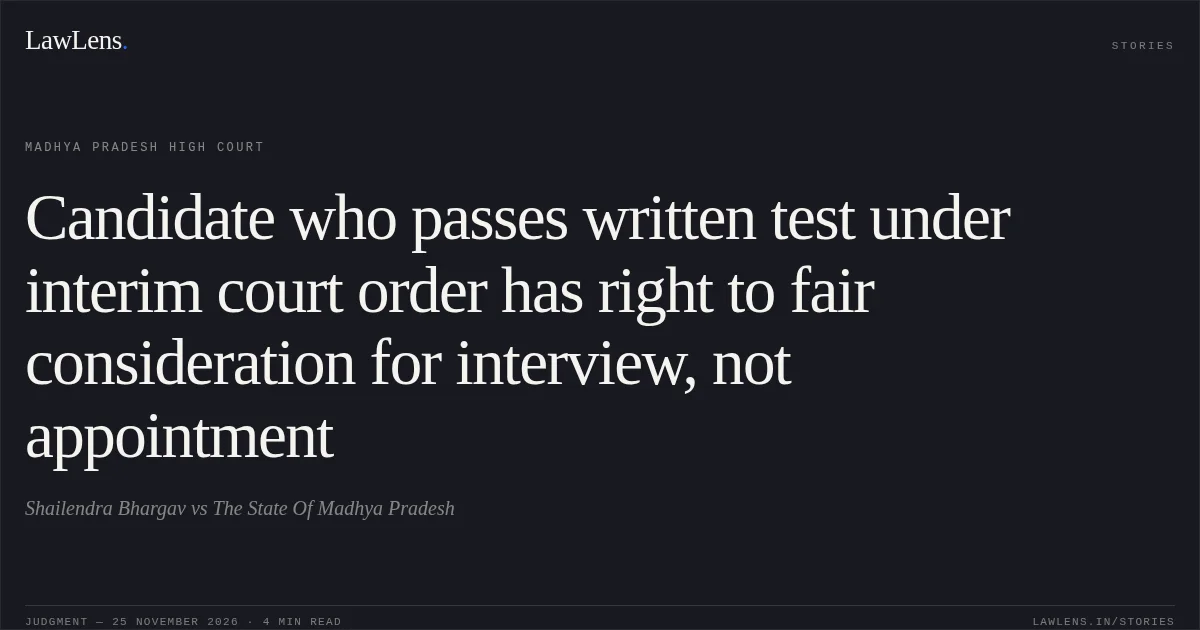
Having passed the written examination under the Court's interim order, the petitioner was entitled to fair consideration for the interview, and the unexplained rejection in the order dated 29.07.2008 cannot be sustained.
¶ 17, 62His age-relaxation eligibility under condition 4(D)(2) must be decided by reference to the 2008 advertisement and recruitment rules, not his present age. Passage of time and delay do not, in these circumstances, defeat his claim.
¶ 24, 56, 63, 64Original Court PDF
Shailendra BhargavvsThe State Of Madhya Pradesh
Click to open original judgment
Original judgment, available to read, download and summarize on LawLens.in