Facts
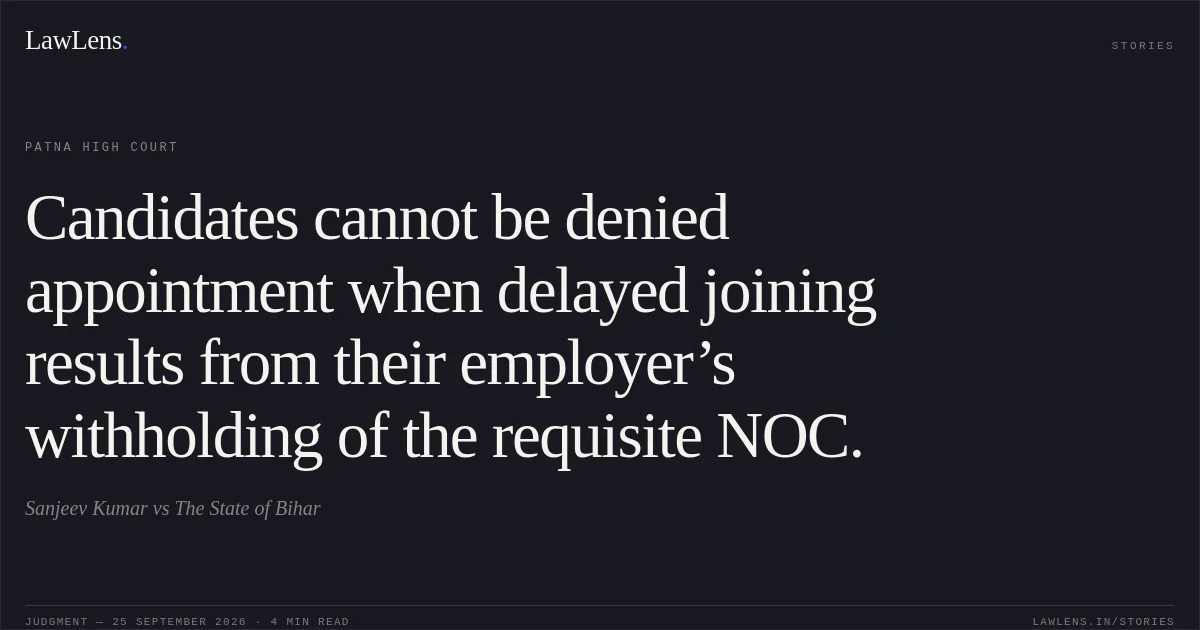
Both petitioners were serving in the Indian Air Force and, after obtaining permission through proper channel, participated in the Bihar Public Service Commission’s 60th–62nd Combined Competitive Examination and, in Shahid Eqwal’s case, the 63rd Combined Competitive Examination as well.
Source reference: paras. 2, 7, 28They successfully cleared the preliminary examination, mains examination and interview and were provisionally selected for appointment as Deputy Superintendents of Police in the Bihar Police Service.
Source reference: paras. 2, 7, 28Their appointment/joining required submission of a relieving order, No Objection Certificate or discharge certificate from the Indian Air Force.
Source reference: paras. 7, 11, 28–29.1, 32–34The Air Force did not initially issue the requisite documents.
Source reference: paras. 7, 11, 28–29.1, 32–34The petitioners challenged that refusal before the Armed Forces Tribunal or the Delhi High Court and simultaneously informed the Bihar authorities of the pending proceedings.
Source reference: paras. 7, 11, 28–29.1, 32–34The State authorities extended their joining time on several occasions.
Source reference: paras. 7, 11, 28–29.1, 32–34Sanjeev Kumar was eventually discharged from service with effect from 20 December 2024 pursuant to proceedings before the Delhi High Court, while Shahid Eqwal was discharged on 30 September 2025 upon completion of his regular tenure.
Source reference: paras. 2, 7–9, 17–22, 30After obtaining discharge documents, both petitioners requested permission to join the post.
Source reference: paras. 2, 7–9, 17–22, 30Their requests were rejected on the ground that they had failed to join within the prescribed or extended period and that the vacancies had been carried forward to subsequent recruitments under Resolution No. 2374 dated 16 July 2007.
Source reference: paras. 2, 7–9, 17–22, 30Issues
Whether the petitioners’ failure to join within the prescribed or extended period, caused by the non-issuance of NOC/discharge certificates by the Indian Air Force and their pursuit of legal remedies, could be treated as voluntary non-joining under paragraphs 15 and 16 of Resolution No. 2374 dated 16 July 2007?
Source reference: paras. 28–30, 37–41Whether the State authorities acted arbitrarily and without proper application of mind in rejecting the petitioners’ requests after repeatedly extending their joining time and without assigning cogent reasons for refusing further extension?
Source reference: paras. 32–36.2Whether the petitioners were entitled to have their joining accepted notwithstanding the fact that the vacancies had been carried forward and appointments had subsequently been made against them?
Source reference: paras. 20–22, 35–44Law Applied
The Court applied paragraphs 15 and 16 of General Administration Department Resolution No. 2374 dated 16 July 2007, under which a selected candidate is ordinarily required to join within the prescribed period and an unfilled vacancy may be carried forward to the next requisition.
Source reference: para. 30However, the Court held that such provisions could not operate mechanically where non-joining was caused by circumstances beyond the candidate’s control.
Source reference: para. 30Relying on E.P. Royappa v. State of Tamil Nadu, the Court reiterated that arbitrariness is incompatible with equality, and relying on Maneka Gandhi v. Union of India, that State action must be fair, just and reasonable.
Source reference: paras. 4.1–4.2, 13Under Narender Singh v. State of Haryana, (2022) 3 SCC 286, a meritorious candidate cannot be denied appointment for delay or non-production of an NOC attributable to the employer and not to the candidate.
Source reference: paras. 31.1, 37Kumari Laxmi Saroj v. State of Uttar Pradesh, Civil Appeal No. 9040 of 2022, similarly establishes that a candidate should not suffer for delay in obtaining a required certificate where the delay is not attributable to the candidate.
Source reference: paras. 31.2, 38The Court also relied on East Coast Railway v. Mahadev Appa Rao, (2010) 7 SCC 678, which requires public authorities to apply their minds and provide reasons for administrative decisions; mechanical or unreasoned orders are legally vulnerable as arbitrary.
Source reference: paras. 31.3, 36Reasoning
The Court found that the petitioners had not deliberately abandoned their appointments.
Source reference: para. 34They had obtained permission to participate in the selection process, completed all stages of selection, promptly sought the required NOC or discharge documents, pursued legal remedies when those documents were refused, and kept the State authorities informed.
Source reference: paras. 34, 36.2, 37.1–37.3The State’s repeated extensions of joining time, granted even while Resolution No. 2374 was in force, demonstrated that the authorities were aware of and had recognised the exceptional circumstances.
Source reference: paras. 32–33Having extended the time earlier, the authorities were required to explain why further extension or acceptance of joining was refused after the petitioners finally obtained their discharge certificates.
Source reference: paras. 35–36.1The impugned orders did not provide cogent reasons and merely invoked the expiry of the joining period and the carry-forward policy.
Source reference: paras. 35–36.1Applying the principles against arbitrariness and mechanical decision-making, the Court held that paragraphs 15 and 16 of the Resolution could not be used as a bar in these peculiar circumstances, since the delay was not attributable to the petitioners.
Source reference: paras. 37–41Holding
The Court set aside the rejection orders and the communications carrying forward the vacancies—Letter No. 3011 dated 27 February 2026 and Letter No. 6267 dated 27 June 2022 in CWJC No. 4936 of 2026, and Letter No. 2745 dated 5 March 2025 and Letter No. 10137 dated 10 October 2022 in CWJC No. 12375 of 2025.
The respondents were directed to accept both petitioners’ joining as Deputy Superintendents of Police within 30 days, subject to verification of documents and completion of other formalities.
Source reference: para. 44The petitioners were to be treated as having joined from the date of actual joining pursuant to the Court’s order and were held entitled to salary and other admissible benefits only from the date of actual joining, in accordance with the applicable rules.
Source reference: para. 45The writ petitions were accordingly allowed, with no order as to costs.
Source reference: paras. 46–47Original Court PDF
Sanjeev KumarvsThe State of Bihar
Click to open original judgment
Original judgment, available to read, download and summarize on LawLens.in