Facts
The appellant applied for the post of Additional District Judge under the Rajasthan Judicial Service Rules, 2010.
Source reference: no citationFollowing a 2011 amendment to Rule 41, a minimum qualifying benchmark of 25% marks in the viva-voce (7.5 out of 30) was introduced
Source reference: para. 7The appellant secured 161/250 in the written exam (11th rank in aggregate merit) but was awarded 7/30 in the viva-voce
Source reference: para. 8Consequently, he was disqualified for falling short of the interview cut-off by 0.50 marks
Source reference: para. 8The appellant challenged the vires of Rule 41. During the pendency of the writ, the State further amended the rules in 2017 to delete the interview cut-off
Source reference: para. 10The High Court dismissed the writ, terming the challenge "academic" due to the 2017 amendment and holding that previous appointments could not be disturbed
Source reference: para. 11Issues
1. Whether the introduction of a minimum qualifying mark for viva-voce in judicial recruitment is constitutionally valid and consistent with the Shetty Commission recommendations
Source reference: para. 3, 172. Whether a candidate, after participating in a selection process and failing, is legally estopped from challenging the recruitment rules
Source reference: para. 203. Whether the 2017 deletion of the rule rendered the challenge to the 2011 recruitment academic
Source reference: para. 11, 28Law Applied
The Court applied the principle that Shetty Commission recommendations are non-mandatory guidelines, as established in Mahinder Kumar v. High Court of Madhya Pradesh, and must yield to validly enacted statutory service rules
Source reference: para. 17It relied on Syed T.A. Naqshbandi v. State of JK and Malik Mazhar Sultan v. UP Public Services Commission to affirm that recruitment must strictly follow existing statutory rules
Source reference: para. 18the Court applied the doctrine of estoppel as articulated in Om Prakash Shukla v. Akhilesh Kumar Shukla, Madan Lal v. State of J K, and Dhananjay Malik v. State of Uttaranchal, which prevents unsuccessful candidates from challenging the selection criteria after voluntarily participating in the process
Source reference: paras. 21–23, 30Reasoning
The Court reasoned that the 25% interview cut-off was not arbitrary but a rational benchmark to assess intellectual and personal qualities essential for a District Judge, which a written test cannot fully capture
Source reference: para. 19It rejected the appellant's reliance on the Shetty Commission, noting that once the State frames statutory rules under its legislative competence, those rules govern the process regardless of prior general guidelines
Source reference: para. 17The Court highlighted that the appellant participated in the process with "eyes wide open" and only challenged the rules after failing, thus attracting the bar of estoppel
Source reference: para. 20, 30the Court observed that granting relief after a decade would cause administrative chaos ("Pandora’s box"), disturb settled seniority of serving judges, and violate the rights of other candidates who accepted their disqualification under the same rules
Source reference: paras. 24–27Holding
The Supreme Court dismissed the appeal and affirmed the High Court's judgment
The Court held that the challenge to Rule 41 was academic following its deletion in 2017
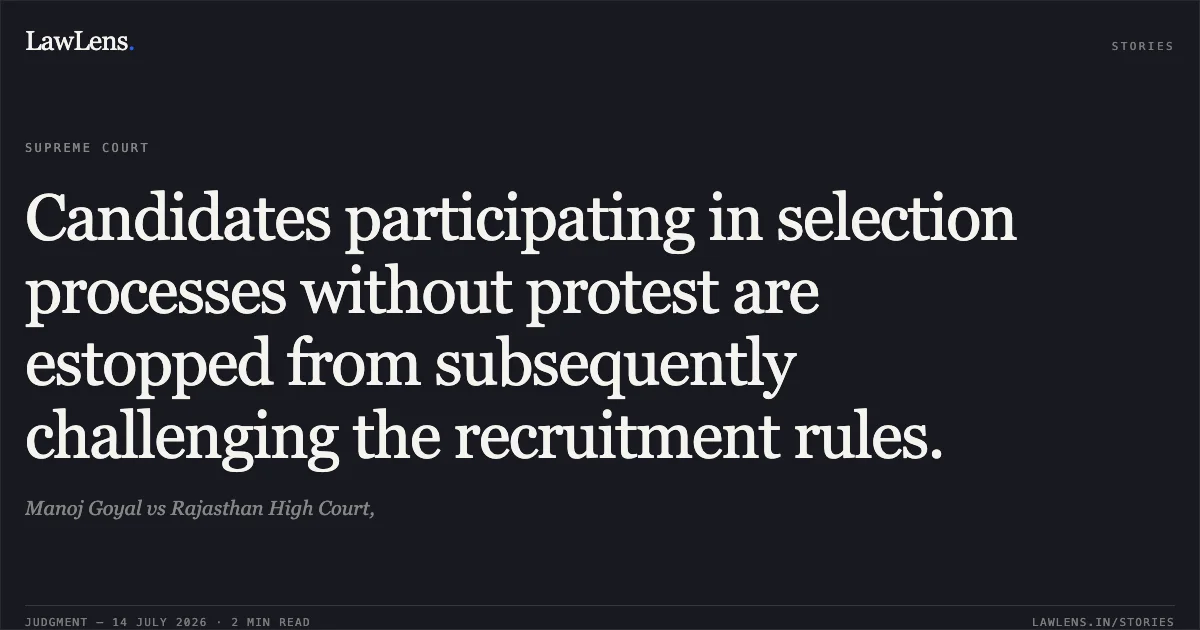
Source reference: para. 28It further held that the interview cut-off was within legislative competence and that the appellant, having participated without protest, was estopped from challenging the results
Source reference: para. 28, 30No relief of appointment or retrospective seniority could be granted as it would disrupt the judicial cadre and administrative finality
Source reference: paras. 24, 29Acts & Sections Cited
1 provisions across 1 statute referred to in this judgment. Linked provisions open on LawLens.
Rajasthan Judicial Service Rules, 20101
Original Court PDF
Manoj GoyalvsRajasthan High Court,
Click to open original judgment
Original judgment, available to read, download and summarize on LawLens.in


![Subsequent exoneration does not retrospectively invalidate a finalized promotion select list.. UNNIKRISHNAN M vs M/o Environment And Forests. CAT - ['Ernakulam']. LawLens](/stories/thumbnails/subsequent-exoneration-does-not-retrospectively-invalidate-a-finalized-promotion-select-li-ce80a0e84f2f4887857271e8b4341c42.webp)