01Facts
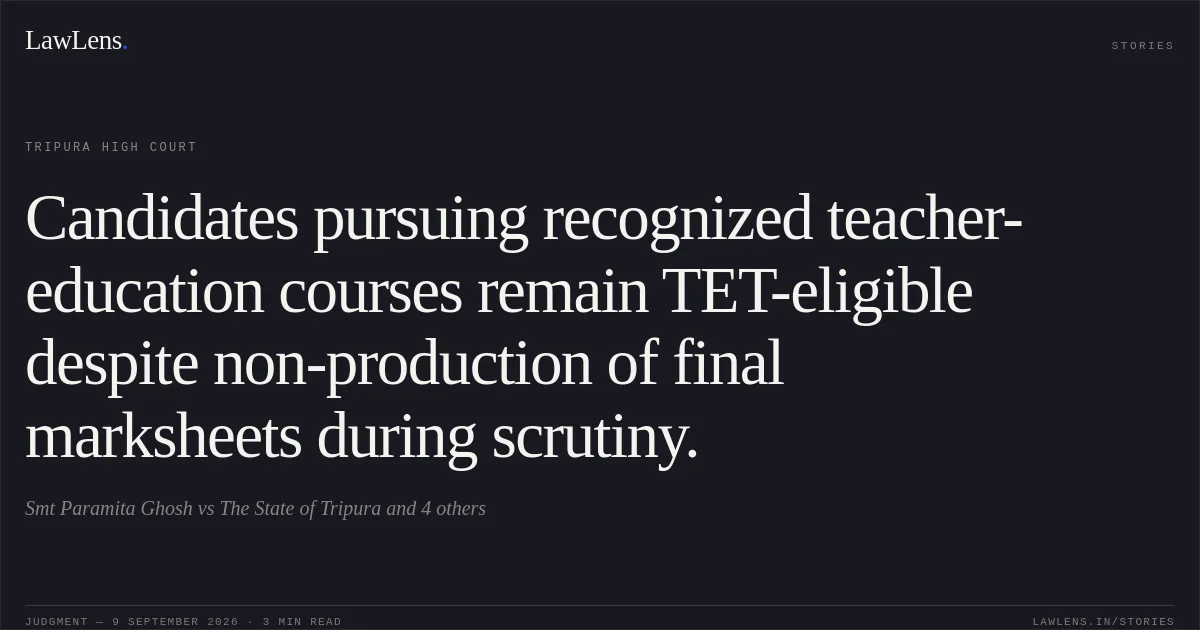
The petitioner had passed the Madhyamik Examination in 2017 and the Higher Secondary Examination in 2019. She enrolled in the NCTE-recognised D.El.Ed. course for the 2023–25 session and had completed the Part-I and Part-II examinations, though the final result and marksheet were awaited when she applied for the Tripura Teachers’ Eligibility Test (T-TET) 2024.
p. 3She appeared in T-TET Paper-I and secured 102 marks, which was above the qualifying threshold.
pp. 5–6The T-TET 2024 Prospectus permitted candidates pursuing B.Ed./D.El.Ed. courses to appear provisionally, but required them to produce the final pass marksheet during document scrutiny, failing which their candidature would be cancelled.
p. 6A similar requirement was reiterated in the notice dated 26 June 2025, and the petitioner’s name was not included in the list of candidates eligible for issuance of TET certificates dated 13 December 2025 because she had not produced the final marksheet during scrutiny.
pp. 6–8During the pendency of the writ petition, the petitioner’s final D.El.Ed. result was published and the marksheet was issued.
pp. 7–802Issues
i.Whether a candidate who was pursuing an NCTE-recognised D.El.Ed. course when appearing in T-TET could be treated as eligible under Clause 5(ii) of the NCTE Guidelines merely because she had not produced the final course marksheet during document scrutiny.
pp. 10–14ii.Whether the stipulation in the T-TET 2024 Prospectus and the notice dated 26 June 2025, requiring production of the final B.Ed./D.El.Ed. marksheet during scrutiny and providing for cancellation of candidature otherwise, was legally sustainable in the petitioner’s circumstances.
pp. 6–8, 13–14iii.Whether the petitioner was entitled to verification of her subsequently-issued original documents and issuance of the TET certificate.
pp. 13–1403Law Applied
The Court applied Clause 5(i)–(ii) of the NCTE Guidelines dated 11 February 2011, under which persons possessing the prescribed academic and professional qualifications, as well as persons pursuing an NCTE- or RCI-recognised teacher-education course, are eligible to appear in the TET.
p. 4, 10It also relied on the NCTE notification dated 23 August 2010 prescribing the minimum qualifications for appointment as teachers in Classes I–V and VI–VIII.
pp. 4–5Under the guidelines, a candidate securing 60% or more in the TET is treated as having passed, subject to the applicable relaxation for reserved categories, and the appropriate Government is required to issue TET certificates to successful candidates.
p. 4The Court followed Omkar Singh & Ors. v. State of Uttar Pradesh & Ors., (2021) 14 SCC 486, which held that “pursuing” means being admitted to and undergoing the teacher-training course; completion of the examination or declaration of the result by the date of applying for TET cannot be added as an extra eligibility condition.
pp. 10–13The Court also relied on its earlier decision in Anjan Das, which granted comparable relief to a similarly situated candidate.
pp. 13–14Provisions in the judgment · 1 · Linked ones open on LawLens
Right of Children to Free and Compulsory Education Act, 2009 Section 23
04Reasoning
The petitioner was admittedly enrolled in and pursuing the recognised D.El.Ed. course when she applied for and appeared in T-TET 2024. Under Clause 5(ii) of the NCTE Guidelines and Omkar Singh, that status was sufficient to make her eligible to appear in the TET; the authorities could not impose an additional condition that the final course marksheet must already have been issued or produced by the date of scrutiny.
pp. 10–13Since the petitioner secured 102 marks, she had also satisfied the TET qualifying requirement.
pp. 5–6, 13Although the respondents relied on the conditions in the Prospectus and stated that candidates were bound by them, they did not produce any material demonstrating that the petitioner was otherwise ineligible or that her subsequently-issued D.El.Ed. qualification was invalid.
pp. 8–9, 13The Court therefore treated the failure to produce the final marksheet during the original scrutiny period as insufficient, by itself, to defeat the petitioner’s substantive eligibility, particularly after she had obtained and could produce the final marksheet.
pp. 13–1405Holding
The writ petition was allowed. The Court held that the petitioner, having pursued the recognised D.El.Ed. course while appearing in T-TET and having secured qualifying marks, was entitled to consideration for issuance of the TET certificate.
p. 14The respondents were directed to permit her to produce her original documents for verification and thereafter issue the TET certificate within three months from the date of judgment, provided she fulfilled all eligibility criteria for T-TET.
p. 14The writ petition and any pending applications were accordingly disposed of.
p. 14Original Court PDF
Smt Paramita GhoshvsThe State of Tripura and 4 others
Click to open original judgment
Original judgment, available to read, download and summarize on LawLens.in