Facts
The petitioners challenged the Select List dated 21 November 2025 for recruitment to the posts of Public Prosecutor, Additional Public Prosecutor and Assistant Public Prosecutor under the Assam State Prosecution Service Rules, 2023.
Source reference: pp. 47–48They also questioned the selection methodology, including the viva-voce process, marking scheme, non-retention of documents produced by candidates, and the eligibility of certain selected candidates.
Source reference: pp. 47–48The State advertised 299 posts—26 Public Prosecutors, 88 Additional Public Prosecutors and 185 Assistant Public Prosecutors. Of 5,238 applications, 4,659 candidates were issued call letters and 2,390 appeared for the viva-voce test.
Source reference: pp. 60–63, 72–73Three Selection Boards were constituted under amended Rule 15, and they jointly formulated a proficiency-cum-skill viva-voce test carrying 100 marks: 70 marks for professional and analytical skills, 20 for personality and temperament, and 10 for academic performance.
Source reference: pp. 63–69The viva-voce tests were conducted between August 2024 and April 2025. The Boards prepared a consolidated merit and recommended list on 21 June 2025, and the Select List was published on 21 November 2025.
Source reference: pp. 72–75The petitioners, having participated in the selection process, filed the writ petition on 7 January 2026 after their names were not included in the Select List.
Source reference: pp. 72–75Appointment orders were subsequently issued to 241 candidates on 15 March 2026.
Source reference: p. 76Issues
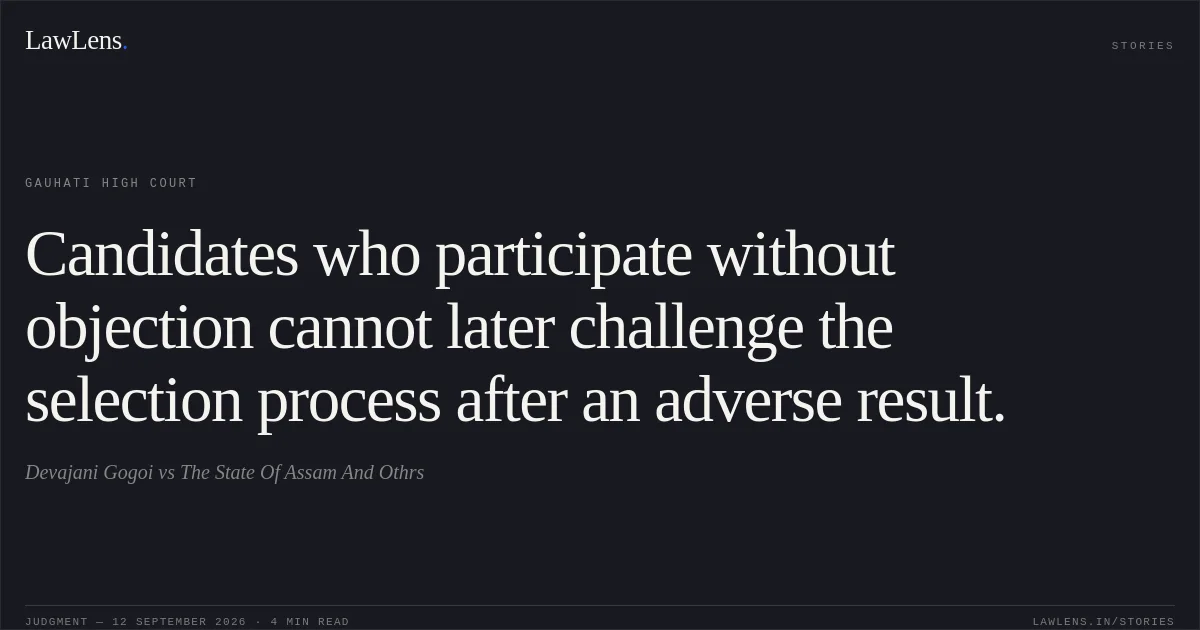
Whether the petitioners, having participated in the selection process without objection and having challenged it only after being unsuccessful, had the locus standi to assail the selection process.
Source reference: pp. 99–120Whether the selection process and Select List dated 21 November 2025 were illegal, arbitrary, non-transparent or violative of Articles 14 and 16 of the Constitution.
Source reference: pp. 120–137Law Applied
The Court applied Rules 5, 7, 15 and 19 of the Assam State Prosecution Service Rules, 2023.
Source reference: pp. 51–58Rule 19(ii) authorised the Selection Board to devise a proficiency-cum-skill viva-voce test for assessing drafting, analytical and presentation skills, mental agility, grasp of arguments and knowledge of judicial precedent; Rule 19(iv) required a true and faithful record of the Board’s proceedings.
Source reference: pp. 51–58The Court held that the notification dated 20 June 2024, issued under Article 162 of the Constitution, validly empowered the Selection Boards to devise the methodology.
Source reference: pp. 100–102It relied on Madan Lal v. State of J&K, Dr. G. Sarana v. University of Lucknow, Sadananda Halo v. Momtaz Ali Sheikh, Pradeep Kumar Rai v. Dinesh Kumar Pandey, Karnati Ravi v. Commissioner, Mohd. Mustafa v. Union of India and Tajvir Singh Sodhi v. State of J&K for the principle that an unsuccessful candidate who participates without protest generally cannot challenge the selection after the result is adverse.
Source reference: pp. 104–118The recognised exceptions include selection contrary to statutory rules, application of undisclosed or altered criteria, and apparent illegality or mala fides; the Court also considered Raj Kumar v. Shakti Raj, Dr. (Major) Meeta Sahai v. State of Bihar, Salam Samarjeet Singh v. High Court of Manipur and Ramjit Singh Kardam v. Sanjeev Kumar.
Source reference: pp. 104–118Judicial review of selection processes is limited: courts cannot substitute their assessment for that of an expert Selection Board absent proven mala fides, statutory violation or inherent arbitrariness, as held in Sadananda Halo and Tajvir Singh Sodhi.
Source reference: pp. 134–136Reasoning
The Court held that the petitioners were aware of Rule 19(ii), the notification constituting the Boards, and the viva-voce instructions before participating.
Source reference: pp. 118–120Petitioners 1 and 2 appeared for two categories and Petitioner 3 appeared for three categories, yet none objected to the methodology, marking scheme or requirement to produce professional documents before the results were declared. Petitioner 4 did not even appear for the viva-voce.
Source reference: pp. 118–120The Court therefore applied the rule against approbation and reprobation and found that the petitioners’ challenge was an attempt to question the process only after an adverse result.
Source reference: pp. 118–120On merits, the Court found that the Boards had statutory and administrative authority to devise the viva-voce method.
Source reference: pp. 120–129The marking scheme was uniformly applied to all candidates and was consistent with the broad criteria in Rule 19(ii); it did not amount to an impermissible alteration of the rules of the game.
Source reference: pp. 120–129The non-retention of the applications, petitions, appeals and judgments produced by candidates did not vitiate the process because those materials were used only to frame questions and assess the candidates’ responses, while the assessment records and marks were maintained.
Source reference: pp. 129–134The Court further held that the allegation concerning candidates appointed to Foreigners Tribunals did not establish ineligibility under Clause 8(iv) of the advertisement, which required a self-declaration concerning continued legal practice and did not itself prescribe an additional eligibility condition.
Source reference: pp. 136–137No mala fides, discriminatory treatment, violation of the statutory rules, or inherent arbitrariness was established.
Source reference: pp. 134–137Holding
The Court answered the first issue against the petitioners, holding that they lacked a sustainable basis to challenge the selection after participating without protest and approaching the Court only after failing to qualify.
It also answered the second issue against them, holding that the selection process and Select List dated 21 November 2025 did not violate Articles 14 or 16 and were not contrary to the Assam State Prosecution Service Rules, 2023.
Source reference: pp. 119–137The writ petition was dismissed for want of merit, with no order as to costs.
Source reference: p. 138Acts & Sections Cited
2 provisions across 1 statute referred to in this judgment. Each provision opens on LawLens.
Code of Criminal Procedure, 19732
Original Court PDF
Devajani GogoivsThe State Of Assam And Othrs
Click to open original judgment
Original judgment, available to read, download and summarize on LawLens.in
![Dismissal for proved financial misconduct involving public funds is not disproportionate.. AJAY KUMAR vs INFORMATION TECHNOLOGY DEPARTMENT. CAT - ['Jammu']. LawLens](/stories/thumbnails/dismissal-for-proved-financial-misconduct-involving-public-funds-is-not-disproportionate-582d896f10fe4a39ac4f0c85f29340d1.webp)