01Facts
The Tamil Nadu Uniformed Services Recruitment Board issued a notification dated 08 March 2022 for recruitment, inter alia, to the post of Sub-Inspector of Police.
¶ 2.1The respondent participated in the selection process, cleared the written examination, certificate verification, physical measurement, endurance and efficiency tests, and viva voce.
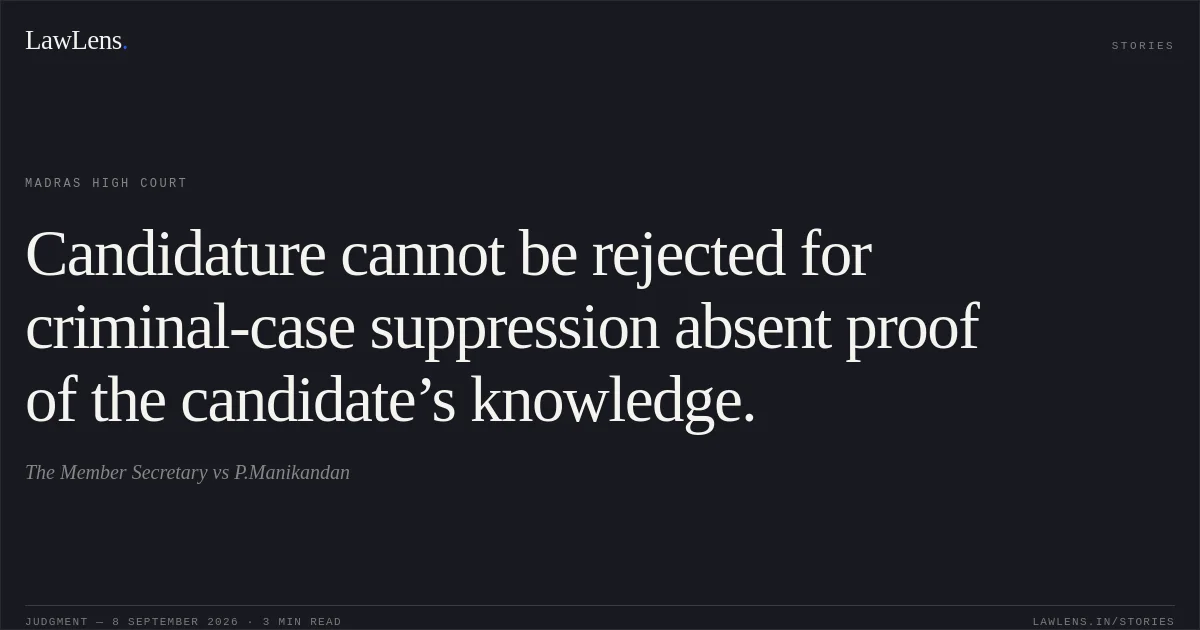
¶ 2.1–2.3His candidature was subsequently rejected on the ground that he had suppressed his involvement in Crime No.32 of 2022 registered at Dhalavaipuram Police Station, Virudhunagar District, while submitting his application on 02 April 2022.
¶ 2.4The respondent contended that he was unaware of the FIR when he submitted the application.
¶ 6The case arose from allegations primarily concerning his brother, and the investigating agency subsequently filed Final Report No.62 of 2022, deleting the respondent’s name from the array of accused.
¶ 6The learned Single Judge allowed the respondent’s writ petition in W.P.(MD) No.5421 of 2023, holding that there was no material to establish knowing suppression. The recruitment authorities challenged that decision in the present writ appeal.
¶ 1–2.402Issues
i.Whether the respondent knowingly suppressed his implication in Crime No.32 of 2022 when he submitted his recruitment application on 02 April 2022?
¶ 8ii.Whether the recruitment authorities were justified in cancelling the respondent’s candidature solely on the ground of alleged suppression of the pending criminal case, without examining his knowledge of the case, the seriousness of the allegations, and the subsequent deletion of his name from the final report?
¶ 9–1503Law Applied
The Court applied the principles laid down by the three-Judge Bench of the Supreme Court in Avtar Singh v. Union of India, (2016) 8 SCC 471, namely that information regarding arrest, conviction, acquittal or pendency of a criminal case must be truthful; however, cancellation of candidature for suppression requires consideration of the relevant circumstances, including the seriousness of the offence, applicable service rules, the nature of the post and the candidate’s knowledge of the fact allegedly suppressed.
¶ 10In particular, the Court relied on the rule that where the criminal case was not known to the candidate when the form was submitted, the appointing authority must still consider the seriousness of the crime, and that knowledge must be attributable to the candidate before he can be held guilty of suppressio veri or suggestio falsi.
¶ 10The Court also relied on Shatrughn Yadav v. Fertilizers and Chemicals Travancore Ltd. (F.A.C.T.), 2026 SCC OnLine SC 1537, which held that termination for alleged suppression must not be mechanical and requires a two-stage inquiry: first, whether there was actual suppression or false information having regard to the candidate’s knowledge; and second, whether, considering the nature of the suppression, the offence, the post, and the outcome of the criminal proceedings, termination or cancellation was justified.
¶ 1404Reasoning
The Court accepted that higher standards of honesty and integrity may be expected from candidates seeking appointment to the police force.
¶ 9Nevertheless, the decisive question was not merely whether an FIR had been registered before the application, but whether the respondent had knowledge of the FIR and deliberately failed to disclose it.
The authorities rejected his candidature solely on the basis that Crime No.32 of 2022 pre-dated the application; they did not conduct any inquiry into whether he knew of the registration of the case on 02 April 2022 or deliberately withheld the information.
¶ 11, 15The Court further noted that the investigating agency had found the respondent uninvolved and had deleted his name from the final report, while the department itself was aware of that development.
¶ 12Since no material established that the respondent knew of the criminal case when he submitted the application, the essential element of deliberate suppression was absent.
¶ 13, 15The Court also emphasised that an FIR is only an allegation and cannot, by itself, conclusively establish guilt, character or unsuitability, particularly where the candidate is subsequently exonerated.
¶ 16–1905Holding
The Court held that the recruitment authorities failed to establish that the respondent knowingly or deliberately suppressed his involvement in Crime No.32 of 2022.
¶ 15, 21Their decision was based on a mechanical assumption that the existence of a pre-application FIR necessarily amounted to suppression, contrary to the principles in Avtar Singh and Shatrughn Yadav.
¶ 15, 21The writ appeal was dismissed, the order of the learned Single Judge was affirmed, and the connected miscellaneous petitions were closed. There was no order as to costs.
¶ 22Original Court PDF
The Member SecretaryvsP.Manikandan
Click to open original judgment
Original judgment, available to read, download and summarize on LawLens.in