Facts
The complainant, a Scheduled Caste member and Statistical Officer at Kishanganj, alleged that on 26 August 2017 he visited the appellant’s chamber, where the appellant was serving as District Magistrate, to discuss an official file.
Source reference: paras. 2–3The appellant allegedly became angry and abused him using caste-related and vulgar expressions, causing humiliation.
Source reference: paras. 2–3After the complainant’s alleged attempt to lodge an FIR at the SC/ST Police Station was unsuccessful, he instituted a complaint on 12 September 2017.
Source reference: paras. 2–3The Special Judge (SC/ST Act), Kishanganj, took cognizance on 20 September 2017 of offences under Sections 3(1)(r), (s), (u), (v) and 4 of the Scheduled Castes and the Scheduled Tribes (Prevention of Atrocities) Act, 1989, and issued summons to the appellant.
Source reference: paras. 2–3The appellant challenged the cognizance order, contending principally that the alleged incident occurred inside a closed chamber and therefore not at a “place within public view,” and that the cognizance order had been passed hastily without proper examination of the materials.
Source reference: para. 4Issues
1. Whether the alleged caste-based abuse inside the appellant’s closed chamber constituted an offence under Sections 3(1)(r) and (s) of the SC/ST Act, particularly when the incident did not occur at a “place within public view”
Source reference: paras. 4–6, 92. Whether the allegations disclosed offences under Sections 3(1)(u), 3(1)(v) and 4 of the SC/ST Act
Source reference: para. 43. Whether the Special Judge’s order taking cognizance, passed shortly after filing of the complaint and without proper scrutiny of the materials, was legally sustainable
Source reference: paras. 4, 9Law Applied
The Court applied Sections 3(1)(r), 3(1)(s), 3(1)(u), 3(1)(v) and 4 of the Scheduled Castes and the Scheduled Tribes (Prevention of Atrocities) Act, 1989.
Source reference: no citationSections 3(1)(r) and (s), as relevant to the case, require the alleged intentional insult, intimidation or caste-based abuse to occur in a place within public view.
Source reference: no citationThe Court relied on Gunjan alias Girija Kumari v. State (NCT of Delhi) & Anr., 2026 SCC OnLine SC 834, which followed Karuppudayar v. State, 2025 SCC OnLine SC 215, for the principle that a place is “within public view” only where members of the public can witness or hear the alleged utterance; an incident occurring within the four walls of a chamber, where members of the public are not present, does not satisfy that requirement.
Source reference: paras. 5–6The Court also applied the requirement that cognizance must be taken upon proper scrutiny and application of mind to the complaint materials.
Source reference: para. 9Reasoning
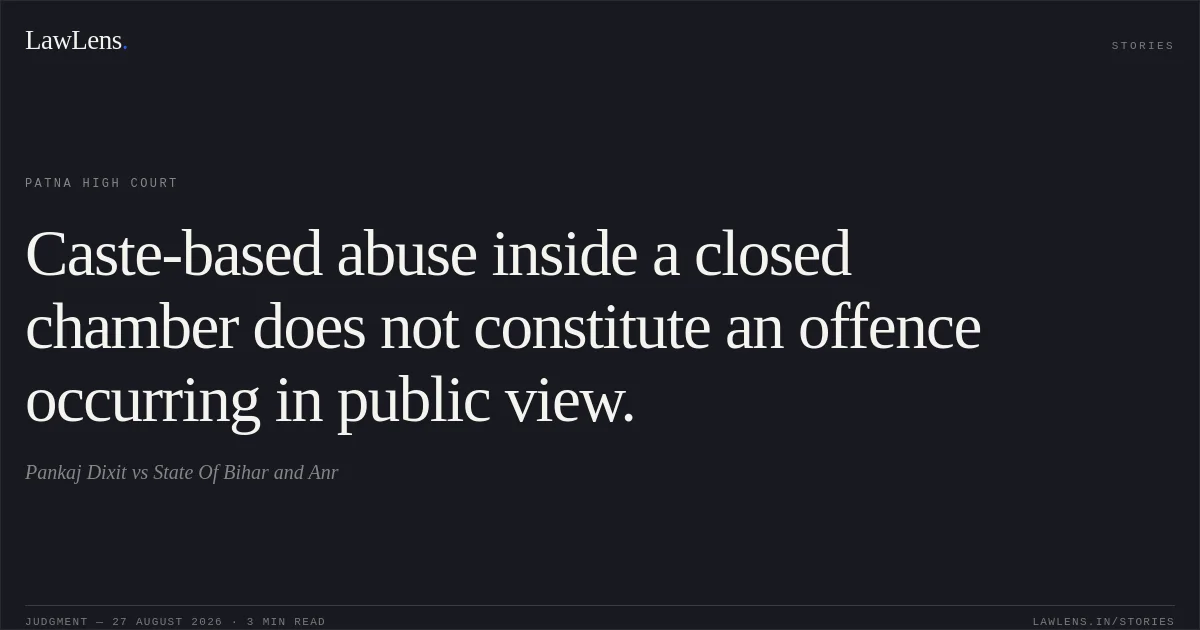
The Court found that the alleged abuse occurred inside the appellant’s chamber, and therefore outside a place within public view as understood in Gunjan and Karuppudayar.
Source reference: paras. 5–6, 9Consequently, the foundational requirement for the alleged offences under Sections 3(1)(r) and (s) was absent.
Source reference: paras. 5–6, 9The Court further noted that the allegations did not disclose the additional acts contemplated under Sections 3(1)(u) and (v), or neglect of duties punishable under Section 4, as asserted by the appellant.
Source reference: para. 4Independently, the Court considered the cognizance order legally infirm because it was passed only eight days after institution of the complaint, without proper scrutiny of the materials or examination of even a single named enquiry witness.
Source reference: paras. 4, 9These circumstances demonstrated haste and lack of adequate application of mind.
Source reference: paras. 4, 9Holding
The Court answered the principal issues in favour of the appellant.
It held that the alleged incident inside the closed chamber did not occur at a place within public view and that the cognizance order suffered from haste and insufficient application of mind.
Source reference: para. 9Accordingly, the order dated 20 September 2017 taking cognizance in Complaint Case No. 37C of 2017/Special Case No. 57 of 2017 under Sections 3(1)(r), (s), (u), (v) and 4 of the SC/ST Act was set aside.
Source reference: paras. 10–11The appeal was allowed.
Source reference: paras. 10–11Acts & Sections Cited
2 provisions across 1 statute referred to in this judgment. Each provision opens on LawLens.
Original Court PDF
Pankaj DixitvsState Of Bihar and Anr
Click to open original judgment
Original judgment, available to read, download and summarize on LawLens.in
![Courts will not interfere with transfers absent mala fides or violation of statutory rules.. M Ramya vs EMPLOYEES STATE INSURANCE CORPORATION (ESIC). CAT - ['Chennai']. LawLens](/stories/thumbnails/courts-will-not-interfere-with-transfers-absent-mala-fides-or-violation-of-statutory-rules-a6845e9ca6f548fca284c51c8351957f.webp)
![Courts cannot direct one-time recruitment age relaxation absent authority in the governing rules or advertisement.. UT OF PUDUCHERRY vs M ANDAL. CAT - ['Chennai']. LawLens](/stories/thumbnails/courts-cannot-direct-one-time-recruitment-age-relaxation-absent-authority-in-the-governing-895d78fde47143e2a8ed0207c4b6a44f.webp)
![A review cannot correct an allegedly erroneous decision absent an error apparent on the record.. Ajit Kumar Jha vs RAILWAY BOARD. CAT - ['Delhi']. LawLens](/stories/thumbnails/a-review-cannot-correct-an-allegedly-erroneous-decision-absent-an-error-apparent-on-the-re-8ac952fd4eba470c92f7da20af72a220.webp)