Facts
Respondent No. 2 lodged FIR No. 37 of 2020 against the appellant and others under Sections 147, 323, 342 and 504 of the Indian Penal Code, 1860 (“IPC”) and Sections 3(1)(r) and 3(1)(s) of the Scheduled Castes and the Scheduled Tribes (Prevention of Atrocities) Act, 1989 (“SC/ST Act”).
Source reference: paras. 3.1–3.2The allegation was that, after one of Respondent No. 2’s sons was injured in a school quarrel, Respondent No. 2 went to the school managed by the appellant, where the appellant and other staff members assaulted him and used caste-based abuses.
Source reference: paras. 3.1–3.2A chargesheet was filed on 17 March 2020, and the Special Judge took cognizance on 8 August 2022.
Source reference: paras. 3.3–3.4The High Court dismissed the appellant’s appeal under Section 14A(1) of the SC/ST Act, holding that the allegations and witness statements disclosed a prima facie case.
Source reference: para. 4A cross-case had also been lodged by the appellant’s wife against Respondent No. 2 concerning an alleged assault at the school.
Source reference: para. 3.6Issues
Whether the alleged caste-based insults or intimidation were made at a place “within public view”, as required under Sections 3(1)(r) and 3(1)(s) of the SC/ST Act?
Source reference: paras. 9–12, 17Whether the FIR and investigation material disclosed specific caste-based words or slurs attributable to the appellant so as to establish a prima facie case under Sections 3(1)(r) and 3(1)(s) of the SC/ST Act?
Source reference: paras. 13–16Whether the summoning order and the High Court’s refusal to interfere with it could be sustained in respect of the offences under the SC/ST Act?
Source reference: paras. 16–19Law Applied
The Court applied Sections 3(1)(r) and 3(1)(s) of the SC/ST Act, which respectively criminalise intentional insult or intimidation with intent to humiliate a member of a Scheduled Caste or Scheduled Tribe, and abuse of such person by caste name, when committed at a place “within public view”.
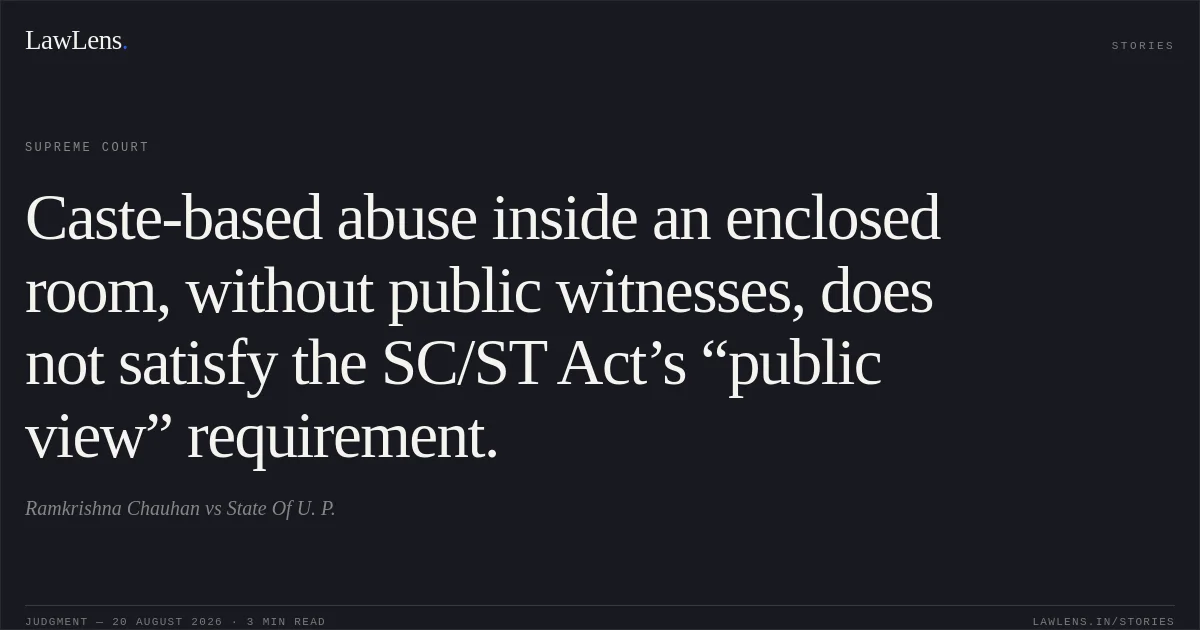
Source reference: para. 10Relying on Hitesh Verma v. State of Uttarakhand, (2020) 10 SCC 710, and Karuppudayar v. State represented by the Deputy Superintendent of Police, Lalgudi, Trichy, 2025 INSC 132, the Court held that “within public view” requires that the place be open and that members of the public be capable of witnessing or hearing the alleged utterance; an occurrence within enclosed premises, where members of the public are not present, does not satisfy the requirement.
Source reference: para. 11Although a court at the cognizance stage need not undertake a meticulous appreciation of evidence, the basic ingredients of the alleged offence must emerge from the FIR, chargesheet and accompanying material.
Source reference: para. 16Reasoning
The Court found that the alleged incident occurred inside an enclosed room in the school, identified as room “A” in the Investigating Officer’s site plan, with no window or public access.
Source reference: para. 12The FIR did not state that any member of the public was present or could hear the alleged caste-based utterances.
Source reference: para. 12Further, the statements of the four school-teacher witnesses described an altercation and scuffle but did not establish that they were inside the room when the alleged abuses were uttered or that they heard any caste-based words; their mere presence elsewhere in the school premises was insufficient to prove “public view”.
Source reference: paras. 14–15The FIR and Respondent No. 2’s statement also contained no specific caste-based words or slurs attributable to the appellant, leaving the allegation general and vague.
Source reference: para. 13Accordingly, the essential statutory ingredients of Sections 3(1)(r) and 3(1)(s) were not disclosed even at the prima facie stage.
Source reference: paras. 16–18Holding
The Supreme Court allowed the appeal and set aside the Allahabad High Court’s judgment dated 10 April 2023.
It held that the offences under Sections 3(1)(r) and 3(1)(s) of the SC/ST Act were not prima facie made out because the alleged utterances were neither shown to have occurred within public view nor specified as caste-based abuses attributable to the appellant.
Source reference: paras. 17–18The proceedings arising from FIR No. 37 of 2020 were quashed against the appellant insofar as they related to those SC/ST Act offences, while the proceedings for the remaining IPC offences were directed to continue.
Source reference: para. 19Acts & Sections Cited
7 provisions across 3 statutes referred to in this judgment. Each provision opens on LawLens.
Scheduled Castes and the Scheduled Tribes (Prevention of Atrocities) Act, 19891
Indian Penal Code, 18605
Code of Criminal Procedure, 19731
Original Court PDF
Ramkrishna ChauhanvsState Of U. P.
Click to open original judgment
Original judgment, available to read, download and summarize on LawLens.in