Facts
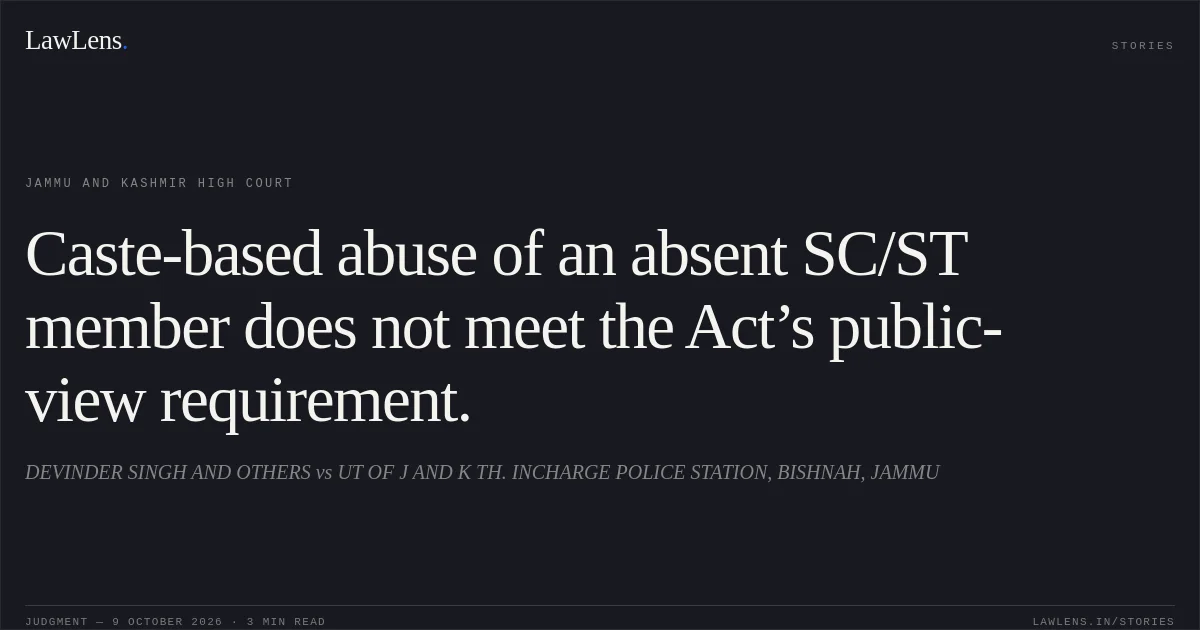
The complainant alleged that the petitioners entered a plot connected with a petrol-pump business and abused and threatened her, including by using caste-based terms referring to her and her husband, who belongs to a Scheduled Caste.
Source reference: pp. 1–3, paras. 1–3The FIR invoked Sections 79, 351(2), 352 and 3(5) of the Bharatiya Nyaya Sanhita, 2023, and Section 3 of the Scheduled Castes and Scheduled Tribes (Prevention of Atrocities) Act, 1989 (“SC/ST Act”).
Source reference: pp. 1–3, paras. 1–3The petitioners maintained that the FIR arose from a dispute over the sale of land and transfer of a petrol-pump dealership, and contended that the SC/ST Act provisions were not attracted because the complainant was not a member of a Scheduled Caste and her husband was absent when the alleged incident occurred.
Source reference: pp. 5–6, paras. 8–9After the Special Judge rejected their bail application, the petitioners sought quashing of the FIR and bail.
Source reference: p. 3, paras. 3–4The High Court considered bail on the basis of the FIR allegations, the parties’ competing accounts of their civil dispute, and the status of the investigation.
Source reference: pp. 3, 8–12, paras. 3–4, 17–26Issues
1. Whether the allegations in the FIR prima facie disclosed an offence under Section 3(1)(r) or 3(1)(s) of the SC/ST Act, where the complainant was not herself a member of a Scheduled Caste and her Scheduled Caste husband was not present during the alleged incident.
Source reference: pp. 9–11, paras. 18–232. Whether, in the circumstances—including the nature of the other alleged offences and the parties’ ongoing civil dispute—the petitioners had made out a case for bail.
Source reference: pp. 8–9, 11–12, paras. 16–17, 24–27Law Applied
Sections 3(1)(r) and 3(1)(s) of the SC/ST Act criminalise, respectively, intentional insult or intimidation with intent to humiliate a member of a Scheduled Caste or Scheduled Tribe in a place within public view, and abuse of such a person by caste name in a place within public view.
Source reference: p. 9, para. 19Caste is determined by birth and is not acquired through marriage to a member of a Scheduled Caste; the Court relied on Sunita Singh v. State of Uttar Pradesh, (2018) 2 SCC 493, for that proposition.
Source reference: p. 10, para. 20Relying on Asmathunnisa v. State of Andhra Pradesh, (2011) 11 SCC 259, the Court stated that, for the “within public view” requirement, the person allegedly insulted must be present and viewed by the public; the Court considered that requirement relevant where the alleged caste-based abuse was directed at a person who was absent.
Source reference: p. 10, para. 22The Court also considered the punishments prescribed for the BNS offences and the SC/ST Act offence in assessing the bail application.
Source reference: p. 8, paras. 16–17Reasoning
The complainant’s marriage to a Scheduled Caste person did not make her a member of that community, so alleged caste-based abuse directed at her would not, on that basis, constitute an offence under Section 3 of the SC/ST Act.
Source reference: p. 10, para. 20Although the FIR also alleged abuse of her husband, the complainant admitted that he was not present at the spot; applying Asmathunnisa, the Court formed the prima facie view that the public-view requirement was not met in respect of the alleged abuse directed at him.
Source reference: pp. 10–11, paras. 21–23The Court left the ultimate determination to the investigating agency, but considered that the SC/ST Act offence was not prima facie made out for the purpose of bail.
Source reference: p. 11, para. 23It also noted that the BNS offences carried comparatively limited terms of imprisonment and that the parties were engaged in a serious dispute concerning the land and petrol-pump dealership, making it possible that the dispute had prompted the FIR.
Source reference: pp. 8, 11–12, paras. 16, 24–26Holding
The Court held that a case for bail had been made out and admitted the petitioners to bail, subject to furnishing a bond and surety of ₹50,000 each, cooperating with the investigation, not tampering with witnesses, not leaving the Union Territory without the Investigating Officer’s prior permission, and not engaging in similar activities.
The investigation was permitted to continue, but any charge sheet against the petitioners could not be filed without the Court’s permission.
Source reference: p. 13, paras. 28–30The complainant was directed to file an affidavit stating whether she had filed and signed the pleadings and vakalatnama in the civil suit brought in her name; the bail application was disposed of, while the quashing petition was listed for a further hearing.
Source reference: p. 13, paras. 28–30Acts & Sections Cited
6 provisions across 3 statutes referred to in this judgment. Each provision opens on LawLens.
Bharatiya Nagarik Suraksha Sanhita, 20231
Bharatiya Nyaya Sanhita, 20234
Scheduled Castes and the Scheduled Tribes (Prevention of Atrocities) Act, 19891
Original Court PDF
DEVINDER SINGH AND OTHERSvsUT OF J AND K TH. INCHARGE POLICE STATION, BISHNAH, JAMMU
Click to open original judgment
Original judgment, available to read, download and summarize on LawLens.in