Facts
The petitioner alleged that Opposite Party No. 2, proprietor of Jai Maa Kali Rice Mill, obtained 17 truckloads of Mansuri rice on credit between 30 January and 8 February 2014 for a total value of ₹52,82,803. After payment of ₹36,16,000, ₹16,66,803 allegedly remained due. The parties subsequently executed an agreement on 31 July 2016 for repayment by January 2017, but the amount allegedly remained unpaid.
Source reference: p.2The petitioner further alleged that, when he demanded payment on 3 December 2021, Opposite Parties Nos. 2 and 3 abused and assaulted him and used caste-based insults. He filed Complaint Case No. 10 of 2022 alleging offences under Sections 406, 420, 323, 506 and 34 of the IPC and Sections 3(1)(r) and 3(1)(s) of the SC/ST Act.
Source reference: pp.2–3The Special Court dismissed the complaint under Section 203 of the Cr.P.C. on 13 December 2022. The petitioner challenged that order before the High Court.
Source reference: p.2The High Court noted that the complaint arose substantially out of a business transaction and outstanding monetary liability, with allegations of abuse, assault and caste-based insults added to the dispute.
Source reference: pp.4–6Issues
1. Whether the Special Court acted illegally in dismissing the complaint under Section 203 of the Cr.P.C. despite the complainant’s allegations and the statements of the inquiry witnesses?
Source reference: pp.3–4, 62. Whether the allegations disclosed offences under Sections 406, 420, 323, 506 and 34 of the IPC warranting criminal prosecution, or whether the complaint was essentially an attempt to recover a civil/business debt through criminal proceedings?
Source reference: pp.4–63. Whether the alleged caste-based abuses satisfied the requirements of Sections 3(1)(r) and 3(1)(s) of the SC/ST Act, particularly the requirement that the insult or intimidation occur in a place within public view?
Source reference: pp.6–7Law Applied
The Court considered Section 203 of the Cr.P.C., which permits dismissal of a complaint where, after examining the complainant and considering the inquiry material, there is insufficient ground for proceeding. It also considered Sections 406, 420, 323, 506 and 34 of the IPC and Sections 3(1)(r) and 3(1)(s) of the SC/ST Act.
Source reference: no citationThe Court relied on Bimla Tiwari v. State of Bihar, (2023) 11 SCC 607, for the principle that criminal proceedings cannot be used as a means of arm-twisting or recovery of money.
Source reference: p.6It further relied on Ramkrishna Chauhan v. State of U.P., 2026 SCC OnLine SC 1676, for the principle that an offence under Sections 3(1)(r) and 3(1)(s) of the SC/ST Act requires the basic ingredients of caste-based insult or intimidation to be established, including occurrence in a place within public view where applicable.
Source reference: pp.6–7The Court also invoked State of Haryana v. Bhajan Lal, 1992 Supp (1) SCC 335, particularly category 7, concerning criminal proceedings instituted maliciously or with an ulterior motive.
Source reference: p.8Reasoning
The High Court examined the complaint, the complainant’s solemn affirmation and the inquiry-witness statements and found that the dominant dispute concerned recovery of ₹16,66,803 arising from business dealings.
Source reference: pp.4–6The witnesses’ responses to the Court’s questions reinforced that the complaint was primarily connected with the outstanding business amount, although allegations of abuse and assault were also made.
Source reference: pp.5–6Applying Bimla Tiwari, the Court held that criminal process could not be employed principally to secure recovery of the alleged debt.
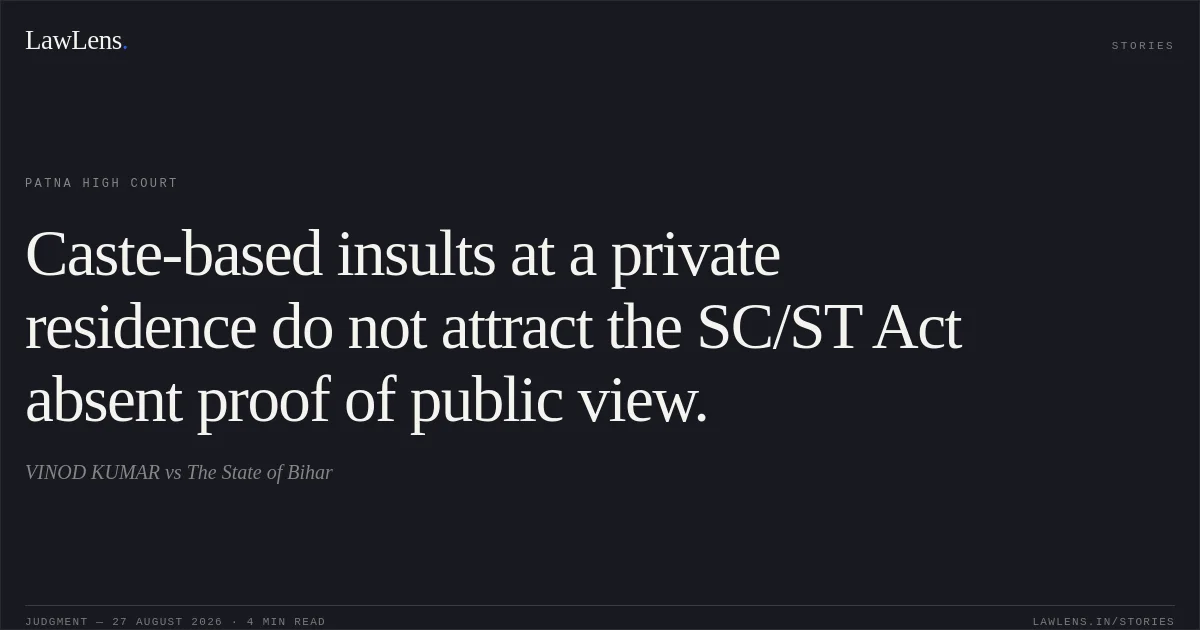
Source reference: p.6Regarding the SC/ST Act allegations, the Court accepted the finding that the occurrence took place at Opposite Party No. 2’s house and that the material did not state that the alleged caste-based abuses were uttered in the presence or hearing of members of the public. Consequently, the statutory requirement of occurrence in a place within public view was not established.
Source reference: pp.6–7In light of the essentially civil nature of the dispute, the insufficient material supporting the alleged criminal offences, and the apparent ulterior purpose of pursuing monetary recovery, the Court treated the complaint as falling within the Bhajan Lal category of malicious prosecution.
Source reference: pp.7–8Holding
The High Court held that the complaint was primarily a device for recovering an outstanding business debt and that the allegations of abuse, assault and caste-based insults did not justify interference with the Special Court’s order.
It further held that the SC/ST Act allegations were not made out because the alleged occurrence was at the house of Opposite Party No. 2 and was not shown to have taken place in a place within public view.
Source reference: pp.6–8The application was accordingly dismissed, and the order dated 13 December 2022 dismissing Complaint Case No. 10 of 2022 under Section 203 of the Cr.P.C. was left undisturbed.
Source reference: p.8Acts & Sections Cited
7 provisions across 3 statutes referred to in this judgment. Each provision opens on LawLens.
Code of Criminal Procedure, 19731
Indian Penal Code, 18605
Scheduled Castes and the Scheduled Tribes (Prevention of Atrocities) Act, 19891
Original Court PDF
VINOD KUMARvsThe State of Bihar
Click to open original judgment
Original judgment, available to read, download and summarize on LawLens.in
![Courts will not interfere with transfers absent mala fides or violation of statutory rules.. M Ramya vs EMPLOYEES STATE INSURANCE CORPORATION (ESIC). CAT - ['Chennai']. LawLens](/stories/thumbnails/courts-will-not-interfere-with-transfers-absent-mala-fides-or-violation-of-statutory-rules-a6845e9ca6f548fca284c51c8351957f.webp)
![Courts cannot direct one-time recruitment age relaxation absent authority in the governing rules or advertisement.. UT OF PUDUCHERRY vs M ANDAL. CAT - ['Chennai']. LawLens](/stories/thumbnails/courts-cannot-direct-one-time-recruitment-age-relaxation-absent-authority-in-the-governing-895d78fde47143e2a8ed0207c4b6a44f.webp)
![A review cannot correct an allegedly erroneous decision absent an error apparent on the record.. Ajit Kumar Jha vs RAILWAY BOARD. CAT - ['Delhi']. LawLens](/stories/thumbnails/a-review-cannot-correct-an-allegedly-erroneous-decision-absent-an-error-apparent-on-the-re-8ac952fd4eba470c92f7da20af72a220.webp)