Facts
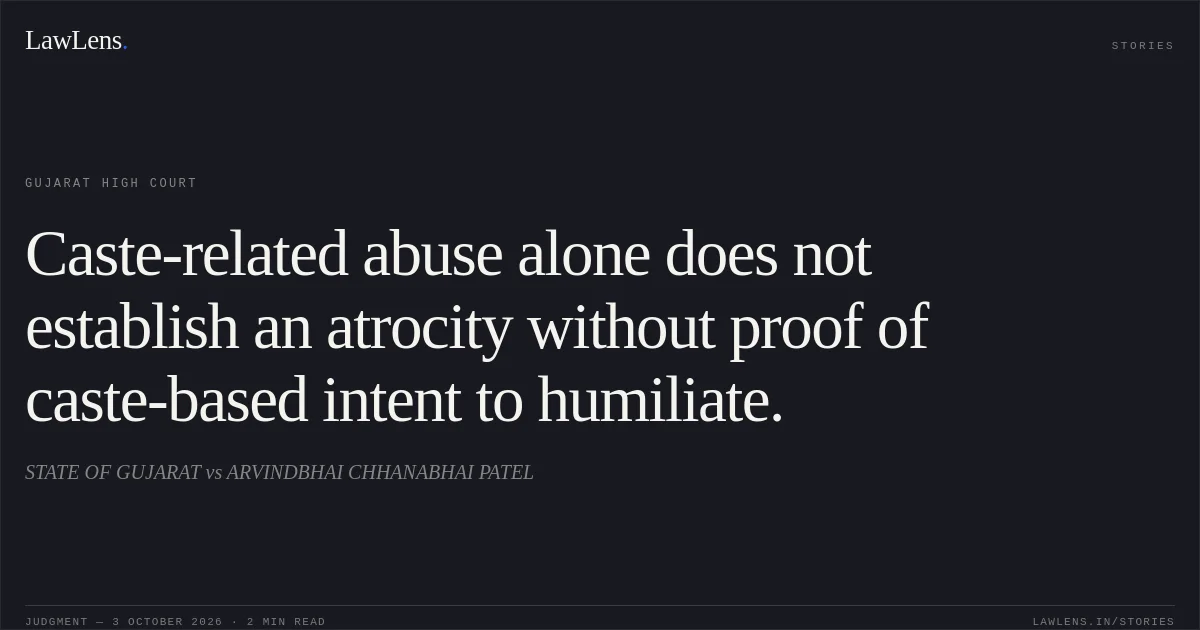
The State appealed under Section 378(1)(3) of the Code of Criminal Procedure against the acquittal of the accused of offences under Sections 323, 427, 504 and 506(2) of the Indian Penal Code and Section 3(1)(10) of the Scheduled Castes and Scheduled Tribes (Prevention of Atrocities) Act, 1989
Source reference: para. 1The complainant alleged that the accused assaulted him, damaged his motorcycle, used caste-related insults and threatened him.
Source reference: paras. 2–2.5The trial court acquitted the accused after finding that the prosecution had not proved the charges beyond reasonable doubt.
Source reference: paras. 2–2.5On appeal, the High Court noted that the accompanying witness did not corroborate the complainant, the FIR was delayed amid settlement discussions, and the evidence raised doubts about the incident and its circumstances.
Source reference: paras. 8–12Issues
Whether the trial court erred in acquitting the accused, including in its appreciation of the prosecution evidence
Source reference: para. 6Whether the acquittal suffered from illegality or perversity warranting appellate interference
Source reference: para. 6Whether the prosecution proved the essential ingredients of the charged offence under Section 3(1)(10) of the Atrocities Act
Source reference: paras. 13, 16–19Law Applied
Under Section 378(1)(3) CrPC, an appellate court may review and reappreciate the evidence in an appeal against acquittal, but must account for the reinforced presumption of innocence; where two reasonable views are possible, the acquittal should not be disturbed, absent a manifest error or a perverse conclusion (Chandrappa v. State of Karnataka, (2007) 4 SCC 415; Rajesh Prasad v. State of Bihar, (2022) 3 SCC 471; Babu Sahebagouda Rudragoudar v. State of Karnataka, (2024) 8 SCC 149)
Source reference: paras. 21–24For the Atrocities Act charge, the prosecution had to establish the essential statutory ingredients, including the requisite caste-linked basis and context for the alleged insult; the Court referred to Shajan Skaria v. State of Kerala and authorities concerning the Act’s provisions on caste-based insults and public view.
Source reference: paras. 16–19The prosecution also bore the burden of proving the IPC charges beyond reasonable doubt.
Source reference: paras. 12, 25Reasoning
The High Court found that the complainant’s account lacked corroboration from the accompanying witness, that the delay in reporting followed unsuccessful settlement discussions, and that the medical evidence did not support the injuries as described.
Source reference: paras. 8–12The evidence also disclosed a village-election dispute and did not conclusively establish the place and circumstances of the incident.
Source reference: paras. 8–12As to the Atrocities Act charge, the prosecution did not establish in whose presence the alleged words were spoken or how the accused intended to insult the complainant on account of caste.
Source reference: para. 13Applying the reinforced presumption of innocence and the standard governing appeals against acquittal, the Court found no perversity or material error in the trial court’s assessment.
Source reference: paras. 15, 21–26Holding
The Court held that the prosecution had failed to prove the charges beyond reasonable doubt and that the acquittal disclosed no error warranting appellate intervention.
The State’s appeal was dismissed, the acquittal was confirmed, the bail bond was cancelled, and the record and proceedings were directed to be returned to the trial court.
Source reference: para. 27Acts & Sections Cited
13 provisions across 4 statutes referred to in this judgment. Each provision opens on LawLens.
Code of Criminal Procedure, 19735
Indian Penal Code, 18605
Scheduled Castes and the Scheduled Tribes (Prevention of Atrocities) Act, 19892
Protection of Civil Rights Act, 19551
Original Court PDF
STATE OF GUJARATvsARVINDBHAI CHHANABHAI PATEL
Click to open original judgment
Original judgment, available to read, download and summarize on LawLens.in