Facts
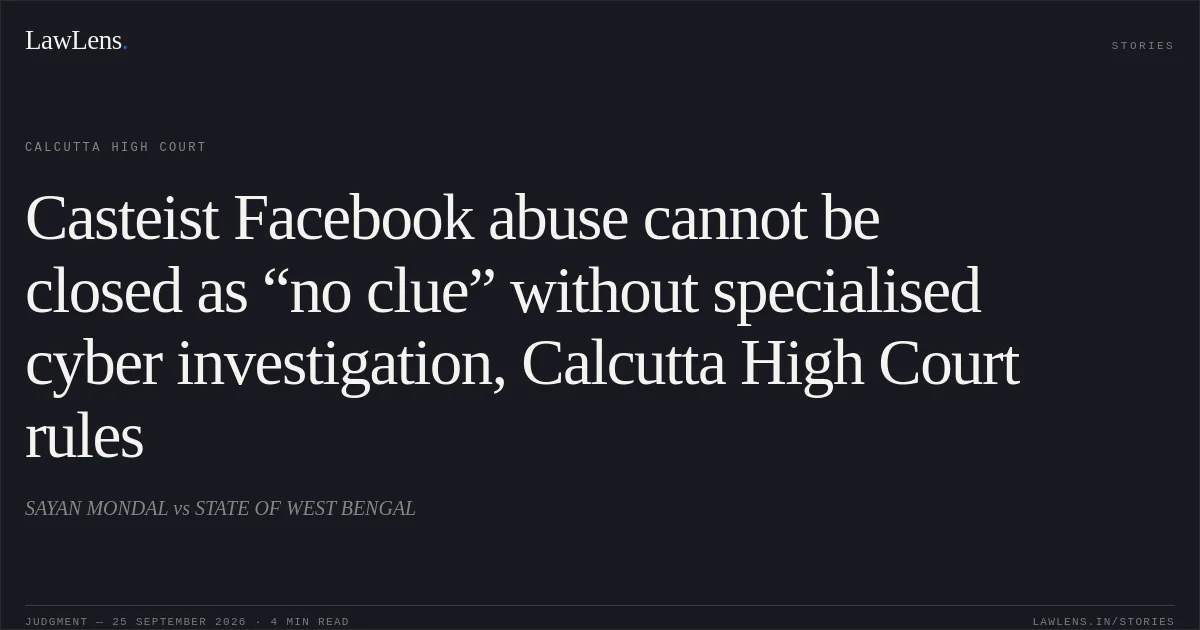
The petitioner, a member of the Scheduled Caste community, lodged a complaint alleging that Rabiul Islam Bulbul and Sayan Dutta, through Facebook, posted abusive and casteist remarks targeting his caste, religion, deity, and family. Screenshots and digital links were enclosed with the complaint.
Source reference: para. 2The complaint resulted in Behala Police Station Case No. 274 dated 17 October 2022 under Sections 3(1)(r) and 3(1)(s) of the Scheduled Castes and the Scheduled Tribes (Prevention of Atrocities) Act, 1989, subsequently registered as Special Case No. 89 of 2022.
Source reference: para. 2During investigation, the petitioner’s statement was recorded under Section 164 of the Code of Criminal Procedure, statements of independent witnesses were recorded under Section 161, and the digital material was formally seized.
Source reference: para. 3The police nevertheless submitted a “Final Report True—No Clue” on the ground that Facebook, despite being approached through the Cyber Police Station, had not supplied the actual user particulars.
Source reference: para. 3The petitioner filed a na-raji/protest petition, which the Special Court rejected on 27 June 2023. The court accepted the FRT and dropped the proceeding, also relying on the fact that charge-sheets had been filed in three other cases instituted by the petitioner.
Source reference: para. 3Issues
1. Whether the Special Court was justified in accepting the “Nil/No Clue” final report and rejecting the petitioner’s na-raji petition merely because charge-sheets had been filed in other, separate cases instituted by him?
Source reference: para. 72. Whether the materials collected during investigation, including the electronic screenshots, digital links, and the petitioner’s Section 164 statement, required further investigation under Section 173(8) of the Cr.P.C.?
Source reference: paras. 7–103. Whether the investigating agency could close the case solely because the local cyber inquiry did not obtain user particulars from Facebook, without pursuing specialised cyber-forensic investigation?
Source reference: para. 10Law Applied
The Court exercised jurisdiction under Section 482 read with Sections 395 and 397 of the Cr.P.C. and considered the power of further investigation under Section 173(8) Cr.P.C.
Source reference: no citationUnder Sections 3(1)(r) and 3(1)(s) of the SC/ST Act, caste-based insults or abuses, including those made in a place within public view, constitute an offence; the concept of public view may extend to the digital sphere where offensive material is disseminated through social media.
Source reference: para. 10Relying on Bhagwant Singh v. Commissioner of Police & Anr., (1985) 2 SCC 537, the Court held that a Magistrate or Special Court must independently assess a protest petition and determine whether the investigation was perfunctory or material evidence was overlooked.
Source reference: para. 8Under Vinay Tyagi v. Irshad Ali alias Deepak & Ors., (2013) 5 SCC 762, further investigation may be directed where the circumstances disclose an inadequate or incomplete investigation, including through appropriate specialised agencies.
Source reference: para. 10The State’s reliance on K. Vadivel v. V. Shanthi & Ors., (2024) 19 SCC 382, concerning cautious exercise of the power under Section 173(8), was treated as factually distinguishable.
Source reference: para. 11Reasoning
The Court held that the Special Court’s reliance on the petitioner’s other cases was legally impermissible because each criminal transaction must be assessed independently on its own allegations and evidentiary foundation.
Source reference: para. 9The existence of charge-sheets in unrelated proceedings could not operate as a negative presumption against the present complaint or justify acceptance of the FRT.
Source reference: para. 9The Court further found that the investigation could not be treated as conclusive merely because Facebook had not supplied user-identification particulars.
Source reference: paras. 6, 8, 10The FIR, the Section 164 statement, the seized screenshots, and the digital links disclosed material requiring meaningful evaluation and potentially further technical investigation.
Source reference: paras. 6, 8, 10In the Court’s view, the investigating agency had not exhausted specialised cyber-forensic measures, including tracing digital footprints, profile logs, and other technical evidence through an appropriate supervisory or specialised cyber unit.
Source reference: para. 10The failure to pursue those avenues rendered the investigation inadequate and the acceptance of the “No Clue” report unsustainable.
Source reference: para. 10Holding
The Court answered the principal issue in favour of the petitioner and held that the order dated 27 June 2023 was legally unsustainable.
It set aside the impugned order, quashed the acceptance of the FRT and the dropping of Special Case No. 89 of 2022, and remanded the matter to the Special Court for further investigation under Section 173(8) Cr.P.C.
Source reference: paras. 13–15The further investigation was directed to be conducted under the supervision of the Deputy Commissioner of Police, South-West Division or the specialised cyber-cell supervisory tier, with assistance from cyber-forensic personnel.
Source reference: para. 15A further police report was directed to be filed before the Special Court within three months from communication of the judgment.
Source reference: para. 15The revision was accordingly allowed, with no order as to costs.
Source reference: paras. 17, 20Acts & Sections Cited
7 provisions across 2 statutes referred to in this judgment. Each provision opens on LawLens.
Code of Criminal Procedure, 19736
Scheduled Castes and the Scheduled Tribes (Prevention of Atrocities) Act, 19891
Original Court PDF
SAYAN MONDALvsSTATE OF WEST BENGAL
Click to open original judgment
Original judgment, available to read, download and summarize on LawLens.in