Facts
The applicant was initially engaged as a casual labourer in July 1985 at the Council of Scientific and Industrial Research (CSIR) - Indian Institute of Chemical Biology.
Source reference: para. 3Following a 2008 Tribunal order in a prior application (O.A. 137/2004), the applicant was identified as a casual worker under the CSIR Casual Workers Absorption Scheme, 1995, and his pay was fixed accordingly in 2009.
Source reference: para. 4, 9He was subsequently granted "temporary status" effective July 2, 2010, and completed a Multi-Skill Training Programme in 2012.
Source reference: para. 9Despite serving for decades and the existence of vacancies, the respondents rejected his claim for regularization via a speaking order dated November 15, 2018.
Source reference: para. 3, 5The respondents contended that the applicant lacked requisite qualifications, was not on the rolls as of September 10, 1993, and had failed to qualify in a selection process for the post of Lab Attendant.
Source reference: para. 6, 7The matter reached the Tribunal again after the High Court of Calcutta set aside a previous order on procedural grounds and remanded the case for fresh adjudication.
Source reference: para. 1Issues
1. Whether the respondents were justified in denying regularization to the applicant despite his long-term continuous service and grant of temporary status.
Source reference: para. 32. Whether the applicant's failure to qualify in a specific selection process for "Lab Attendant" precluded his right to regularization of his service as a casual worker.
Source reference: para. 13Law Applied
The Tribunal applied the CSIR Casual Workers Absorption Scheme, 1995, and DoPT Office Memoranda dated 10.09.1993, 16.10.2014, and 26.02.2016 regarding the regularization and benefits of temporary status employees.
Source reference: para. 4-6It relied heavily on the constitutional principles established in State of Karnataka v. Uma Devi [(2006) 4 SCC 1], as interpreted by recent Supreme Court precedents including Shripal Another v. Nagar Nigam Ghaziabad [(2025) Live Law SC 153], Jaggo v. Union of India Others (2024), and Government of Puducherry Another v. K. Velajagan Others (2025).
Source reference: para. 14-17These precedents establish that long-term engagement in perennial work under "temporary" labels constitutes exploitation and that Uma Devi cannot be used as a shield to deny regularization to irregular appointees who have worked continuously for years.
Source reference: para. 14, 17Reasoning
The Tribunal observed that the applicant had been serving since 1985 and was officially granted temporary status in 2010, which implied he was performing duties of a perennial nature against sanctioned posts.
Source reference: para. 9, 11, 18The Tribunal dismissed the respondents' argument regarding the applicant’s failure in the Lab Attendant selection, noting that the prayer in the O.A. was for general regularization of his casual/temporary service, not specifically for the Lab Attendant post.
Source reference: para. 13Citing the Supreme Court’s stance in Jaggo and Shripal, the Tribunal found that labeling essential, recurring work as "temporary" for decades deprives workers of dignity and benefits.
Source reference: para. 15-16It held that the applicant’s long tenure and successful training outweighed the technical objections raised by the respondents, concluding that the persistence of such exploitative engagements without regularization was an "utter travesty of justice".
Source reference: para. 18Holding
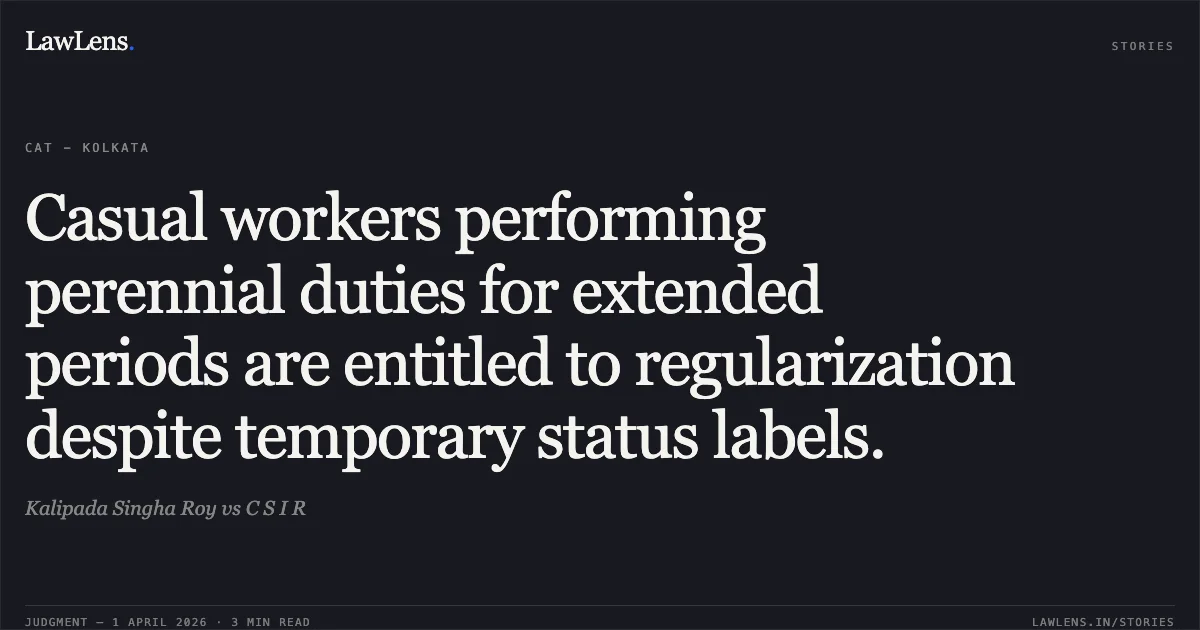
The Tribunal allowed the Original Application, setting aside the impugned order dated November 15, 2018.
It directed the respondents to regularize the applicant’s services effective from July 2, 2009 (the date he was identified as a casual worker), in view of his perennial duties and successful completion of training.
Source reference: para. 18The respondents were ordered to grant him all consequential benefits within three months.
Source reference: para. 18No order as to costs was made.
Source reference: para. 19Acts & Sections Cited
1 provisions across 1 statute referred to in this judgment. Each provision opens on LawLens.
Administrative Tribunals Act, 19851
Original Court PDF
Kalipada Singha RoyvsC S I R
Click to open original judgment
Original judgment, available to read, download and summarize on LawLens.in


![Subsequent exoneration does not retrospectively invalidate a finalized promotion select list.. UNNIKRISHNAN M vs M/o Environment And Forests. CAT - ['Ernakulam']. LawLens](/stories/thumbnails/subsequent-exoneration-does-not-retrospectively-invalidate-a-finalized-promotion-select-li-ce80a0e84f2f4887857271e8b4341c42.webp)