01Facts
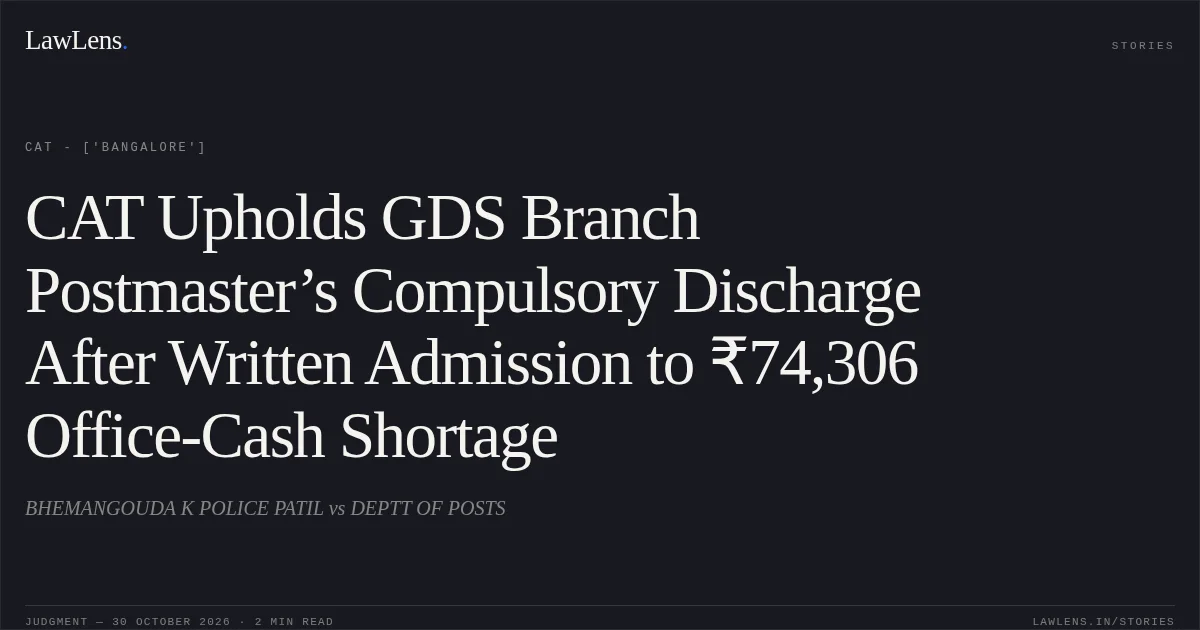
The applicant, a Gramin Dak Sevak Branch Postmaster, was charged with keeping office cash short, retaining departmental records and assets, and unsatisfactory work.
pp. 3–4, 7–11Following an inquiry in which he admitted the charges in writing, the disciplinary authority ordered his compulsory discharge, with proportionate service-related monetary benefits and gratuity.
pp. 3–4, 7–11His appeal was rejected.
pp. 3–4, 7–11The applicant challenged the disciplinary and appellate orders, alleging procedural unfairness and that his admission had been obtained under pressure.
pp. 3–4, 7–11His earlier writ petition had been dismissed for failure to exhaust the alternative appellate remedy.
pp. 3–4, 7–1102Issues
i.1. Whether the disciplinary proceedings and compulsory-discharge order were vitiated by procedural unfairness, including because the applicant’s written admission was allegedly obtained under threat or pressure.
pp. 7–12ii.2. Whether the penalty of compulsory discharge was disproportionate to the charges found proved.
pp. 12–13, 1803Law Applied
Under Rule 21 of the Department of Posts, Gramin Dak Sevaks (Conduct & Engagement) Rules, 2020, a GDS must maintain integrity and devotion to duty and must not act in a manner unbecoming of a GDS; the charges also invoked Rule 11 of the Rules for Branch Offices and Rules 177(1)–(3) read with Rule 11.
pp. 7–9In judicial review of disciplinary proceedings, B.C. Chaturvedi v. Union of India, (1995) 6 SCC 749, establishes that a court or tribunal does not reappreciate evidence as an appellate authority, but may intervene where the proceedings violate natural justice or statutory rules, the finding is based on no evidence, or the conclusion is one no reasonable person could reach.
pp. 13–15Regional Manager, U.P. SRTC v. Hoti Lal, (2003) 3 SCC 605, and State Bank of India v. Ramesh Dinkar Punde, (2006) 7 SCC 212, affirm that employees handling public money or serving in positions of trust are held to a high standard of integrity and that serious financial misconduct may warrant severe punishment.
pp. 16–18Provisions in the judgment · 1 · Linked ones open on LawLens
Administrative Tribunals Act, 1985 Section 19
04Reasoning
The Tribunal found that the applicant had denied the charges in his initial representation but later admitted all three charges unconditionally in writing during the inquiry and requested that it be concluded.
pp. 9–15, 17–18He neither promptly complained that the admission was coerced nor raised that allegation in his subsequent representation on the inquiry report.
pp. 9–15, 17–18The Tribunal therefore rejected the coercion claim and found no procedural lapse.
pp. 9–15, 17–18It also relied on the shortage of cash and the absence of supporting records for the applicant’s explanation concerning eMO vouchers.
pp. 9–15, 17–18Applying the limited scope of judicial review in B.C. Chaturvedi, the Tribunal declined to reassess the inquiry evidence and held that compulsory discharge was not disproportionate given the nature of the charges and the applicant’s responsibility for public money.
pp. 9–15, 17–1805Holding
The Tribunal held that the inquiry and disciplinary order disclosed no reviewable procedural or evidentiary defect, and that the penalty was not disproportionate.
pp. 17–18It found no error in the appellate authority’s rejection of the appeal, dismissed the OA, and made no order as to costs.
pp. 17–18Original Court PDF
BHEMANGOUDA K POLICE PATILvsDEPTT OF POSTS
Click to open original judgment
Original judgment, available to read, download and summarize on LawLens.in