Facts
On 14 September 2013, the appellant was riding his motorcycle on NH-47 near the RTO Office, Avinashi, when he attempted to overtake a lorry and collided with an oncoming auto-rickshaw. He fell onto the road and was run over by the lorry, sustaining grievous injuries, including amputation of his left leg and fracture of the right leg.
Source reference: paras. 2, 11, 14–16He claimed compensation from the owner and insurer of the auto and the owner and insurer of the lorry. The Motor Accident Claims Tribunal awarded total compensation of Rs.50,75,456 but attributed 50% contributory negligence to the appellant and 50% to the auto driver, awarding him only Rs.25,37,728 against the auto insurer.
Source reference: p.4; para. 6The Tribunal also found the lorry insurer not liable, inter alia, because the lorry’s insurance policy had been validly cancelled.
Source reference: p.4; para. 6The appellant filed the present appeal under Section 173 of the Motor Vehicles Act, 1988, challenging the apportionment of negligence.
Source reference: p.2Issues
1. Whether the Tribunal was justified in attributing 50% contributory negligence to the appellant for riding in the centre of the road and attempting to overtake the lorry?
Source reference: paras. 6–10, 13–172. Whether the negligence attributable to the auto driver ought to have been fixed at a higher proportion, thereby enhancing the compensation payable by the auto insurer?
Source reference: paras. 17–193. Whether the Tribunal’s determination of compensation under the various heads required interference?
Source reference: para. 19Law Applied
The Court applied Section 173 of the Motor Vehicles Act, 1988, governing appeals against awards of the Motor Accident Claims Tribunal.
Source reference: p.2It reiterated that the claimant bears the initial burden of establishing negligence through oral and documentary evidence on the basis of preponderance of probabilities.
Source reference: para. 13The Court applied the doctrine of contributory negligence, under which compensation may be reduced proportionately where the claimant’s own negligent conduct materially contributes to the accident.
Source reference: paras. 16–18The apportionment must depend on the conduct of each participant and the surrounding facts, including the position and movement of the vehicles.
Source reference: paras. 16–18The Court also accepted the Tribunal’s finding that the lorry insurer was not liable because the relevant insurance policy had been validly cancelled.
Source reference: para. 6Reasoning
The appellant’s own evidence indicated that he had moved towards the centre of the road, and the FIR stated that he attempted to overtake the lorry despite the auto approaching from the opposite direction.
Source reference: paras. 14–15His failure to examine his brother, who lodged the complaint, or any independent eyewitness weakened his challenge to the Tribunal’s factual findings.
Source reference: para. 15Accordingly, some negligence was properly attributable to him.
Source reference: para. 15However, the accident occurred on a broad National Highway, and the auto, travelling in the opposite direction, collided with the smaller two-wheeler in the middle of the road instead of keeping to its left.
Source reference: paras. 17–18The Court therefore found a greater degree of negligence on the part of the auto driver.
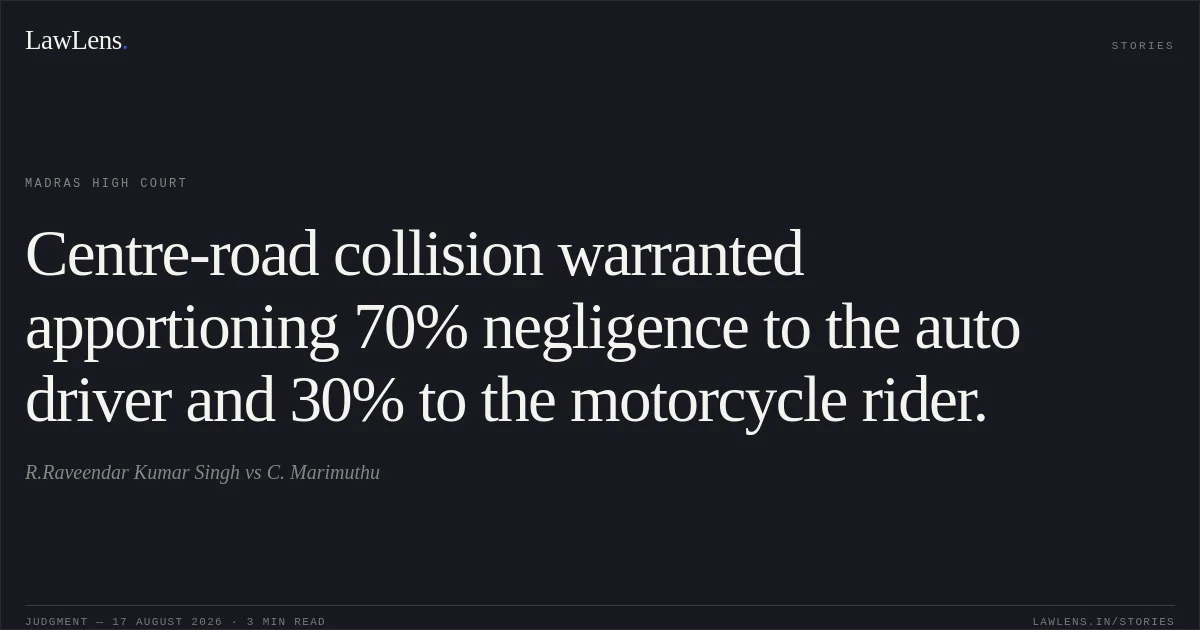
Source reference: paras. 17–18It held that the Tribunal’s equal apportionment was not appropriate and re-apportioned negligence as 70% on the auto driver and 30% on the appellant.
Source reference: para. 19Since the compensation assessed under the individual heads was not disputed, the Court retained the total award of Rs.50,75,456 and awarded 70% thereof.
Source reference: para. 19Holding
The appeal was partly allowed.
The Court reduced the appellant’s contributory negligence from 50% to 30% and fixed 70% negligence on the auto driver.
Source reference: para. 19; p.11Consequently, the compensation payable by the second respondent, insurer of the auto, was enhanced to Rs.35,52,800, calculated as 70% of Rs.50,75,456, with interest at 7.5% per annum from the date of the claim petition until disbursement.
Source reference: para. 19; p.11The insurer was directed to deposit the balance amount, after giving credit for any amount already deposited, within four weeks.
Source reference: para. 19The appellant was permitted to withdraw the amount in accordance with the Tribunal’s directions.
Source reference: para. 19The finding exonerating the lorry insurer and the compensation awarded under the other heads were not disturbed.
Source reference: paras. 6, 19–20Acts & Sections Cited
1 provisions across 1 statute referred to in this judgment. Each provision opens on LawLens.
Motor Vehicles Act, 19881
Original Court PDF
R.Raveendar Kumar SinghvsC. Marimuthu
Click to open original judgment
Original judgment, available to read, download and summarize on LawLens.in