Facts
M/s Vikromatic Steels Pvt. Ltd. availed CENVAT credit of ₹87,52,175 on inputs covered by invoices from five registered dealers.
Source reference: p. 2–14The Department alleged that the invoices were unsupported by actual receipt of goods and traced them to non-existent or allegedly uninvolved manufacturers.
Source reference: p. 2–14The demand, interest and penalties—including a personal penalty on the company’s director—were confirmed by the adjudicating authority and upheld in appeal.
Source reference: p. 2–14The Tribunal considered the Department’s reliance on third-party statements, electronic data retrieved from a third party’s hard disk, transport-related material, and the company’s records of its purchases and manufacturing activity.
Source reference: p. 44–48Issues
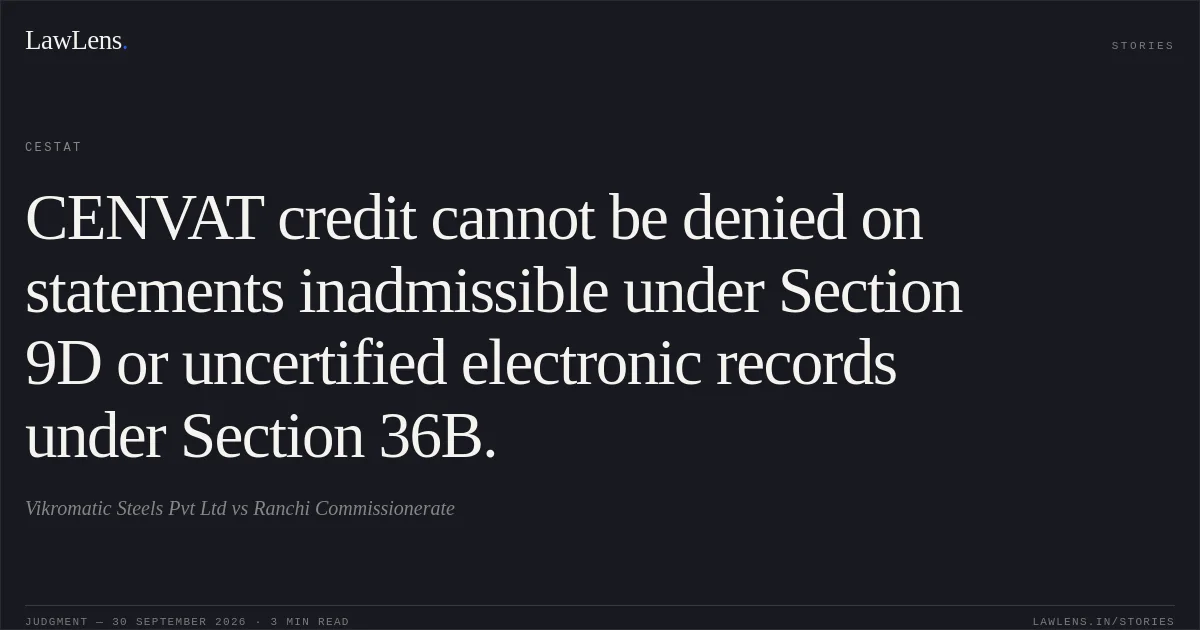
Whether the Department could rely on investigation statements without following the procedure prescribed by Section 9D of the Central Excise Act, 1944.
Source reference: para. 20–20.5; p. 49–56Whether electronic records retrieved from a third-party hard disk were admissible without compliance with Section 36B of the Act.
Source reference: para. 21–21.8; p. 56–60Whether the evidence, considered as a whole, established that the company had not received the goods covered by the invoices and had wrongly availed CENVAT credit.
Source reference: para. 18–19, 22–24; p. 45–48, 60–68Whether the personal penalty imposed on the director under Rule 26 of the Central Excise Rules, 2002 was sustainable.
Source reference: para. 25–25.2; p. 68–69Law Applied
Section 9D of the Central Excise Act governs when an investigation statement may be used to prove the truth of its contents in adjudication: unless a statutory exception under Section 9D(1)(a) applies, the maker must be examined as a witness and the adjudicating authority must determine whether the statement should be admitted under Section 9D(1)(b).
Source reference: para. 20.1–20.3; p. 49–53Section 36B prescribes conditions for admitting computer-generated records, including the certificate contemplated by Section 36B(4).
Source reference: para. 21.1–21.3; p. 56–57Under Rule 9(5) of the CENVAT Credit Rules, 2004, the claimant bears the burden of establishing credit eligibility; Rules 14 and 15(2), read with Sections 11A and 11AC of the Act, provide for recovery and penalty where credit is wrongly taken or utilised.
Source reference: para. 12, 13(V); p. 12–13, 25–26Rule 26 requires evidence supporting personal liability; a director’s position alone does not establish the requisite knowing involvement or dealing with goods liable to confiscation.
Source reference: para. 25–25.2; p. 68–69Reasoning
The Tribunal found that the adjudicating authority had relied on the dealers’ statements without examining the makers or recording that a Section 9D(1)(a) exception applied; those statements therefore could not prove their contents against the company.
Source reference: para. 20.2–20.5; p. 50–56It also held the hard-disk data inadmissible because the statutory requirements of Section 36B, including certification, had not been met.
Source reference: para. 21.3–21.8; p. 57–60The remaining material did not adequately establish non-receipt: the alleged cash flowback was not independently corroborated, transport discrepancies were limited or not invoice-specific, and the Department had shown neither an alternative source of inputs nor stock or production discrepancies inconsistent with the company’s manufacturing and clearances.
Source reference: para. 18.1–19.2, 22.1–23.10; p. 46–48, 60–67The ₹8,00,000 deposit during investigation was not, by itself, an admission of liability.
Source reference: para. 26; p. 69With the primary demand unsupported, and no admissible evidence establishing the director’s personal, knowing involvement, the Rule 26 penalty also could not stand.
Source reference: para. 25.1–25.2; p. 68–69Holding
The Tribunal held that the demand for ₹87,52,175 was unsustainable and set it aside, together with the consequential interest and the equivalent penalty imposed on the company.
It also set aside the personal penalty imposed on the director under Rule 26.
Source reference: para. 27(iv); p. 70The appeals were allowed with consequential relief, if any.
Source reference: para. 28–29; p. 70Acts & Sections Cited
6 provisions across 3 statutes referred to in this judgment. Each provision opens on LawLens.
Central Excise Act, 19444
Customs Act,19621
Bharatiya Sakshya Adhiniyam, 20231
Original Court PDF
Vikromatic Steels Pvt LtdvsRanchi Commissionerate
Click to open original judgment
Original judgment, available to read, download and summarize on LawLens.in