Facts
The appellant claimed CENVAT credit of ₹8,59,346 on 18 invoices for the period April 2013 to March 2014.
Source reference: pp. 1–2, paras. 1–5, 7, 9During audit, the appellant could not produce all the invoices. It asserted that Anti-Evasion officials had taken the documents and relied on entries in its Input Duty Credit Register, which it said had been attested by the Superintendent, as well as vendor ledger entries and evidence of payment.
Source reference: pp. 1–2, paras. 1–5, 7, 9The Department issued an audit memo on 31 July 2015 identifying the credit in question; a show-cause notice followed on 6 September 2017.
Source reference: pp. 1–2, paras. 1–5, 7, 9The lower authorities confirmed the demand, with interest and penalty, and the appellant appealed.
Source reference: pp. 1–2, paras. 1–5, 7, 9Issues
Whether the CENVAT credit could be denied because the appellant had not produced all 18 invoices, despite its accounting records indicating receipt and accounting of the goods.
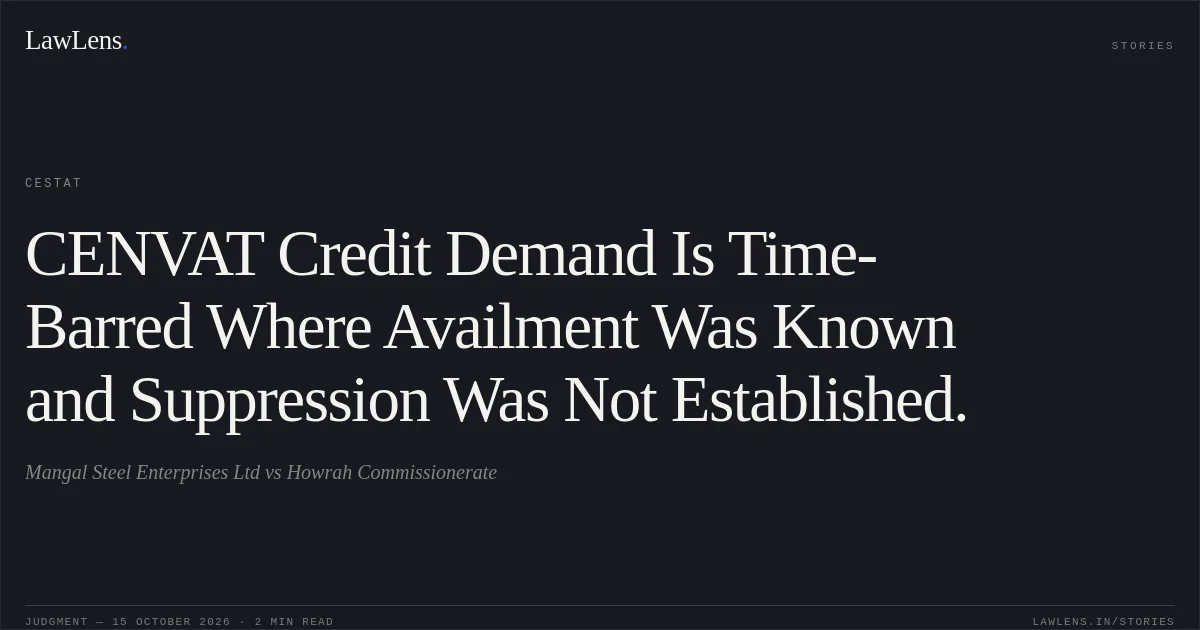
Source reference: pp. 1–3, paras. 2, 5, 7–8Whether the show-cause notice issued on 6 September 2017 was time-barred in light of the Department’s knowledge of the issue from the audit memo dated 31 July 2015.
Source reference: p. 2, para. 3; pp. 3, 6, paras. 9–11Law Applied
The Tribunal relied on Commissioner of Central Excise, Kolkata v. ITC Ltd., 2013 (291) E.L.T. 377 (Tri.-Kolkata), for the principle that where credit is disclosed in the applicable returns and suppression or misstatement with intent to evade duty is neither admitted nor established, the extended period of limitation cannot be invoked merely because the Department later considers the credit inadmissible.
Source reference: pp. 4–6, para. 10It also discussed Section 11A(1) of the Central Excise Act, 1944, distinguishing the computation of the limitation period where suppression is established from cases where it is not.
Source reference: p. 6, para. 10Reasoning
The Tribunal noted that the appellant’s register recorded the receipt of the goods and was stated to have been attested by the Superintendent; it also noted that some invoices had been produced. The show-cause notice did not allege that the goods had not been received.
Source reference: p. 3, paras. 7–11On limitation, the Tribunal found that the Department was aware of the credit issue by 31 July 2015, as reflected in the Superintendent’s letter, while the show-cause notice was issued more than two years later. Applying ITC Ltd., the Tribunal concluded that the extended period was unavailable in the absence of established suppression.
Source reference: p. 6, paras. 9–11The Tribunal did not separately determine the ultimate substantive admissibility of the credit; it allowed the appeal on limitation.
Source reference: p. 6, para. 11Holding
The Tribunal held that the demand was time-barred, set aside the impugned order, and allowed the appeal on that ground.
It further held that the appellant was entitled to consequential relief, if any, in accordance with law.
Source reference: p. 6, para. 12Acts & Sections Cited
1 provisions across 1 statute referred to in this judgment. Each provision opens on LawLens.
Central Excise Act, 19441
Original Court PDF
Mangal Steel Enterprises LtdvsHowrah Commissionerate
Click to open original judgment
Original judgment, available to read, download and summarize on LawLens.in