Facts
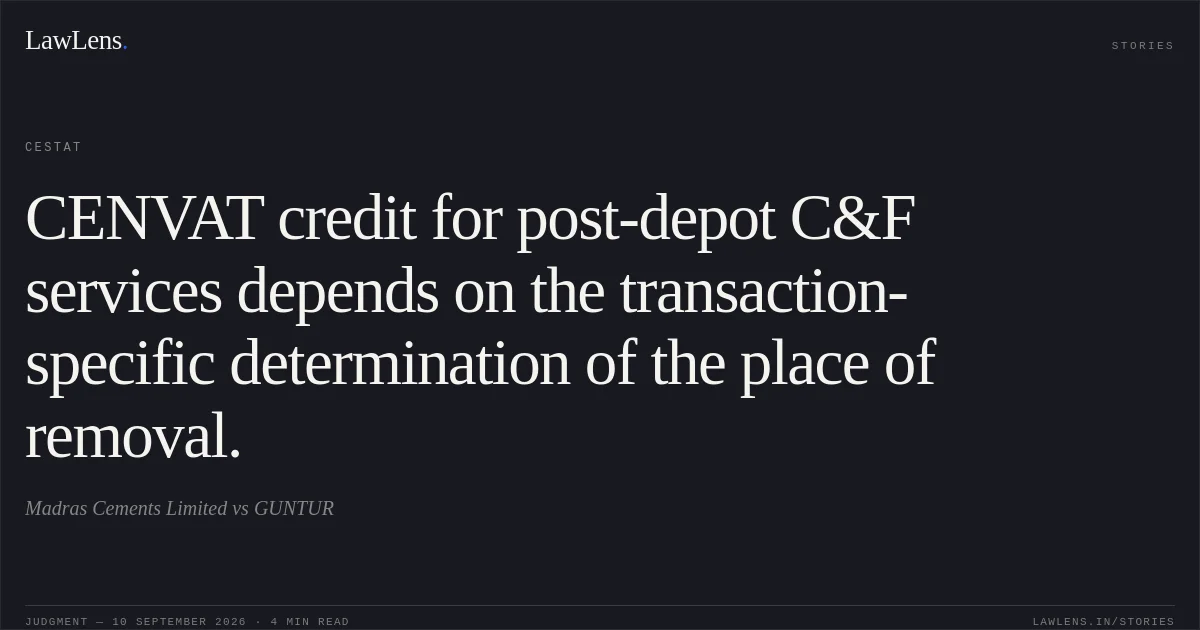
Madras Cements Ltd., a cement manufacturer, cleared cement from its factory and also stock-transferred it to depots and warehouses in different States. Clearing and forwarding agents at these locations performed receipt, unloading, storage, handling, loading, and, in some cases, delivery-related unloading at customers’ premises.
Source reference: para. 2–3The appellant claimed CENVAT credit of service tax paid on these C&F services for March 2008 to March 2011. The adjudicating authority disallowed credit of ₹52,44,388 with interest and imposed an equivalent penalty under Rule 15(2) of the CENVAT Credit Rules, 2004, holding that the services were rendered beyond the “place of removal”.
Source reference: para. 1The appellant contended that the sales were on an FOR-destination basis and that the customer’s premises constituted the place of removal. It also argued that the credit had been disclosed in statutory records and ER-1 returns, and that departmental audits had been conducted.
Source reference: para. 4–6The Department relied on the post-1 April 2008 restriction in Rule 2(l) and contended that FOR-destination sales did not automatically establish the customer’s premises as the place of removal.
Source reference: para. 7Issues
1. Whether C&F services relating to receipt, unloading, storage, handling, and loading of cement at the appellant’s depots or warehouses constituted eligible “input services” under Rule 2(l) of the CENVAT Credit Rules, 2004.
Source reference: para. 9–102. Whether transportation, delivery, and unloading services rendered after clearance from the depot, including at the customer’s premises, were eligible for CENVAT credit when the sales were described as FOR-destination transactions.
Source reference: para. 11–143. Whether the extended period of limitation could be invoked in the absence of evidence of fraud, collusion, wilful misstatement, or suppression of facts with intent to evade duty.
Source reference: para. 15–164. Whether the equivalent penalty under Rule 15(2) of the CENVAT Credit Rules, 2004 read with Section 11AC of the Central Excise Act, 1944, was sustainable.
Source reference: para. 17Law Applied
The Tribunal applied Rule 2(l) of the CENVAT Credit Rules, 2004, under which services used in or in relation to the manufacture and clearance of final products up to the “place of removal” qualify as input services.
Source reference: para. 3, 9Section 4(3)(c) of the Central Excise Act, 1944 includes a depot, the premises of a consignment agent, or any other premises from which excisable goods are sold after clearance from the factory within the expression “place of removal”.
Source reference: para. 10For post-depot transportation and delivery, the Tribunal relied on Commissioner v. Roofit Industries Ltd., 2015 (319) E.L.T. 221 (S.C.); Commissioner v. Emco Industries Ltd., 2015 (322) E.L.T. 394 (S.C.); Bharat Fritz Werner Ltd. v. CCE, Bangalore, 2022 (66) G.S.T.L. 434 (Kar.); the Larger Bench decision in Ramco Cements Ltd. v. CCE, Puducherry, 2023 (12) TMI 1332 (CESTAT Chennai); and CBEC Circular No. 1065/4/2018-CX dated 8 June 2018.
Source reference: para. 12These authorities require examination of the contractual terms, transfer of title and risk, freight and insurance obligations, inclusion of freight in assessable value, and whether delivery at the buyer’s premises was an essential condition of sale.
Source reference: para. 12On limitation and penalty, the Tribunal applied Cosmic Dye Chemical v. CCE, 1995 (75) E.L.T. 721 (S.C.); Pushpam Pharmaceuticals Co. v. CCE, 1995 (78) E.L.T. 401 (S.C.); and Uniworth Textiles Ltd. v. CCE, 2013 (288) E.L.T. 161 (S.C.), holding that mere omission or an incorrect legal interpretation does not establish deliberate suppression with intent to evade duty.
Source reference: para. 15–17Reasoning
The Tribunal distinguished services performed within the appellant’s depots from services rendered after clearance from those depots. Since Section 4(3)(c) expressly treats a depot or similar premises from which goods are sold as a place of removal, services involving receipt, unloading, storage, handling, and loading at such depots had a direct nexus with the appellant’s business and were eligible input services.
Source reference: para. 10However, the eligibility of transportation, delivery, and unloading at customers’ premises depended on whether the customer’s premises was the actual place of removal. The description of sales as FOR-destination was not conclusive; the adjudicating authority was required to examine the contracts, invoices, freight arrangements, insurance, passage of title and risk, and whether delivery at the customer’s premises was an essential condition of sale.
Source reference: para. 11–14Because the original order assumed that the factory or depot was necessarily the place of removal without undertaking this factual examination, a limited remand was necessary.
Source reference: para. 14On limitation, the appellant had recorded the credit in statutory records and returns, and the record disclosed departmental audits. In the absence of positive evidence of deliberate suppression or intent to evade duty, the extended period was unavailable.
Source reference: para. 15–16The same absence of culpable conduct defeated the equivalent penalty under Rule 15(2) read with Section 11AC.
Source reference: para. 17Holding
The appeal was partly allowed and partly remanded.
CENVAT credit for C&F services involving receipt, unloading, storage, handling, and loading at the appellant’s depots or warehouses was held admissible.
Source reference: para. 18(i)Credit for transportation, delivery, and unloading at customers’ premises was to be re-examined by applying the relevant contractual and transactional factors governing the place of removal.
Source reference: para. 18(ii)The demand relating to the extended period of limitation was set aside, and the equivalent penalty was quashed in full.
Source reference: para. 18(iii)–(iv)The matter was remanded solely for re-quantification of any credit falling within the normal limitation period and factual verification, with directions that the appellant be allowed to produce relevant contracts, purchase orders, invoices, freight documents, and insurance records, and that a speaking order be passed without reopening the findings on extended limitation and penalty.
Source reference: para. 18(v), 19–20Acts & Sections Cited
2 provisions across 1 statute referred to in this judgment. Each provision opens on LawLens.
Central Excise Act, 19442
Original Court PDF
Madras Cements LimitedvsGUNTUR
Click to open original judgment
Original judgment, available to read, download and summarize on LawLens.in